
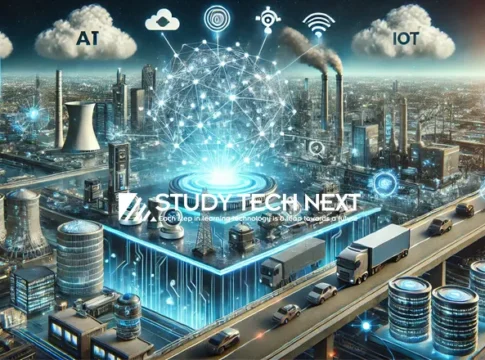

Machine learning (ML) with edge computing is a powerful approach that enables AI-driven decision-making directly on edge devices, such as IoT sensors, smartphones, and industrial machines. This eliminates the need for cloud-based data processing, improving speed, efficiency, and security.
Key Benefits of ML with Edge Computing
- Low Latency – Real-time processing eliminates network delays.
- Reduced Bandwidth Usage – Less data transmission lowers costs.
- Enhanced Privacy & Security – Data remains on the device, reducing cyber threats.
- Offline Capabilities – ML models function without constant internet connectivity.
- Energy Efficiency – Optimized inference reduces power consumption.
Applications of ML with Edge Computing
Healthcare & Wearable Devices
- Application: Real-time patient monitoring, AI-powered diagnostics, smart wearables.
- Example: ECG signal processing on smartwatches to detect abnormal heart rhythms.
- Edge Processing Benefit: Quick decision-making for emergency alerts without cloud dependency.
Autonomous Vehicles & Smart Transportation
- Application: Self-driving cars, traffic management, object recognition.
- Example: Tesla’s Autopilot uses ML models on in-car AI chips to process video feeds in real-time.
- Edge Processing Benefit: Reduces network latency for accident prevention.
Industrial IoT (IIoT) & Predictive Maintenance
- Application: Monitoring equipment in factories, predictive failure detection.
- Example: Sensors on machinery predict breakdowns using ML models running on edge devices.
- Edge Processing Benefit: Reduces downtime and improves operational efficiency.
Smart Surveillance & Security Systems
- Application: AI-based facial recognition, threat detection, motion sensing.
- Example: AI-powered CCTV cameras analyze video footage locally to detect suspicious activity.
- Edge Processing Benefit: Faster detection, reduced bandwidth for video transmission.
Retail & Personalized Customer Experience
- Application: Smart checkout, personalized recommendations.
- Example: Amazon Go stores use edge AI for cashier-less checkout.
- Edge Processing Benefit: Real-time item recognition and billing without cloud latency.
Detailed Process of Machine Learning with Edge Computing
Data Collection & Preprocessing
- Sources: Sensors, cameras, mobile devices, IoT devices.
- Preprocessing: Data normalization, feature extraction, noise reduction (on-device or cloud).
- Example: A smart thermostat collects temperature readings and filters noise before running ML inference.
Model Training (Usually in the Cloud)
- Why Cloud? Training ML models requires high computational power.
- Steps:
- Data Labeling: Annotate data for supervised learning.
- Model Selection: Choose CNNs for vision tasks, RNNs for sequential tasks, etc.
- Training & Optimization: Use TensorFlow, PyTorch, or Scikit-learn to train models.
- Model Compression: Use quantization, pruning, or knowledge distillation to reduce model size for edge deployment.
- Example: A traffic monitoring system trains an object detection model using dashcam footage on the cloud.
Model Deployment on Edge Devices
- Frameworks Used:
- TensorFlow Lite (TFLite)
- ONNX Runtime
- Google Edge TPU
- NVIDIA Jetson Nano
- Deployment Steps:
- Convert the trained model to a lightweight format.
- Deploy the model to edge devices.
- Optimize for hardware acceleration (e.g., TPU, GPU, or DSP).
- Example: A security camera deploys a YOLOv5 model for real-time object detection.
Inference at the Edge
- Process:
- Input data (image, sensor reading, audio) is fed into the deployed ML model.
- The model makes real-time predictions.
- Results trigger an action or alert.
- Example: A drone uses an edge ML model to detect obstacles and adjust flight paths instantly.
Model Update & Federated Learning (Optional)
- Why? ML models improve over time with new data.
- Methods:
- On-Device Training: Devices retrain small updates locally.
- Federated Learning: Devices share model updates (not raw data) to a central server for collective improvement.
- Example: Google’s Gboard keyboard improves text predictions using federated learning across users.
Edge ML vs. Cloud ML: A Quick Comparison
| Feature | Edge ML | Cloud ML |
|---|---|---|
| Latency | Low (real-time) | High (depends on network) |
| Power Consumption | Lower | Higher |
| Privacy | High (data stays on device) | Lower (data transmitted) |
| Computational Power | Limited | High (scalable) |
| Connectivity | Can work offline | Requires internet |
Challenges & Future Trends
Challenges
- Limited processing power on edge devices.
- Energy efficiency constraints.
- Security risks in distributed models.
Future Trends
- TinyML: Running ultra-lightweight ML models on microcontrollers.
- 5G & AI: Faster connectivity for distributed ML inference.
- AI-Optimized Edge Hardware: More powerful AI chips for edge computing.
Conclusion
Machine learning with edge computing is revolutionizing industries by enabling faster, more efficient, and secure AI applications. From healthcare to self-driving cars, Edge ML is shaping the future of AI-driven automation. With advancements in hardware, software, and connectivity (like 5G), Edge AI will continue to expand its reach across various domains.