
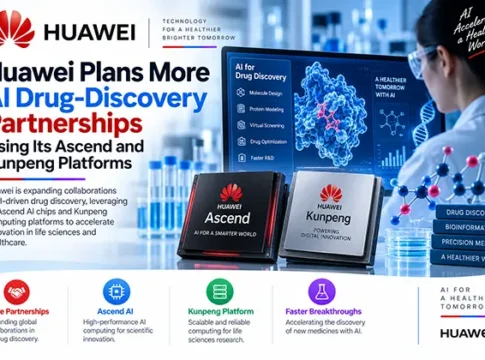

Huawei is making significant strides in the realm of artificial intelligence (AI) drug discovery, leveraging its powerful Ascend and Kunpeng platforms. On August 27, Huawei’s healthcare president announced plans to expand partnerships with pharmaceutical companies, aiming to revolutionize the drug discovery process. This initiative promises to enhance compound screening and model adaptation, potentially accelerating drug development while reducing costs. In this article, we delve into Huawei’s strategic plans, collaborations, and the broader implications for the pharmaceutical industry.
Huawei’s Strategic Expansion in AI Drug Discovery
Huawei’s commitment to AI-driven drug discovery is underscored by its recent announcement to forge more partnerships with pharmaceutical companies. By utilizing its Ascend and Kunpeng computing platforms, Huawei aims to streamline the drug discovery process, making it faster and more cost-effective. These platforms are designed to handle complex computations required for screening compounds and adapting models, which are crucial steps in the early stages of drug development.
Collaborations with Pharmaceutical Giants
Huawei’s collaboration with Guangzhou Pharmaceutical is a testament to its dedication to advancing AI in healthcare. This partnership focuses on integrating AI technologies into clinical practice, potentially benefiting both researchers and patients. By enhancing the efficiency of drug discovery, Huawei’s initiatives could lead to quicker development of new medicines, offering hope for faster treatment options.
The Role of Ascend and Kunpeng Platforms
The Ascend and Kunpeng platforms are at the heart of Huawei’s AI drug discovery efforts. These platforms provide the computational power necessary for processing large datasets and running complex algorithms. By adapting models to these platforms, Huawei aims to improve the accuracy and speed of compound screening, a critical step in identifying potential drug candidates.
Potential Benefits and Challenges
The integration of AI in drug discovery offers numerous benefits, including reduced costs and accelerated timelines. However, it also presents challenges such as model validation, data integrity, and regulatory compliance. Additionally, geopolitical risks could impact Huawei’s ability to collaborate internationally, particularly in regions with stringent data protection laws.
Comparisons with Nvidia-Backed Partnerships Huawei’s approach to AI drug discovery can be compared to Nvidia-backed pharmaceutical partnerships. Both companies leverage advanced computing technologies to enhance drug development. However, Huawei’s focus on its proprietary platforms, Ascend and Kunpeng, sets it apart, offering unique capabilities tailored to specific computational needs in drug discovery. Expert Perspectives on AI in Drug Discovery Experts in the field of AI and pharmaceuticals recognize the potential of AI to transform drug discovery. By automating complex processes and providing insights from vast datasets, AI can significantly reduce the time and cost associated with bringing new drugs to market. However, experts also caution that the success of these initiatives depends on overcoming technical and regulatory hurdles. FAQs on Huawei’s AI Drug Discovery Initiatives“The distinction between early research tools and validated medicines is crucial. While AI can expedite research, the transition to approved treatments requires rigorous testing and regulatory approval.” – Industry Expert
- What are the main goals of Huawei’s AI drug discovery partnerships? Huawei aims to enhance the efficiency and cost-effectiveness of drug discovery through AI technologies.
- How do Ascend and Kunpeng platforms contribute to this initiative? These platforms provide the computational power needed for complex data processing and model adaptation in drug discovery.
- What challenges does Huawei face in this endeavor? Key challenges include model validation, data integrity, regulatory compliance, and geopolitical risks.