
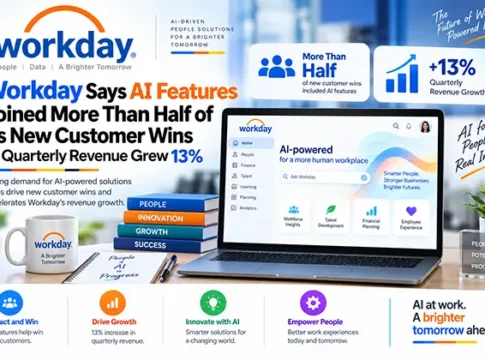

Workday, a leader in enterprise cloud applications for finance and human resources, recently announced a significant milestone in its quarterly earnings report. The company revealed that artificial intelligence (AI) features were a key factor in more than half of its new customer wins, contributing to a 13% growth in quarterly revenue. This development underscores the growing importance of AI in enterprise solutions and its impact on productivity and decision-making processes.
Workday’s Financial Performance in August 2023
In its August 27 earnings report, Workday reported a 13% increase in total revenue, reaching $1.79 billion. Subscription revenue, a critical component of its business model, also saw a significant rise, contributing $1.59 billion to the total. This growth is attributed to the company’s strategic focus on integrating AI capabilities into its offerings, which has resonated well with new and existing customers.
AI Features Driving Customer Wins
Workday’s management highlighted that AI features were instrumental in securing more than half of its new customer wins. These AI-driven tools, including AI-assisted payroll, finance, and forecasting solutions, have enhanced the company’s value proposition by offering improved accuracy and efficiency in financial operations. This trend reflects a broader shift in the enterprise software market, where AI is becoming a critical differentiator.
Impact on Employers, Workers, and Investors
The integration of AI in Workday’s solutions offers several benefits for employers and workers. For employers, AI tools streamline operations, reduce errors, and provide actionable insights, leading to better decision-making and cost savings. Workers benefit from reduced manual workloads and enhanced productivity. Investors, on the other hand, see AI as a growth driver, potentially leading to higher returns as the company expands its market share.
Risks and Challenges
Despite the benefits, the adoption of AI in enterprise solutions is not without risks. Model errors, labor displacement, privacy concerns, and governance issues are potential challenges that Workday and its customers must navigate. Ensuring robust data governance and ethical AI practices will be crucial in mitigating these risks and maintaining trust among stakeholders.
Analyst Perspectives and Forecast Limitations Analysts have generally responded positively to Workday’s AI-driven strategy, noting its potential to enhance competitive positioning. However, they caution that the full impact of AI on revenue growth may take time to materialize, given the complexities involved in AI implementation and integration. Additionally, external factors such as economic conditions and regulatory changes could influence future performance. Comparisons with Competing Platforms Workday’s focus on AI sets it apart from competitors like SAP and Oracle, which are also investing heavily in AI technologies. While these companies offer similar AI capabilities, Workday’s seamless integration and user-friendly interface provide a competitive edge. However, the rapidly evolving landscape means that continuous innovation will be necessary to maintain this advantage. Practical Buyer Guidance“AI is not just a feature; it’s a fundamental shift in how we approach enterprise solutions,” said a Workday executive, emphasizing the transformative potential of AI in business operations.
- Evaluate the specific AI features offered by Workday and how they align with your business needs.
- Consider the potential productivity gains and cost savings from AI integration.
- Assess the risks associated with AI adoption, including data privacy and governance.
- Compare Workday’s offerings with those of competitors to ensure the best fit for your organization.
- What are the key AI features in Workday’s solutions? Workday offers AI-assisted payroll, finance, and forecasting tools designed to enhance accuracy and efficiency.
- How does AI contribute to Workday’s revenue growth? AI features have been a significant factor in new customer acquisitions, driving subscription revenue growth.
- What are the risks of adopting AI in enterprise solutions? Potential risks include model errors, labor displacement, privacy concerns, and governance challenges.