
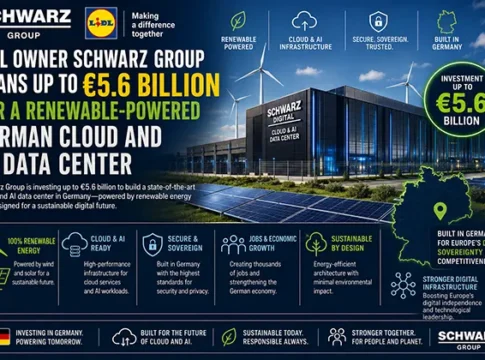

The Schwarz Group, the owner of the popular retail chain Lidl, has announced an ambitious plan to invest up to €5.6 billion in a renewable-powered cloud and AI data center in Germany. This strategic move, revealed on August 27, aims to bolster digital sovereignty and sustainability by leveraging renewable energy sources. The proposed data center, set to begin construction near Rostock in 2027, is expected to significantly impact the local economy and the broader tech landscape in Europe.
The Vision for a Renewable-Powered Data Center
The Schwarz Group’s plan involves the development of a state-of-the-art data center with an initial capacity of 240MW, with potential expansion to one gigawatt by 2045. This facility will be powered entirely by renewable electricity, aligning with global trends towards sustainable energy solutions. The project underscores the Group’s commitment to environmental responsibility and innovation in the tech industry.
Investment and Economic Impact
The investment, projected to reach up to €5.6 billion by 2033, is expected to create approximately 120 jobs, providing a significant boost to the local economy. The data center will not only serve as a hub for cloud and AI services but also as a catalyst for economic development in the region. The use of closed-loop cooling systems and the potential reuse of residential heat further highlight the project’s sustainable approach.
Digital Sovereignty and Strategic Importance
By establishing a major data center in Germany, the Schwarz Group aims to enhance digital sovereignty within Europe. This move is particularly significant in the context of increasing concerns over data privacy and security. The facility will provide cloud services to a range of customers, ensuring that data remains within European jurisdiction and is subject to stringent EU regulations.
Challenges and Risks
Despite its promising outlook, the project faces several challenges. Energy supply, permitting processes, and environmental considerations are critical factors that could impact the execution of the plan. The Schwarz Group must navigate these complexities to ensure the project’s success and sustainability.
Comparisons with European Rivals
The Schwarz Group’s initiative can be compared to similar projects by other European tech giants. For instance, companies like Amazon and Google have also invested in renewable-powered data centers across Europe. However, the Schwarz Group’s focus on digital sovereignty and local economic impact sets it apart from its competitors.
Guidance for Stakeholders
- Local communities should engage with project planners to understand potential impacts and benefits.
- Cloud customers can anticipate enhanced data security and compliance with EU regulations.
- Environmental groups should monitor the project’s adherence to sustainability commitments.