
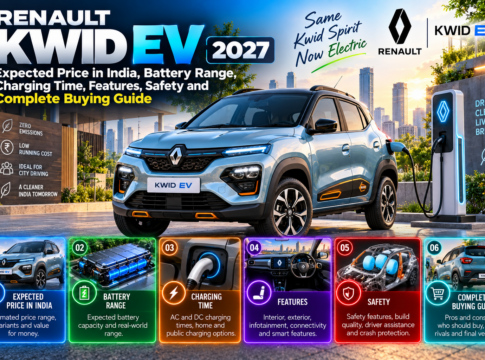
The Renault Kwid EV 2027 is set to revolutionize affordable electric mobility in India. With its expected launch in June 2027, this compact electric hatchback promises to deliver a blend of style, efficiency, and practicality. As electric vehicles gain traction, the Kwid EV aims to offer an accessible entry point for Indian buyers looking to embrace sustainable transportation.
Key Highlights
- Expected Indian launch in June 2027, marking a significant step for affordable electric mobility.
- Estimated price range of ₹8–11 lakh ex-showroom, influenced by market dynamics and government policies.
- Provisional 26.8 kWh battery with a claimed range of up to 305 km, pending Indian-market confirmation.
- Electric motor output of approximately 65 bhp and 125 Nm torque, ideal for city commuting.
- Support for AC home charging and potential DC fast-charging options.
- Compact SUV-inspired design with practical urban dimensions.
- Digital cockpit with modern infotainment, comfort, and safety features.
- Competes with Tata Tiago EV, MG Comet EV, and affordable petrol hatchbacks.
What You Will Learn
- Comparison of the Renault Kwid EV’s estimated price with other affordable electric cars in India.
- Understanding the synergy between electric motors, lithium-ion batteries, and battery management systems.
- Explanation of kWh, kW, and km/kWh metrics used in electric vehicles.
- Differences between home charging, public AC charging, and DC fast charging.
- Factors affecting real-world range, including speed, temperature, and traffic conditions.
- Insights into electric acceleration, regenerative braking, and single-speed transmissions.
- Calculating electricity expenses, cost per kilometre, and long-term ownership economics.
- Checklist for first-time EV buyers before booking or purchasing a small electric car.
How and Why It Works
The Renault Kwid EV’s mechanical systems and electrical architecture are designed to deliver efficient power delivery and practical engineering. Here’s how it works:
Electric Motor and Performance
An electric motor converts electrical energy into mechanical motion, providing instant torque and smooth acceleration. The Kwid EV is expected to feature a single-motor front-wheel-drive configuration, delivering approximately 65 bhp and 125 Nm of torque. This setup ensures strong low-speed response, making it ideal for urban driving.
Battery Technology and Driving Range
The Kwid EV is anticipated to house a 26.8 kWh lithium-ion battery. Battery capacity directly influences driving range, with a claimed distance of up to 305 km. However, real-world range can vary due to factors like city traffic, highway speeds, air-conditioning use, and more.
Charging Technology
Charging options include AC home charging and potential DC fast charging. While household sockets and dedicated home chargers offer convenience, public DC fast-charging stations provide quicker top-ups. Charging speed depends on the vehicle’s onboard charger and battery management system.
Starting and Mechanical Systems
Electric cars like the Kwid EV do not require a conventional starter motor. When the driver presses the start button, the traction battery powers the inverter, which drives the electric motor. Regenerative braking and conventional friction brakes work together to optimize energy use.
Gear System and Transmission
The Kwid EV is expected to use a single-speed reduction gearbox, eliminating the need for manual gear shifting. This simplifies the driving experience compared to the petrol Kwid’s manual and AMT transmissions.
Comfort and Handling
The compact dimensions of the Kwid EV promise excellent manoeuvrability in crowded urban environments. Its seating configuration, suspension tuning, and battery placement are designed to offer a comfortable ride while maintaining practicality for city driving.
Safety and Features
Expected safety features include airbags, ABS with EBD, electronic stability control, and more. However, these are subject to official confirmation for the Indian market. The Kwid EV’s digital cockpit is likely to feature modern infotainment and connectivity options.
Design and Body Styling
The Kwid EV’s design draws inspiration from SUV styling, with a bold exterior and practical proportions. While it shares similarities with the Renault Kwid E-Tech and Dacia Spring, the Indian model will have market-specific adaptations.
Practical Applications
Renault Kwid EV Expected Price in India
The estimated ex-showroom price of ₹8–11 lakh positions the Kwid EV as an affordable option. However, buyers should consider additional costs like registration, insurance, and charging equipment. Government incentives, if available, could further influence the final price.
Home Charging Cost in India
To calculate charging expenses, consider the battery capacity, electricity tariff, and charging efficiency. For example, with a 26 kWh battery and a tariff of ₹8 per kWh, the cost to fully charge the battery would be approximately ₹208, assuming 90% efficiency.
Cost Per Kilometre
Electricity cost per kilometre can be calculated using the formula: Electricity tariff ÷ Driving efficiency in km/kWh. For instance, at 7 km/kWh, the cost would be approximately ₹1.14 per km.
Monthly and Annual Running Costs
For a daily commute of 20 km, the monthly electricity cost would be around ₹684. For longer distances, such as 1,500 km per month, the cost would be approximately ₹2,565. These calculations help in understanding the economic benefits of EV ownership.
Renault Kwid EV vs Petrol Kwid
Comparing the Kwid EV with its petrol counterpart reveals differences in powertrain technology, running costs, and maintenance. While the EV offers lower running costs and quieter operation, the petrol version may have advantages in long-distance travel and refuelling convenience.
Renault Kwid EV vs Tata Tiago EV vs MG Comet EV
A comparison table highlights key differences among these models, including price, battery capacity, range, and features. While the Kwid EV’s specifications are provisional, it aims to compete effectively in the affordable EV segment.
Which Buyers May Find the Kwid EV Suitable?
The Kwid EV is ideal for first-time EV buyers, small families, and city commuters. Its compact size and efficient powertrain make it suitable for urban environments, while reliable home charging access enhances its practicality.
Charging Infrastructure and Practicality
Prospective buyers should assess charging infrastructure availability near their homes and workplaces. Reliable home charging is crucial for urban EV ownership, ensuring convenience and cost-effectiveness.
Booking and Purchase Checklist
Before purchasing, confirm launch details, official variants, warranty coverage, and service support. Evaluate charging equipment, installation requirements, and final quotations to make an informed decision.
Limitations and Misconceptions
While the Kwid EV offers promising features, potential buyers should be aware of uncertainties regarding price, launch date, and specifications. Real-world range can vary, and charging infrastructure may pose challenges in certain areas.
Learning Takeaways
- Verify the Renault Kwid EV’s official India launch date and pricing.
- Understand battery capacity and real-world driving range differences.
- Check motor output and vehicle performance expectations.
- Confirm charging connector compatibility and capabilities.
- Calculate home-charging electricity expenses and cost per kilometre.
- Compare the Kwid EV with the Tata Tiago EV and MG Comet EV.
- Review safety equipment and crash-test information.
- Assess charging infrastructure near home and regular destinations.
- Take an independent test drive after the production model becomes available.
In conclusion, the Renault Kwid EV 2027 presents an exciting opportunity for Indian buyers seeking an affordable electric vehicle. By understanding its features, costs, and practical applications, potential owners can make informed decisions that align with their needs and lifestyle.