
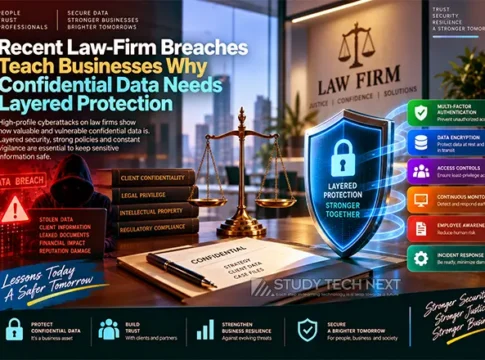

In an era where data breaches are becoming increasingly common, the recent incidents involving prominent law firms Quinn Emanuel and McDermott have underscored the critical need for businesses to adopt layered protection strategies for confidential data. As reported by Reuters on September 3, 2026, these breaches highlight vulnerabilities that can have far-reaching consequences, not only for the firms involved but also for their clients. This article delves into the lessons businesses can learn from these breaches and how they can implement robust data protection measures.
Key Highlights
- Understanding the importance of maintaining sensitive-data inventories to track and protect critical information.
- Implementing the principle of least privilege to minimize access to confidential data.
- Enhancing identity protection measures to safeguard against unauthorized access.
- Continuous monitoring of systems to detect and respond to potential threats promptly.
- Developing a comprehensive incident response plan to mitigate the impact of breaches.
- Ensuring transparent client communication to maintain trust and manage reputational risks.
- Recognizing the limitations of relying on a single security product for data protection.
- Evaluating third-party risks to prevent vulnerabilities from external partners.
- How to create and maintain an effective sensitive-data inventory.
- Steps to implement least privilege access controls within your organization.
- Best practices for identity protection and authentication.
- Strategies for effective system monitoring and threat detection.
- Components of a robust incident response plan.
- Approaches to client communication during and after a data breach.
- Understanding the role of layered security in protecting confidential data.
- Assessing and managing risks associated with third-party vendors.
- Conduct regular audits of sensitive-data inventories.
- Implement least privilege access controls.
- Use multi-factor authentication for identity protection.
- Set up continuous monitoring systems for real-time threat detection.
- Develop and regularly update an incident response plan.
- Communicate transparently with clients about data protection measures.
- Evaluate third-party vendors for potential security risks.
FAQs“The recent breaches serve as a wake-up call for businesses to reassess their data protection strategies. Layered security is not just an option but a necessity in today’s digital landscape.” — Cybersecurity Expert
- What is layered protection? Layered protection involves using multiple security measures to protect data, ensuring that if one layer fails, others remain to provide defense.
- Why is least privilege important? It minimizes the risk of unauthorized access by ensuring that users only have access to the data necessary for their roles.
- How can small businesses afford robust data protection? By prioritizing key areas and using scalable solutions, small businesses can implement effective security measures within their budget.