
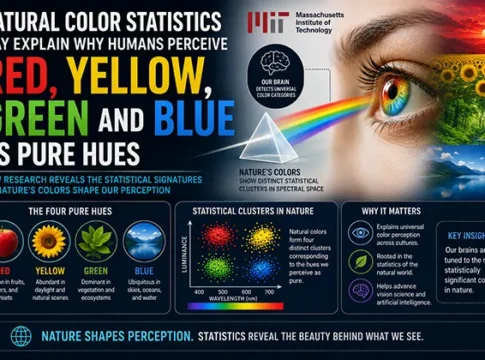

The perception of color is a fascinating aspect of human vision, deeply rooted in both biology and culture. Recent research from the University of California, Berkeley, suggests that natural color statistics may explain why humans perceive red, yellow, green, and blue as pure hues. This groundbreaking analysis connects color patterns in nature with the brain’s simplified representation of these four pure hues, alongside black and white, offering new insights into visual perception, language, and color naming.
Understanding the Connection Between Natural Color Statistics and Pure Hues
The study conducted by researchers at UC Berkeley delves into how the brain processes color by examining the statistical distribution of colors in natural environments. By analyzing these patterns, the researchers propose that the brain simplifies the complex spectrum of colors into a manageable set of pure hues: red, yellow, green, and blue. This simplification is thought to be influenced by the frequency and distribution of these colors in nature, which the brain has evolved to recognize and categorize efficiently.
Research Methods and Mathematical Modeling
The research team employed advanced mathematical modeling to analyze the color statistics of various natural scenes. By using a large dataset of images from diverse environments, they were able to identify common color patterns and their frequencies. This data was then used to model how the human brain might process and simplify these patterns into the pure hues we perceive. The models suggest that the brain’s representation of color is not arbitrary but rather a reflection of the statistical properties of colors in our environment.
Implications for Visual Perception and Language
This research has significant implications for our understanding of visual perception and language. The way we perceive and name colors is deeply intertwined with these natural statistics, suggesting that our linguistic categories for colors may be shaped by the same processes that influence our visual perception. This could explain why certain color names are universal across cultures, as they reflect common patterns in the natural world.
Applications in Technology and Design
The findings from this study have potential applications in various fields, including display technology, imaging, accessibility, and computer vision. By understanding how the brain processes color, designers and engineers can create more effective and intuitive visual displays. For instance, optimizing color palettes in digital interfaces to align with natural color statistics could enhance user experience and accessibility for individuals with color vision deficiencies.
Practical Design Implications
Designers can leverage these insights to create products that are more visually appealing and easier to use. By aligning design elements with the brain’s natural color processing, products can become more intuitive, reducing cognitive load and improving user satisfaction. This approach can be particularly beneficial in areas such as web design, where color plays a crucial role in user interaction.
Limitations and Comparisons with Existing Theories
While the study provides compelling evidence for the role of natural color statistics in color perception, it is not without limitations. The research acknowledges potential neurological, cultural, sampling, and model limitations. Additionally, it is important to compare these findings with established theories such as the opponent-process theory and color constancy. These theories have long explained aspects of color perception, and the new research offers a complementary perspective rather than a replacement.
“Our study suggests that the brain’s representation of color is a reflection of the statistical properties of colors in our environment, offering a new perspective on how we perceive and categorize colors.” – UC Berkeley Research Team
Expert Perspectives and Future Research
Experts in the field of visual perception have praised the study for its innovative approach and potential to reshape our understanding of color perception. However, they also emphasize the need for further research to explore the nuances of how cultural and individual differences might influence color perception. Future studies could expand on this work by incorporating a broader range of environmental samples and exploring the impact of cultural factors on color naming and perception.
Frequently Asked Questions
- What are pure hues? Pure hues are colors perceived as primary and distinct, such as red, yellow, green, and blue, without any tint or shade.
- How does this research impact technology? It can improve display technologies and user interfaces by aligning color palettes with natural color statistics, enhancing user experience.
- Are there cultural differences in color perception? Yes, cultural factors can influence how colors are perceived and named, although some color categories are universal.