
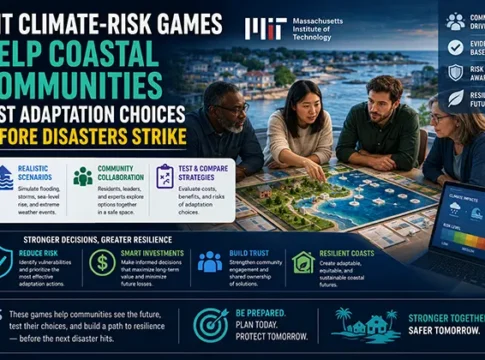

In an era where climate change poses unprecedented challenges, innovative solutions are crucial for communities at risk. MIT’s climate-risk games, spearheaded by Sai Ravela, offer a groundbreaking approach to help coastal communities in India, Bangladesh, and the Sundarbans test adaptation choices before disasters strike. These participatory simulations engage residents, planners, educators, and climate researchers in collaborative learning, providing a unique platform to explore scenarios and tradeoffs without predicting specific disasters or guaranteeing successful adaptation.
Understanding MIT’s Climate-Risk Games
MIT’s climate-risk games are designed to simulate real-world scenarios involving storms, salinity, agriculture, and shared resources. By modeling decisions in a controlled environment, these games allow participants to understand the potential impacts of their choices on their communities. The simulations are particularly focused on coastal areas, where the effects of climate change are most pronounced.
Participatory Simulations: A Collaborative Approach
The participatory nature of these simulations is key to their success. By involving local residents and stakeholders, the games foster a sense of ownership and responsibility. Participants are encouraged to share their knowledge and experiences, which enriches the learning process and enhances the relevance of the simulations to local contexts.
Benefits of Collaborative Learning and Preparedness
Collaborative learning through these games offers numerous benefits. It enhances community preparedness by allowing participants to test various adaptation strategies and understand their potential outcomes. This hands-on approach is more effective than conventional lectures or top-down risk models, as it actively engages participants in the decision-making process.
“The games explore scenarios and tradeoffs rather than predict specific disasters or guarantee successful adaptation,” says Sai Ravela, highlighting the exploratory nature of the simulations.
Challenges and Limitations
Despite their benefits, the climate-risk games face certain challenges. One major limitation is the uncertainty inherent in climate modeling. While the games provide valuable insights, they cannot account for all variables or predict exact outcomes. Additionally, the need for accurate local data and representation can be a barrier, as can issues of accessibility and cultural transfer.
Expert Perspectives on Climate-Risk Games
Experts in the field of climate research emphasize the importance of these games in fostering a deeper understanding of climate risks. They argue that while traditional methods provide valuable data, participatory simulations offer a more nuanced view of how communities can adapt to changing conditions.
Practical Guidance for Community Deployment
For communities interested in deploying these simulations, practical guidance is essential. It involves gathering accurate local data, ensuring community engagement, and facilitating the games effectively. By addressing these factors, communities can maximize the benefits of the simulations and enhance their resilience to climate risks.
- Gather accurate and relevant local data.
- Engage community members and stakeholders actively.
- Facilitate the simulations with trained personnel.
Future Implications of Climate-Risk Games
Looking ahead, the implications of MIT’s climate-risk games are significant. As climate change continues to impact vulnerable communities, these simulations offer a proactive approach to adaptation. By exploring various scenarios and tradeoffs, communities can better prepare for the uncertainties of the future, making informed decisions that enhance their resilience.
In conclusion, MIT’s climate-risk games represent a pioneering effort to help coastal communities test adaptation choices before disasters strike. By fostering collaborative learning and preparedness, these simulations provide a valuable tool for understanding and mitigating the impacts of climate change. As we continue to face the challenges of a changing climate, such innovative approaches will be crucial in building resilient communities worldwide.