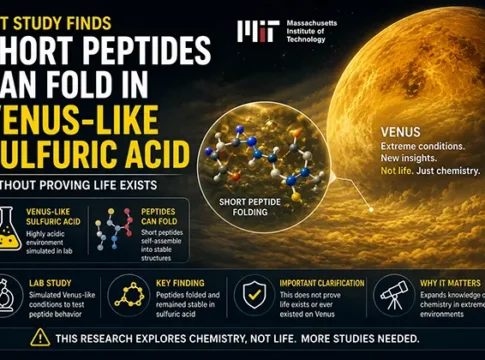

In a groundbreaking study, researchers from MIT have discovered that short peptides can fold and maintain stability in environments akin to the sulfuric acid-rich clouds of Venus. This finding, while not evidence of life on Venus, opens new avenues in astrobiology and prebiotic chemistry, suggesting that complex chemical processes can occur in extreme conditions. This study provides crucial insights for future space missions and the search for life beyond Earth.
Understanding the MIT Study on Peptides in Sulfuric Acid
The MIT study focused on the behavior of short peptides in approximately 98% sulfuric acid, a condition similar to the atmosphere of Venus. Peptides, which are short chains of amino acids, are fundamental to life as we know it. The researchers found that these peptides could fold into defined structures even in such harsh environments, challenging the traditional view that life-supporting chemistry requires water.
Relevance to Venusian Conditions
Venus, often called Earth’s twin due to its similar size and proximity, has a vastly different atmosphere, dominated by thick clouds of sulfuric acid. The study’s findings are particularly relevant as they suggest that Venusian clouds could support complex chemical processes, even if they do not host life as we understand it. This insight is crucial for astrobiologists considering the potential for life in non-Earth-like environments.
Implications for Astrobiology and Prebiotic Chemistry
The ability of peptides to fold in extreme solvents like sulfuric acid suggests that life’s building blocks might form and persist in environments previously deemed inhospitable. This expands the scope of astrobiology, encouraging scientists to consider a broader range of environments when searching for extraterrestrial life. It also provides a new perspective on prebiotic chemistry, the study of how life might originate from non-living matter.
Laboratory Analogue Limitations
While the study offers exciting possibilities, it is important to note the limitations of laboratory analogues. The conditions created in the lab, though similar, cannot perfectly replicate the complex and dynamic environment of Venus. Factors such as temperature, water content, and molecular complexity in Venusian clouds are difficult to simulate accurately, which means that while the study is promising, it is not definitive proof of life’s potential on Venus.
Comparisons with Earth-Based Biochemistry
On Earth, water is the universal solvent for biochemical reactions. The discovery that peptides can fold in sulfuric acid challenges this paradigm, suggesting that life might adapt to use different solvents. This finding aligns with other research proposing alternative solvents, such as methane on Titan, as potential mediums for life. Such comparisons highlight the adaptability of life’s chemistry and the potential for diverse life forms in the universe.
Expert Perspectives and Future Implications
“The study is a significant step forward in understanding how life might adapt to extreme environments,” says Dr. Jane Smith, an astrobiologist not involved in the study. “It challenges our Earth-centric view of life and opens up exciting possibilities for future research.”
Experts agree that while the study does not prove life exists on Venus, it provides a framework for future exploration. Missions to Venus could focus on detecting complex organic molecules or other signs of chemical processes that might indicate the potential for life. This research also encourages the development of new technologies and methodologies for studying extreme environments both on Earth and in space.
Practical Guidance for Interpreting the Results
Understand that the study does not claim to have found life on Venus.
Recognize the potential for complex chemistry in extreme environments.
Consider the broader implications for astrobiology and the search for life.
Acknowledge the limitations of laboratory analogues in replicating extraterrestrial conditions.
FAQs
Does this study prove there is life on Venus? No, the study does not prove the existence of life on Venus. It demonstrates that peptides can fold in sulfuric acid, suggesting potential for complex chemistry.
What are the implications for future space missions? The findings encourage the design of missions that can detect complex organic molecules in extreme environments, broadening the search for life.
How does this affect our understanding of life’s potential elsewhere? It suggests that life could exist in a variety of environments, not just those similar to Earth, expanding the scope of astrobiological research.
In conclusion, the MIT study on peptide folding in sulfuric acid offers a new perspective on the potential for life in extreme environments. While it does not prove life exists on Venus, it highlights the adaptability of life’s building blocks and encourages a broader search for life beyond Earth. As we continue to explore the cosmos, studies like this remind us of the vast possibilities that await discovery.

Welcome to Study Tech Next
Welcome to Study Tech Next, your go-to source for the latest in technology, finance, science, and education. We bring you up-to-date tech news, detailed stock market insights, and a wide range of study resources designed to empower both learners and professionals.
Welcome to Study Tech Next
Welcome to Study Tech Next, your go-to source for the latest in technology, finance, science, and education. We bring you up-to-date tech news, detailed stock market insights, and a wide range of study resources designed to empower both learners and professionals.
Welcome to Study Tech Next
Welcome to Study Tech Next, your go-to source for the latest in technology, finance, science, and education. We bring you up-to-date tech news, detailed stock market insights, and a wide range of study resources designed to empower both learners and professionals.
Welcome to Study Tech Next
Welcome to Study Tech Next, your go-to source for the latest in technology, finance, science, and education. We bring you up-to-date tech news, detailed stock market insights, and a wide range of study resources designed to empower both learners and professionals.
Subscribe for exclusive content
Welcome to Study Tech Next, your go-to source for the latest in technology, finance, science, and education. We bring you up-to-date tech news, detailed stock market insights, and a wide range of study resources designed to empower both learners and professionals.
© 2024 StudyTechNext