
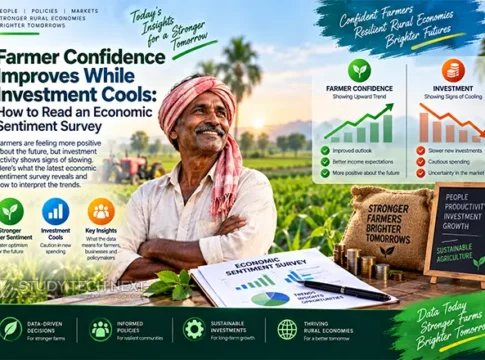
Farmer confidence is on the rise, according to the latest Purdue Ag Economy Barometer, which saw an increase from 126 to 135 in September 2026. This uptick reflects a more optimistic outlook among farmers regarding the agricultural economy, even as investment intentions show signs of cooling. Understanding how to interpret these economic sentiment surveys can provide valuable insights for business planning and strategic decision-making in the agricultural sector.
Key Highlights
- The Ag Economy Barometer rose from 126 to 135 in September 2026, indicating improved farmer confidence.
- Survey conducted with a sample of 402 farmers between August 15 and August 19, 2026.
- Index construction includes current conditions and future expectations.
- Despite rising confidence, investment intentions in capital spending have cooled.
- Input costs remain a significant concern for farmers.
- Distinction between sentiment and realized income or forecast guarantees.
- Practical examples for business planning based on survey insights.
- Methodological cautions in interpreting economic headlines.
What You Will Learn
- How the Ag Economy Barometer is constructed and what it measures.
- The significance of the 402-farmer sample size and survey timing.
- Differences between current conditions and future expectations indices.
- Impact of input costs on farmer sentiment and decision-making.
- Reasons behind the cooling of investment intentions despite rising confidence.
- How to distinguish sentiment from actual economic outcomes.
- Examples of how farmers can use survey data for strategic planning.
- Common pitfalls in interpreting economic sentiment surveys.
Understanding the Ag Economy Barometer
The Ag Economy Barometer is a crucial tool for gauging the economic sentiment of the agricultural sector. It is constructed using responses from a monthly survey of 400 U.S. agricultural producers. The index is a composite measure derived from two sub-indices: the Index of Current Conditions and the Index of Future Expectations. In September 2026, the barometer rose to 135, reflecting a more positive outlook among farmers.
Survey Sample and Timing
The survey conducted for the September 2026 report included 402 farmers, providing a robust sample size for reliable insights. Conducted between August 15 and August 19, 2026, the timing of the survey captures the sentiment of farmers during a critical period of the agricultural calendar, offering a snapshot of their economic outlook.
Current Conditions vs. Future Expectations
The Index of Current Conditions reflects farmers’ perceptions of the present economic environment, while the Index of Future Expectations gauges their outlook for the coming months. The rise in the overall barometer suggests that while current conditions may be challenging, there is optimism about future improvements.
Investment Intentions and Input Costs
Despite the rise in confidence, the survey indicates a cooling in investment intentions, particularly in capital spending. This trend may be attributed to persistent concerns over input costs, which continue to weigh heavily on farmers’ financial planning. Understanding these dynamics is essential for interpreting the broader economic sentiment.
Distinguishing Sentiment from Economic Outcomes
It’s important to distinguish between economic sentiment and actual economic outcomes. While the Ag Economy Barometer provides valuable insights into farmers’ perceptions, it does not guarantee realized income or forecast specific economic results. Farmers and stakeholders should use this data as one of several tools in their strategic planning arsenal.
Practical Business-Planning Examples
Farmers can leverage insights from the Ag Economy Barometer to inform their business strategies. For instance, understanding the cooling of investment intentions can guide decisions on capital expenditures, while awareness of input cost concerns can lead to more effective budgeting and resource allocation.
Methodological Cautions
When interpreting economic sentiment surveys, it’s crucial to consider methodological factors such as sample size, survey timing, and question framing. These elements can influence the results and should be taken into account when drawing conclusions from the data.
FAQs and Lessons in Interpreting Economic Headlines
Economic sentiment surveys like the Ag Economy Barometer offer valuable insights but should be interpreted with caution. Common questions include how to differentiate between sentiment and actual economic performance, and how to use survey data in practical decision-making. By understanding these nuances, stakeholders can better navigate economic headlines and make informed decisions.
“The Ag Economy Barometer is a vital tool for understanding farmer sentiment, but it should be used alongside other economic indicators for comprehensive analysis.” – Purdue University
In conclusion, the rise in the Ag Economy Barometer to 135 in September 2026 highlights improved farmer confidence, even as investment intentions cool. By understanding how to interpret these surveys, farmers and stakeholders can make more informed business decisions, balancing optimism with practical considerations of input costs and economic realities.