
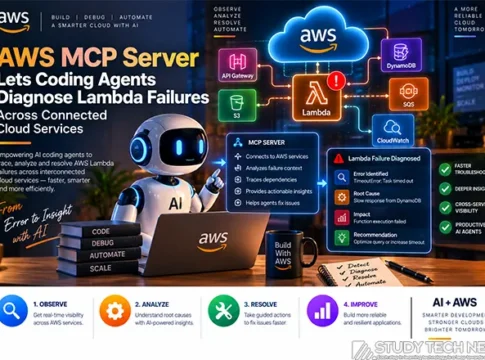
AWS has unveiled a groundbreaking tool, the MCP Server, on September 4, 2026, designed to empower coding agents with the ability to diagnose Lambda failures across interconnected cloud services. This innovative release promises to enhance observability and streamline root-cause analysis, offering a comprehensive view of Lambda configurations, timelines, and their interactions with services like API Gateway, EventBridge, S3, DynamoDB, SNS, SQS, and Step Functions. In this article, we delve into the features, benefits, and potential risks associated with the AWS MCP Server, providing a detailed guide for developers and cloud architects.
Key Highlights
- Release Date: September 4, 2026
- Supported Services: API Gateway, EventBridge, S3, DynamoDB, SNS, SQS, Step Functions
- Availability: Globally available across all AWS regions
- Cost: No additional cost for AWS users
- Benefits: Enhanced observability, efficient root-cause analysis, token-efficiency
- Risks: Permissions management, sensitive logs, hallucinated diagnoses, over-automation
What You Will Learn
- Understanding the AWS MCP Server and its role in cloud diagnostics
- How to leverage observability for better cloud service management
- Implementing distributed tracing to track service interactions
- Establishing a seven-day baseline for performance monitoring
- Applying the principle of least privilege to secure cloud environments
- Conducting effective root-cause analysis to resolve Lambda failures
Exploring the AWS MCP Server
The AWS MCP Server is a pivotal tool for developers aiming to diagnose and resolve Lambda failures efficiently. By providing a detailed inspection of Lambda configurations and their interactions with other AWS services, it enables a comprehensive understanding of the cloud environment. This tool supports a wide array of services, including API Gateway, EventBridge, S3, DynamoDB, SNS, SQS, and Step Functions, ensuring a holistic approach to cloud diagnostics.
Enhanced Observability and Distributed Tracing
Observability is a critical aspect of modern cloud management, and the AWS MCP Server excels in this domain by offering distributed tracing capabilities. This feature allows developers to track the flow of requests across various services, identifying bottlenecks and latency issues that could lead to Lambda failures. By visualizing these interactions, coding agents can pinpoint the exact source of a problem, facilitating quicker resolutions.
Seven-Day Baseline and Token-Efficiency
A unique feature of the AWS MCP Server is its ability to establish a seven-day baseline for performance monitoring. This baseline provides a reference point for normal operational metrics, enabling the detection of anomalies and performance deviations. Additionally, AWS claims that the MCP Server is token-efficient, ensuring that resource usage is optimized without incurring additional costs.
Regional Behavior and Cost Efficiency
The AWS MCP Server is available across all AWS regions, providing consistent performance and diagnostics capabilities globally. Importantly, AWS has stated that this tool is available at no additional cost to users, making it an attractive option for organizations looking to enhance their cloud service management without increasing their budget.
Potential Risks and Considerations
While the AWS MCP Server offers numerous benefits, it is essential to be aware of potential risks. Proper permissions management is crucial to prevent unauthorized access to sensitive logs and data. Additionally, there is a risk of hallucinated diagnoses, where the tool might suggest incorrect root causes due to over-automation. Developers must remain vigilant and apply the principle of least privilege to mitigate these risks.
What Can We Learn from This Topic?
An incident example can illustrate the importance of the AWS MCP Server. Consider a scenario where a Lambda function fails due to a misconfigured API Gateway. Using the MCP Server, a developer can trace the request path, identify the misconfiguration, and resolve the issue promptly. This tool helps dispel misconceptions about cloud diagnostics being overly complex by providing clear, actionable insights.
For those new to cloud diagnostics, a safe mock-diagnostics project can be an excellent way to familiarize oneself with the AWS MCP Server. By simulating a controlled environment with intentional misconfigurations, developers can practice using the tool to diagnose and resolve issues without impacting live services.
AWS MCP Server is a game-changer for cloud diagnostics, offering unparalleled insights into Lambda failures and service interactions.
In conclusion, the AWS MCP Server represents a significant advancement in cloud service management, providing developers with the tools needed to diagnose and resolve Lambda failures efficiently. By leveraging its capabilities, organizations can enhance their observability, optimize resource usage, and maintain robust cloud environments. As AWS continues to innovate, tools like the MCP Server will be instrumental in shaping the future of cloud computing.