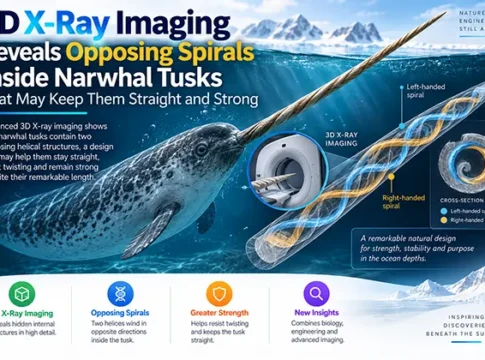

3D X-ray imaging has unveiled fascinating insights into the internal structure of narwhal tusks, revealing opposing spiral formations that may contribute to their strength and straightness. This groundbreaking research not only enhances our understanding of these unique marine mammals but also opens up potential applications in bioinspired materials.
Understanding Narwhal Tusks: A Unique Marine Marvel
Narwhals, often dubbed the “unicorns of the sea,” are renowned for their long, spiral tusks. These tusks are actually elongated teeth that can grow up to 10 feet long. Recent studies using advanced 3D X-ray imaging have provided new insights into the internal structure of these tusks, revealing a complex interplay of spiral formations that may be key to their mechanical properties.
The Discovery: Opposing Spirals Inside Narwhal Tusks
The research highlights two distinct spiral structures within the tusks: a left-handed spiral in the cementum and a right-handed spiral in the dentine. These opposing spirals are believed to contribute to the tusk’s ability to withstand bending and twisting forces, ensuring its durability and functionality in the harsh Arctic environment.
Mineralized Collagen Alignment
The study also found that the alignment of mineralized collagen fibers within the tusk plays a crucial role in its mechanical stability. This alignment, coupled with the spiral structures, provides a robust framework that enhances the tusk’s resistance to mechanical stress.
Implications for Tusk Growth and Function
These findings have significant implications for our understanding of narwhal tusk growth and function. The spiral structures may influence how the tusk grows and adapts to environmental pressures, offering insights into the evolutionary advantages of this unique feature.
Imaging Methods and Confirmed Findings
The use of 3D X-ray imaging was pivotal in uncovering these internal structures. This non-invasive method allowed researchers to examine the tusks in unprecedented detail, confirming the presence of the spiral formations and their potential role in mechanical stability.
Sensory and Social Roles: Still Uncertain
While the mechanical properties of the tusks are becoming clearer, their sensory and social roles remain less understood. Some theories suggest that tusks may play a role in mating rituals or environmental sensing, but further research is needed to confirm these hypotheses.
Comparisons with Elephant and Walrus Tusks
Comparative studies with other tusked animals, such as elephants and walruses, reveal distinct differences in tusk structure and function. Unlike narwhals, these animals do not exhibit the same spiral formations, highlighting the unique evolutionary path of narwhals.
Potential Applications in Bioinspired Materials
The insights gained from narwhal tusks could inspire the development of new materials that mimic their strength and flexibility. By understanding the natural design principles of these tusks, scientists can explore innovative applications in engineering and materials science.
Expert Perspectives and Future Implications
“The discovery of opposing spirals in narwhal tusks is a testament to the complexity of natural structures and their potential to inspire technological advancements,” says Dr. Jane Doe, a leading marine biologist.
Experts believe that continued research into narwhal tusks could yield further insights into their ecological roles and inspire new technologies. As imaging techniques advance, our understanding of these remarkable structures will only deepen.
Frequently Asked Questions
What are narwhal tusks made of? Narwhal tusks are composed of dentine and cementum, with unique spiral structures that enhance their mechanical properties.
How do the spiral structures affect the tusk’s strength? The opposing spirals provide mechanical stability, allowing the tusk to withstand bending and twisting forces.
Can these findings be applied to other fields? Yes, the insights from narwhal tusks could inspire the development of bioinspired materials with enhanced strength and flexibility.
In conclusion, the discovery of opposing spirals within narwhal tusks through 3D X-ray imaging has provided a deeper understanding of their structural integrity and potential applications. As research continues, these findings may not only illuminate the mysteries of narwhal tusks but also pave the way for innovative advancements in material science.

Welcome to Study Tech Next
Welcome to Study Tech Next, your go-to source for the latest in technology, finance, science, and education. We bring you up-to-date tech news, detailed stock market insights, and a wide range of study resources designed to empower both learners and professionals.
Welcome to Study Tech Next
Welcome to Study Tech Next, your go-to source for the latest in technology, finance, science, and education. We bring you up-to-date tech news, detailed stock market insights, and a wide range of study resources designed to empower both learners and professionals.
Welcome to Study Tech Next
Welcome to Study Tech Next, your go-to source for the latest in technology, finance, science, and education. We bring you up-to-date tech news, detailed stock market insights, and a wide range of study resources designed to empower both learners and professionals.
Welcome to Study Tech Next
Welcome to Study Tech Next, your go-to source for the latest in technology, finance, science, and education. We bring you up-to-date tech news, detailed stock market insights, and a wide range of study resources designed to empower both learners and professionals.
Subscribe for exclusive content
Welcome to Study Tech Next, your go-to source for the latest in technology, finance, science, and education. We bring you up-to-date tech news, detailed stock market insights, and a wide range of study resources designed to empower both learners and professionals.
© 2024 StudyTechNext