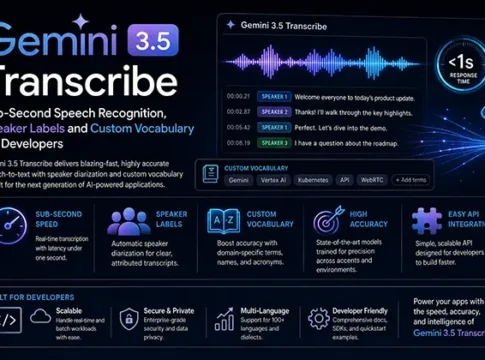

Google’s latest innovation, Gemini 3.5 Transcribe, is set to revolutionize the way developers integrate speech recognition into their applications. Launched on August 26, this cutting-edge tool promises sub-second speech recognition, speaker labels, and custom vocabulary, offering a robust solution for real-time and recorded-audio processing. As developers seek to enhance voice applications, Gemini 3.5 Transcribe emerges as a pivotal tool, boasting precision and low latency. Let’s delve into the features, benefits, and implications of this groundbreaking technology.
Gemini 3.5 Transcribe: Key Features and Capabilities
Gemini 3.5 Transcribe introduces several advanced features that cater to the evolving needs of developers. The tool supports real-time streaming through the Live API and recorded-audio processing via the Interactions API. This dual capability ensures flexibility and efficiency in handling various audio inputs.
Sub-Second Speech Recognition
One of the standout features of Gemini 3.5 Transcribe is its sub-second speech recognition. This capability allows for near-instantaneous transcription, significantly reducing latency and enhancing user experience. Developers can leverage this feature to create more responsive and interactive applications.
Speaker Labels and Custom Vocabulary
The inclusion of speaker labels enables the tool to distinguish between different speakers in a conversation, providing clarity and context in transcriptions. Additionally, the custom vocabulary feature allows developers to tailor the transcription process to specific terminologies and jargon, ensuring higher accuracy in niche applications.
Precision and Latency: Google’s Claims vs. Reality
Google claims that Gemini 3.5 Transcribe offers unparalleled precision and minimal latency. While these claims are impressive, independent validations are crucial to confirm the tool’s performance in real-world scenarios. Developers should conduct thorough testing to ensure the tool meets their specific requirements.
Implementation Guidance for Developers
Integrating Gemini 3.5 Transcribe into applications is straightforward, thanks to comprehensive documentation and support from Google. Developers can access detailed guides on implementing both the Live API and Interactions API, ensuring a smooth integration process.
Review the API documentation thoroughly to understand the capabilities and limitations.
Test the tool in various scenarios to validate its performance and accuracy.
Utilize the custom vocabulary feature to enhance transcription accuracy for specific use cases.
Privacy Considerations and Risks
As with any cloud-based service, privacy is a significant concern. Developers must ensure that they comply with data protection regulations and implement robust security measures to safeguard user data. Google provides guidelines on maintaining privacy, but the onus is on developers to adhere to best practices.
Comparisons with Competing Transcription Systems
Gemini 3.5 Transcribe competes with other transcription systems like Amazon Transcribe and IBM Watson. While each tool has its strengths, Gemini 3.5’s sub-second recognition and custom vocabulary set it apart. However, developers should evaluate each option based on their specific needs and constraints.
FAQs and Future Implications
As developers explore Gemini 3.5 Transcribe, several questions may arise regarding its capabilities and future developments. Google is expected to continue enhancing the tool, potentially expanding language support and refining its features to meet the growing demands of voice applications.
“Gemini 3.5 Transcribe is a game-changer for developers looking to integrate advanced speech recognition into their applications, offering unmatched speed and accuracy.” – Industry Expert
In conclusion, Gemini 3.5 Transcribe represents a significant advancement in speech recognition technology. With its sub-second recognition, speaker labels, and custom vocabulary, it provides developers with a powerful tool to enhance voice applications. As Google continues to innovate, the future of speech recognition looks promising, offering exciting possibilities for developers and users alike.

Welcome to Study Tech Next
Welcome to Study Tech Next, your go-to source for the latest in technology, finance, science, and education. We bring you up-to-date tech news, detailed stock market insights, and a wide range of study resources designed to empower both learners and professionals.
Welcome to Study Tech Next
Welcome to Study Tech Next, your go-to source for the latest in technology, finance, science, and education. We bring you up-to-date tech news, detailed stock market insights, and a wide range of study resources designed to empower both learners and professionals.
Welcome to Study Tech Next
Welcome to Study Tech Next, your go-to source for the latest in technology, finance, science, and education. We bring you up-to-date tech news, detailed stock market insights, and a wide range of study resources designed to empower both learners and professionals.
Welcome to Study Tech Next
Welcome to Study Tech Next, your go-to source for the latest in technology, finance, science, and education. We bring you up-to-date tech news, detailed stock market insights, and a wide range of study resources designed to empower both learners and professionals.
Subscribe for exclusive content
Welcome to Study Tech Next, your go-to source for the latest in technology, finance, science, and education. We bring you up-to-date tech news, detailed stock market insights, and a wide range of study resources designed to empower both learners and professionals.
© 2024 StudyTechNext