
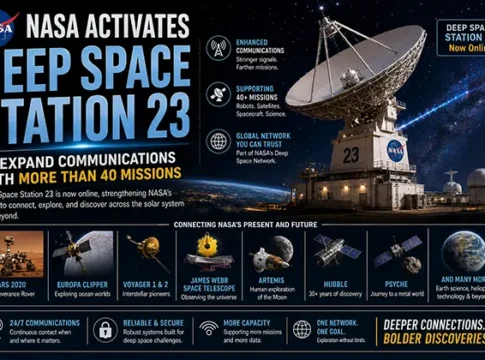

NASA has taken a significant leap forward in its space communication capabilities with the activation of Deep Space Station 23 (DSS-23) at the Goldstone Deep Space Communications Complex. This new 34-meter antenna, which became operational on August 3, 2023, is set to enhance communication with over 40 missions, including the Chandra X-ray Observatory, Mars Reconnaissance Orbiter, Psyche, Juno, and Voyager 1. This development marks a pivotal moment in managing the growing workload of the Deep Space Network (DSN), ensuring robust support for current and future space explorations.
The Role of Deep Space Station 23
Deep Space Station 23 is a crucial addition to NASA’s DSN, which is the backbone of communication for interplanetary missions. The new antenna at Goldstone, California, underwent rigorous testing before its operational debut, ensuring it meets the high standards required for deep space communication. Its activation is a response to the increasing demand for communication channels as NASA’s mission portfolio expands.
Early Tracking and Mission Support
Since its activation, DSS-23 has successfully tracked several key missions. These include the Chandra X-ray Observatory, which provides insights into the universe’s high-energy phenomena, and the Mars Reconnaissance Orbiter, which continues to send back vital data about the Martian surface. Additionally, the antenna supports the Psyche mission, set to explore a metal-rich asteroid, and the Juno spacecraft, which is studying Jupiter’s atmosphere and magnetic field. Notably, DSS-23 also aids in maintaining contact with Voyager 1, humanity’s farthest-traveled spacecraft.
Addressing the Deep Space Network’s Growing Workload
The DSN is experiencing an unprecedented increase in demand due to the sheer number of active and planned missions. DSS-23’s addition helps alleviate some of this pressure by providing additional capacity and redundancy. This is particularly important as the network’s existing infrastructure, including its aging 70-meter dishes, faces scheduling and maintenance challenges.
Arraying and Redundancy Benefits
One of the significant advantages of DSS-23 is its ability to work in conjunction with other antennas, a process known as arraying. This capability enhances signal acquisition and data transmission, ensuring that mission teams receive critical information without delay. The redundancy provided by DSS-23 also means that maintenance on older antennas can proceed without disrupting communication with spacecraft.
Comparisons with Existing 70-Meter Dishes
While the 70-meter dishes have been the workhorses of the DSN, they are increasingly difficult to maintain due to their age. DSS-23, with its modern design and technology, offers a more reliable and efficient alternative. Although smaller in diameter, the new antenna’s advanced capabilities allow it to perform tasks that were previously the domain of the larger dishes.
Practical Explanations of Signal Acquisition
Signal acquisition in deep space communication involves capturing faint signals from spacecraft millions of miles away. DSS-23’s state-of-the-art technology enhances this process, allowing for clearer and more reliable data transmission. This is crucial for mission success, as even minor delays or data loss can impact scientific outcomes.
Future Implications and Developments
Looking ahead, NASA plans to further expand the DSN with a new antenna in Canberra, Australia. This expansion will continue to bolster the network’s capacity, ensuring that it can support an ever-growing number of missions. The activation of DSS-23 is a testament to NASA’s commitment to maintaining a robust communication infrastructure, essential for the success of its ambitious space exploration goals.
Frequently Asked Questions“The activation of DSS-23 is a significant milestone in our efforts to enhance communication capabilities for current and future missions,” said a NASA spokesperson. “This new antenna will play a vital role in ensuring that we can continue to explore the universe and gather valuable scientific data.”
- What is the primary function of DSS-23? DSS-23 is designed to enhance communication with NASA’s deep space missions, providing additional capacity and redundancy to the existing network.
- How does DSS-23 improve signal acquisition? The antenna’s modern technology allows for clearer and more reliable data transmission, crucial for mission success.
- What are the future plans for the DSN? NASA plans to expand the network further with a new antenna in Canberra, Australia, to support the increasing number of missions.