
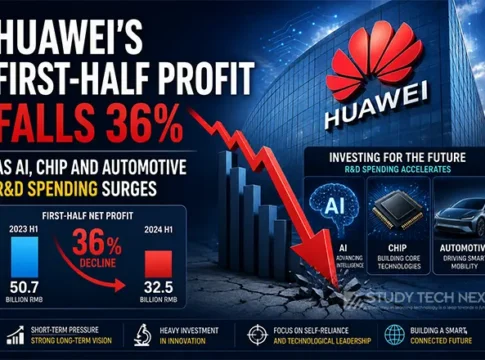

Huawei, a global leader in telecommunications and technology, has reported a significant decline in its first-half net profit, falling by 36%. This downturn comes amidst a strategic pivot towards increased investment in research and development, particularly in artificial intelligence (AI), semiconductors, and automotive technologies. As Huawei navigates these turbulent waters, the implications for its suppliers, customers, and competitors are profound, with potential innovation benefits and risks on the horizon.
Huawei’s Financial Performance: A Closer Look
In the first half of the year, Huawei’s net profit dropped by 36%, a stark contrast to its revenue growth. This decline is attributed to a substantial 25.2% increase in research-and-development spending, which underscores the company’s commitment to innovation in AI, chip technology, and intelligent vehicles. Despite these investments, Huawei faces challenges such as higher input and administrative costs, negative operating cash flow, and rising inventories.
Revenue Growth Amidst Rising Costs
While Huawei’s revenue has shown growth, the increase in costs has overshadowed these gains. The company’s strategic investments in cutting-edge technologies are crucial for its long-term vision but have led to immediate financial pressures. The absence of a detailed segment breakdown further complicates the analysis of Huawei’s financial health, leaving stakeholders to speculate on the specific areas driving revenue.
Strategic Investments in AI, Chips, and Automotive
Huawei’s increased focus on AI, semiconductors, and automotive technologies is a strategic move to diversify its portfolio and reduce reliance on traditional telecommunications. These sectors are poised for significant growth, and Huawei’s investments could position it as a leader in these emerging markets. However, this shift also introduces execution risks and requires substantial funding.
Potential Innovation Benefits and Risks
The potential benefits of Huawei’s investments are vast, including advancements in smart devices and intelligent vehicles. However, these opportunities come with risks, such as the need for successful execution and the potential for increased competition. Huawei must navigate these challenges while managing the impact of international sanctions that have affected its operations.
Huawei’s commitment to innovation is evident in its increased R&D spending, but this comes with the challenge of balancing short-term financial performance with long-term strategic goals.
Market Interpretations and Analyst Perspectives
Analysts have mixed views on Huawei’s current strategy. Some see the increased R&D spending as a necessary step for future growth, while others express concern over the immediate financial strain. The lack of detailed segment reporting adds to the uncertainty, making it difficult to assess the full impact of Huawei’s strategic investments.
Comparisons with Other Technology Giants
When compared to other major technology companies, Huawei’s approach is both bold and risky. While companies like Apple and Samsung continue to dominate in established markets, Huawei’s pivot towards AI and automotive technologies sets it apart. This strategy could yield significant rewards if executed successfully, but it also places Huawei in direct competition with established players in these fields.
Practical Business Implications and Future Outlook
For suppliers, customers, and employees, Huawei’s strategic shift presents both opportunities and challenges. Suppliers may benefit from increased demand for advanced components, while customers could see innovative new products. However, employees face the uncertainty of a rapidly changing business environment. Looking ahead, Huawei’s ability to manage its financial health while pursuing ambitious R&D goals will be crucial.
- Increased R&D spending could lead to groundbreaking innovations.
- Higher costs and negative cash flow present immediate financial challenges.
- International sanctions continue to impact Huawei’s operations.
- Execution risks and competition in new markets are significant concerns.