
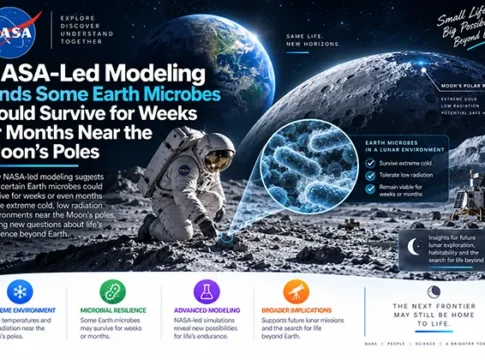

NASA’s latest research has unveiled a fascinating possibility: certain Earth microbes might survive for weeks or even months near the Moon’s poles. This groundbreaking study, published in Science Advances on August 21, leverages simulations based on data from the Lunar Reconnaissance Orbiter. The findings could have significant implications for future lunar missions, including NASA’s Artemis program and the establishment of lunar bases.
Understanding the Research: Microbial Survivability on the Moon
The study conducted by NASA and its collaborators focused on the survivability of five specific fungi and bacteria under lunar conditions. These microorganisms were chosen for their known resilience in extreme environments on Earth. The research aimed to determine whether these microbes could endure the harsh conditions near the Moon’s poles, particularly in permanently shadowed regions where sunlight never reaches.
The Role of Lunar Reconnaissance Orbiter Data
The simulations were based on environmental data collected by the Lunar Reconnaissance Orbiter. This spacecraft has been instrumental in mapping the Moon’s surface and providing detailed information about its temperature, radiation levels, and other critical factors. By using this data, researchers could create accurate models of the lunar environment to test microbial survivability.
Microbes Examined: Fungi and Bacteria
– Aspergillus
– Fusarium
– Deinococcus
– Two other unspecified microbes
Among the microbes tested, Aspergillus, Fusarium, and Deinococcus showed remarkable resilience. These organisms are known for their ability to withstand extreme conditions, making them prime candidates for this study. The research highlighted that while these microbes could survive, their ability to grow or reproduce was not assessed, marking a crucial distinction in understanding microbial life on the Moon.
Implications for Artemis and Future Lunar Missions
The potential for microbial survival on the Moon raises important considerations for NASA’s Artemis program and future lunar bases. The presence of Earth microbes could pose contamination risks, affecting the integrity of lunar samples and complicating planetary protection protocols. Ensuring that missions do not inadvertently introduce Earth life to the Moon is critical for preserving its natural state and for scientific accuracy.
Challenges and Methodological Limitations
While the study provides valuable insights, it also has limitations. The simulations did not account for all possible lunar conditions, and the actual survival of microbes would depend on numerous factors not fully replicated in the models. These limitations highlight the need for further research to refine our understanding of microbial survivability in space.
Expert Perspectives and Future Directions Experts in astrobiology and planetary science emphasize the importance of this research in guiding future exploration efforts. The findings could inform the development of more robust planetary protection measures and influence the design of habitats and equipment for lunar missions. As we continue to explore the Moon and beyond, understanding the survivability of Earth life in space environments will be essential. FAQs About Microbial Survival on the Moon – **What are the primary risks of microbial survival on the Moon?** The main risks include contamination of lunar samples and interference with scientific experiments. – **How does this research impact future lunar missions?** It underscores the need for stringent planetary protection protocols to prevent contamination. – **What are the next steps in this research?** Further studies are needed to explore the full range of lunar conditions and their impact on microbial life. In conclusion, NASA’s research into the survivability of Earth microbes near the Moon’s poles opens new avenues for understanding life in space. While some microbes may endure the harsh lunar environment, the implications for contamination and planetary protection are significant. As we prepare for future lunar missions, these findings will play a crucial role in shaping our approach to exploring and inhabiting the Moon.“The distinction between cellular survival and growth or reproduction is crucial in understanding the potential for life beyond Earth.” – NASA Research Team