
About Us

At Study Tech Next, we’re committed to bringing you insightful, up-to-the-minute content across a spectrum of topics that impact our daily lives.

― Advertisement ―

LVMH’s Luxury Slowdown Shows How Brand Concentration and Regional Demand Can Shape a Global Business

Explore how LVMH's luxury slowdown reveals the impact of brand concentration and regional demand shifts on global business strategies. Learn about the risks of over-reliance on key markets like China and how strategic diversification can mitigate these challenges. Discover insights into maintaining business stability and growth.
HomeNewsBusinessLVMH’s Luxury Slowdown Shows How Brand Concentration and Regional Demand Can Shape...

LVMH’s Luxury Slowdown Shows How Brand Concentration and Regional Demand Can Shape a Global Business

LVMH, the world’s leading luxury goods conglomerate, is experiencing a notable slowdown, as highlighted in a recent Reuters Breakingviews analysis. This slowdown underscores the critical role that brand concentration and regional demand play in shaping global business dynamics. As LVMH navigates these challenges, understanding the implications of its reliance on major brands and the shifting preferences in key markets like China becomes essential for business strategists and students alike. Key Highlights
  • The analysis was published on October 6, 2026, by Reuters Breakingviews.
  • LVMH has reported a significant market-value decline, reflecting broader industry trends.
  • The company’s major divisions, particularly fashion and leather goods, are heavily exposed to market fluctuations.
  • Chinese demand, a critical driver of luxury sales, is showing signs of change, impacting LVMH’s performance.
  • Competitors like Kering and Richemont are also facing similar challenges, highlighting industry-wide issues.
  • Strategic responses proposed include diversifying brand portfolios and enhancing geographic reach.
What You Will Learn
  • How revenue concentration in a few key brands can affect overall business stability.
  • The importance of brand equity in maintaining pricing power amidst market fluctuations.
  • The role of geographic diversification in mitigating regional demand risks.
  • Insights into product mix strategies that can buffer against consumer cycle changes.
  • Understanding valuation multiples and their impact on perceived company value.
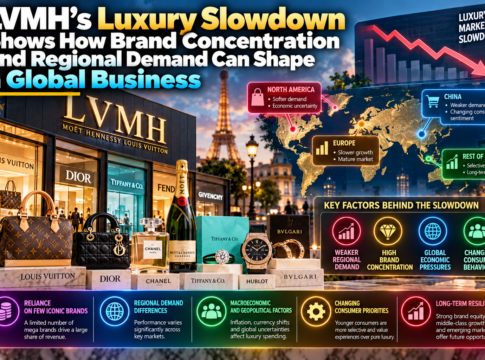
How and Why It Works LVMH’s heavy reliance on its flagship brands, such as Louis Vuitton and Dior, illustrates how concentration can magnify both growth and decline. When these brands perform well, they drive significant revenue and market confidence. However, any downturn in their performance can lead to disproportionate impacts on the company’s overall financial health. Similarly, LVMH’s dependence on the Chinese market means that any shifts in consumer preferences or economic conditions there can have outsized effects on its global operations. Practical Applications For business students, understanding concentration risk is crucial. A concentration-risk matrix can help identify potential vulnerabilities in a business model. This matrix evaluates factors such as brand reliance, market dependency, and product diversity, providing a framework for assessing and mitigating risks associated with over-concentration. Limitations and Misconceptions It’s important to note that the insights from the Reuters Breakingviews analysis are opinion-based and should be interpreted as such. Market value should not be confused with operating cash flow, as they represent different aspects of financial health. Additionally, while the analysis provides valuable insights, it does not predict specific recovery or decline timelines for LVMH or the luxury sector. Learning Takeaways When considering diversification strategies, ask questions such as: How reliant is the business on a single brand or market? What are the potential impacts of regional demand shifts? How can product mix be optimized to buffer against economic cycles? These questions can guide strategic planning without offering direct investment advice. In conclusion, LVMH’s current challenges highlight the intricate balance between brand concentration and regional demand in shaping global business success. By understanding these dynamics, businesses can better navigate the complexities of the luxury market and beyond.