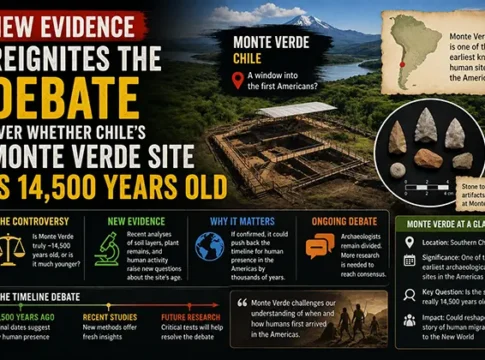

The Monte Verde site in Chile has long been a focal point of archaeological debate, with new evidence once again sparking discussions about its age. Researchers have defended the notion that this site dates back 14,500 years, challenging traditional views of human migration into the Americas. However, competing analyses suggest a much younger timeline, leading to a contentious debate over the site’s true age and its implications for understanding pre-Clovis migration.
The Debate Over Monte Verde’s Age
Monte Verde has been at the center of archaeological discussions since its discovery. The site is believed by some researchers to be 14,500 years old, which would make it one of the earliest known human settlements in the Americas. This early date challenges the long-held Clovis-first model, which posits that the first inhabitants of the Americas arrived around 13,000 years ago. However, recent analyses have introduced new evidence suggesting that some materials at Monte Verde may be much younger, reigniting the debate over its true age.
Evidence Supporting the 14,500-Year Date
Proponents of the earlier date point to a variety of organic artifacts found at Monte Verde, including wood, tools, and plant remains. These items have been radiocarbon dated to approximately 14,500 years ago. Additionally, a possible human footprint found at the site supports the notion of an early human presence. The preservation of these materials in a peat bog has provided a unique opportunity to study them in detail, offering insights into the lifestyle and environment of the site’s ancient inhabitants.
Challenges to the Early Occupation Theory
Despite the compelling evidence for an early occupation, some researchers argue that the materials may have been misdated. They suggest that volcanic ash layers and other geological factors could have affected the dating process. Furthermore, disputes over the exact locations from which samples were taken have led to questions about the reliability of the data. Critics also point out that some artifacts may have been introduced to the site at a later date, complicating the interpretation of the evidence.
Implications for Understanding Pre-Clovis Migration
If Monte Verde is indeed 14,500 years old, it would significantly alter our understanding of how and when humans first arrived in the Americas. It would suggest that pre-Clovis peoples migrated into the continent earlier than previously thought, possibly using coastal routes. This would require a reevaluation of migration theories and the development of new models to explain the peopling of the Americas.
Comparisons with Other Early American Sites
Monte Verde is not the only site challenging the Clovis-first model. Other sites, such as Meadowcroft Rockshelter in Pennsylvania and the Buttermilk Creek Complex in Texas, have also yielded evidence of pre-Clovis occupation. These sites, along with Monte Verde, contribute to a growing body of evidence suggesting that humans were present in the Americas earlier than traditionally believed.
Expert Perspectives
The debate over Monte Verde’s age is far from settled, with experts divided on the issue. Some archaeologists argue that the evidence for an early occupation is compelling and should be taken seriously. Others caution that more research is needed to confirm these findings and that the current evidence is not definitive. This ongoing debate highlights the complexities of archaeological research and the challenges of interpreting ancient evidence.
Monte Verde remains a pivotal site in understanding early human migration into the Americas, but its age is still a matter of scientific debate.
Future Research Needs
To resolve the debate over Monte Verde’s age, further research is essential. This includes more precise dating techniques, additional excavations, and a comprehensive analysis of the site’s stratigraphy. Collaboration between researchers with differing viewpoints could also help to address the current controversies and lead to a more nuanced understanding of the site’s history.
Frequently Asked Questions
What is the significance of Monte Verde? Monte Verde is significant because it challenges the traditional Clovis-first model of human migration into the Americas, suggesting an earlier arrival of humans.
Why is there a debate over its age? The debate stems from conflicting evidence regarding the dating of materials found at the site, with some suggesting an age of 14,500 years and others proposing a much younger date.
What are the implications of an earlier occupation date? An earlier occupation date would require a reevaluation of migration theories and suggest that humans used different routes to enter the Americas.
In conclusion, the debate over whether Chile’s Monte Verde site is 14,500 years old remains unresolved. While new evidence has reignited discussions, the site’s age is still contested, and neither interpretation should be presented as definitively settled. As research continues, Monte Verde will undoubtedly remain a key site in the study of early human migration into the Americas.

Welcome to Study Tech Next
Welcome to Study Tech Next, your go-to source for the latest in technology, finance, science, and education. We bring you up-to-date tech news, detailed stock market insights, and a wide range of study resources designed to empower both learners and professionals.
Welcome to Study Tech Next
Welcome to Study Tech Next, your go-to source for the latest in technology, finance, science, and education. We bring you up-to-date tech news, detailed stock market insights, and a wide range of study resources designed to empower both learners and professionals.
Welcome to Study Tech Next
Welcome to Study Tech Next, your go-to source for the latest in technology, finance, science, and education. We bring you up-to-date tech news, detailed stock market insights, and a wide range of study resources designed to empower both learners and professionals.
Welcome to Study Tech Next
Welcome to Study Tech Next, your go-to source for the latest in technology, finance, science, and education. We bring you up-to-date tech news, detailed stock market insights, and a wide range of study resources designed to empower both learners and professionals.
Subscribe for exclusive content
Welcome to Study Tech Next, your go-to source for the latest in technology, finance, science, and education. We bring you up-to-date tech news, detailed stock market insights, and a wide range of study resources designed to empower both learners and professionals.
© 2024 StudyTechNext