
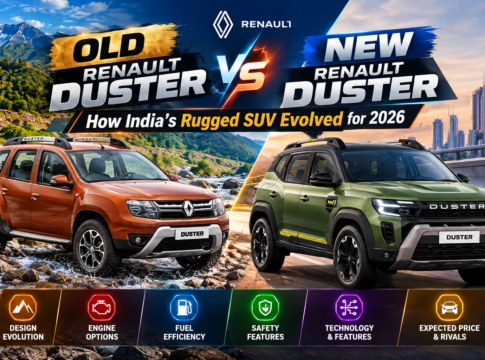
 with the new 2026 SUV. Explore prices, engines, mileage, safety ratings, features and ownership costs in India.)
The Renault Duster is back in India with an entirely new personality. Once known for its strong road presence, comfortable suspension and practical diesel engines, the SUV now offers turbocharged petrol performance, connected technology and modern safety features.
But has the new Duster retained the character that made the original so popular?
The old Duster focused on mechanical practicality. The 2026 Duster combines that SUV identity with modern technology and safety.
This comparison examines the Indian-market 2016–2019 Duster against the new-generation 2026 Duster, excluding the later 2019–2022 facelift and international versions.
1. Key Highlights
- Old Duster: The discontinued 2016–2019 model was a five-seat SUV with petrol and diesel engines. Its last recorded 2019 ex-showroom price range was approximately ₹7.95–15.14 lakh.
- Engine choices: The older range included 1,461cc diesel, 1,498cc petrol and 1,598cc petrol engines, with manual, AMT and CVT options across different variants.
- New Duster price: The 2026 model starts at ₹10.49 lakh ex-showroom, according to Renault India’s October 2026 listing.
- New turbo engines: Buyers can choose the TCe 100 (100 PS) or TCe 160 (163 PS and 280 Nm), with manual and DCT options depending on the variant.
- Design and comfort: The new SUV introduces sharper LED lighting, redesigned interiors, 212 mm ground clearance and a modern digital cockpit.
- Technology: Available features include a 10.1-inch touchscreen, up to a 10.25-inch digital driver display, Google built-in and connected services.
- Safety: The 2026 Duster has a five-star Bharat NCAP rating and offers up to 17 driver-assistance functions, with equipment varying by variant.
- Strong hybrid: Renault has announced the E-Tech 160 strong hybrid and opened bookings, but as of 12 October 2026 it remains listed as coming soon, with final retail pricing pending.
2. What You Will Learn
This comparison explains:
- How the new-generation Duster differs from an ordinary facelift.
- Why the older petrol and diesel engines offer a different driving experience from modern turbo-petrol and strong-hybrid systems.
- How manual, AMT, CVT and DCT transmissions operate.
- Why ground clearance and approach and departure angles matter on uneven roads.
- What digital displays, connected services and ADAS add to daily driving.
- How older Global NCAP results differ from modern Bharat NCAP assessments.
- Why equipment and prices must be checked for the exact variant.
- How to compare used-car repair expenses with the warranty, financing and depreciation costs of a new car.
3. How and Why It Works
Exterior design: classic ruggedness vs modern styling

Old Renault Duster (2016–2019)
Rounded headlamps, traditional grille, prominent wheel arches and a familiar rugged and Muscular stance.

New Renault Duster (2026)
Sharper LED headlamps, bold grille, sculpted bodywork and contemporary SUV styling.
The older Duster featured a straightforward design with conventional headlights, a broad grille and protective body cladding.
The new Duster looks considerably more modern, with an angular front end, distinctive lighting and stronger body lines.
Its 212 mm ground clearance and published approach and departure angles of 26.9° and 34.7° underline Renault’s continued emphasis on rough-road usability. These figures do not by themselves establish off-road capability.
Old vs new Duster: specifications at a glance
| Feature | Old Duster (2016–2019) | New Duster (2026) |
|---|---|---|
| Status | Discontinued | On sale |
| Seats | 5 | 5 |
| Engines | 1.5L/1.6L petrol, 1.5L diesel | 1.0L/1.3L turbo-petrol |
| Transmission | Manual, AMT, CVT | Manual, 6-speed DCT |
| Drivetrain | FWD; selected AWD | FWD in launched range |
| Ground clearance | Approx. 205 mm | 212 mm |
| Length | Approx. 4,315 mm | 4,346 mm |
| Infotainment | Basic audio or older touchscreen | Up to 10.1-inch touchscreen |
| Driver display | Conventional instruments | Up to 10.25-inch digital display |
| Safety | Variant-dependent | Modern safety systems; available ADAS |
| Boot capacity | Commonly listed at 475 L | 518 L to parcel shelf; 700 L to roof |
| Price | ₹7.95–15.14 lakh (2019 historical ex-showroom) | From ₹10.49 lakh (October 2026 ex-showroom) |
Specifications vary by model year and variant. The boot-capacity figures use different reporting conventions and should not be treated as perfectly equivalent. The old price range is not a current used-car valuation.
Engine performance: diesel simplicity or turbo-petrol power?
The old Duster offered naturally aspirated petrol engines and a turbocharged diesel option. The diesel was particularly relevant to buyers who valued torque and long-distance driving.
The new model takes a different approach.
Its TCe 100 produces 100 PS, while the more powerful TCe 160 produces 163 PS and 280 Nm.
A turbocharger uses exhaust-gas energy to compress additional air into the engine, allowing it to develop greater output relative to its displacement.
The new turbo engines offer a different performance character, but their actual fuel efficiency and maintenance requirements should be assessed independently.
Gearbox technology: what changed?
The older Duster offered different transmissions across its range.
- Manual: The driver operates the clutch and selects gears.
- AMT: A conventional manual gearbox uses actuators to automate clutch operation and shifting.
- CVT: Changes its effective transmission ratio continuously to deliver smooth acceleration.
- DCT: Uses two clutches and can prepare the next gear before shifting, helping deliver quicker gear changes.
The 2026 TCe 160 offers a six-speed wet-clutch DCT on relevant variants. It should be evaluated for smoothness during parking and stop-and-go traffic.
Fuel efficiency: does the new Duster save more fuel?
The older Duster’s archived ARAI figures varied by engine and transmission, with approximately 13.6 kmpl listed for certain petrol configurations and around 19.6–19.78 kmpl for selected diesel configurations.
The new petrol Duster’s certified mileage depends on its engine and gearbox. Renault’s forthcoming E-Tech 160 Strong Hybrid separately carries a manufacturer-published certified claim of 29 kmpl.
That hybrid uses a 1.8-litre petrol engine, electric propulsion and a 1.4-kWh self-charging battery. Regenerative braking recovers some energy while slowing down, while the system automatically coordinates petrol and electric operation. It does not require plug-in charging.
The hybrid figure is a standardised test result, not a guarantee of real-world mileage. Traffic, driving style, temperature and load all affect consumption.
Cabin comfort and technology
![Discontinued Renault Duster [2016-2019] Images - CarWale](https://images.openai.com/static-rsc-4/s7j3Xd8usHOeJbhCVkt9BTI5h5L93CjZyZ_8IPZNCo0fcgwtx5jxqHpxYUh_defyXaCGNA5remZLfIYrfjaA9ndBngZ2cF8_kkFwfvLdvG9LmzmSyXUnTlMBoLndlyBSV4J0OXUFg8ujiEnLC5V21F3lybWqcnlDLowzEaEaH_s?purpose=inline)
Old Duster Interior
Conventional instruments, physical controls and a relatively simple dashboard.

New Duster Interior
Larger digital displays, redesigned controls and connected infotainment on supported variants.
The older Duster offered a practical cabin, with infotainment equipment varying substantially between versions.
The new Duster brings a more technology-focused experience through its touchscreen, digital instruments, Google built-in and My Renault connected services.
Some variants also offer features such as a panoramic sunroof, ventilated front seats and additional parking cameras. These should not be assumed to be standard across the range.
Safety: one of the biggest improvements
The 2017 Global NCAP tests highlight an important limitation of the old Duster.
The tested Indian base model without airbags received zero adult-occupant stars. A separate driver-airbag version received three adult-occupant stars.
The new 2026 Duster achieved five stars for adult and child occupant protection under Bharat NCAP.
However, the test protocols differ, so the star ratings cannot be compared as mathematically identical measurements.
The new model also offers advanced driver-assistance functions on applicable variants. ADAS helps the driver; it does not provide autonomous driving.
4. Practical Applications
Which Renault Duster should you buy?
| Your priority | What to consider |
|---|---|
| Lower purchase budget | A carefully inspected used Duster |
| Modern safety | New 2026 Duster |
| Diesel powertrain | Older diesel Duster, subject to local regulations |
| Advanced infotainment | New Duster |
| Automatic gearbox | Older CVT/AMT or new DCT, depending on variant |
| Current warranty | New Duster |
| Higher-mileage city driving | Compare available petrol versions and upcoming strong hybrid |
| Rough-road comfort | Test suspension, tyres and ground clearance on both vehicles |
Used Renault Duster buyer checklist
- Check the registration certificate, VIN and ownership history.
- Verify service records and any accident or flood damage.
- Inspect the engine, turbocharger and diesel injectors where fitted.
- Check suspension components, steering and tyre condition.
- Evaluate clutch, manual gearbox, AMT or CVT operation.
- Test the air-conditioning and all electrical equipment.
- Check dashboard warning lights and diagnostic fault codes.
- Confirm AWD, airbags and other equipment for the exact variant.
- Review local diesel-age restrictions and emissions compliance.
- Obtain an independent qualified mechanic’s inspection.
Never inspect beneath a car supported only by a jack; use professional lifting equipment.
For the new Duster, verify the dealer’s current on-road quotation, warranty terms, connected-data permissions, update policy, safety equipment and DCT behaviour. Conduct test drives on appropriate roads without deliberately triggering ADAS emergency functions.
Remember: A used SUV’s lower asking price can be offset by repairs, fuel expenditure or insurance costs. Compare the total ownership cost, not just the purchase price.
5. Limitations and Misconceptions
Common misconceptions
“Every old Duster has AWD.” Incorrect. AWD was limited to selected configurations.
“The old Duster costs ₹7.95 lakh today.” Not necessarily. That figure comes from historical ex-showroom pricing, not the October 2026 used-car market.
“The new Duster has a diesel engine.” No diesel is listed in the launched India-specification 2026 range.
“The new Duster has all features in every variant.” Incorrect. ADAS, larger screens, sunroof and other equipment vary by grade.
“Five Bharat NCAP stars can be directly compared with older Global NCAP stars.” No. The tests used different protocols and configurations.
“ARAI mileage is guaranteed.” No. It comes from standardised testing, while real-world results depend on conditions and vehicle health.
Frequently Asked Questions
1. Is the old Renault Duster still worth buying in 2026?
It can be a reasonable used-car option if its condition, safety equipment, legal usability and ownership costs meet the buyer’s needs.
2. Is the new Duster more powerful?
The TCe 160 produces 163 PS and 280 Nm, offering higher published peak power than the older mainstream Duster engines. Actual driving performance depends on the configuration and conditions.
3. Does the 2026 Duster offer AWD?
The currently launched Indian petrol range is front-wheel drive. Do not assume international specifications apply.
4. Does the upcoming hybrid need external charging?
No. Renault’s E-Tech strong hybrid recharges its battery during vehicle operation.
5. Is the new Duster automatically cheaper to maintain?
No. A new warranty helps manage specified risks, but servicing, repairs, insurance and depreciation still contribute to ownership expenses.
6. Which Duster is more suitable for family use?
The new model offers more modern safety and convenience technologies. However, buyers should compare rear-seat comfort, luggage space, equipment and total cost for their actual needs.
6. Learning Takeaways
The evolution of the Renault Duster illustrates how buyer priorities have changed over a decade.
The old model demonstrated the appeal of capable suspension, practical packaging and straightforward vehicle controls.
The 2026 model introduces turbocharged petrol engines, a redesigned cabin, more digital integration and substantially updated safety technology.
Before purchasing either generation, confirm the exact model year, variant, VIN, engine, transmission, drivetrain, service records, safety equipment, applicable crash-test result and full ownership costs.
Looking ahead, strong hybrids, software updates and connected services could become more important to SUV ownership. But newer technology does not guarantee lower costs, better reliability or stronger resale value.
Final Verdict
The old Duster represents traditional SUV practicality, while the 2026 Duster reflects a more connected and safety-focused generation.
A well-maintained older Duster may still appeal to budget-conscious buyers. The new SUV provides a stronger proposition for those prioritising modern safety, technology and manufacturer warranty support.
The better choice depends on your budget, driving conditions and the condition and specification of the actual vehicle—not simply its age.