
About Us

At Study Tech Next, we’re committed to bringing you insightful, up-to-the-minute content across a spectrum of topics that impact our daily lives.

― Advertisement ―

LVMH’s Luxury Slowdown Shows How Brand Concentration and Regional Demand Can Shape a Global Business

Explore how LVMH's luxury slowdown reveals the impact of brand concentration and regional demand shifts on global business strategies. Learn about the risks of over-reliance on key markets like China and how strategic diversification can mitigate these challenges. Discover insights into maintaining business stability and growth.
HomeNewsBusinessAI at Work: Why Technology Often Changes Individual Tasks Before It Replaces...

AI at Work: Why Technology Often Changes Individual Tasks Before It Replaces an Entire Job

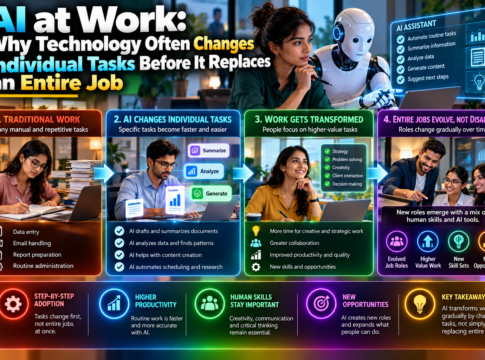
Artificial Intelligence (AI) is reshaping the workplace, but rather than replacing entire jobs, it often transforms individual tasks first. This nuanced evolution was highlighted in a recent discussion with ADP Chief Economist Nela Richardson, as reported by Reuters. Understanding this dynamic is crucial for workers and students aiming to future-proof their careers in an AI-driven world. Key Highlights
  • Publication Date: October 7, 2026, via a Reuters podcast.
  • Interview Format: A discussion with ADP Chief Economist Nela Richardson.
  • Task-Change Argument: AI modifies tasks within jobs before replacing entire roles.
  • Younger-Worker Concerns: Younger employees are more anxious about job security.
  • Experienced-Worker Resilience: Older workers show adaptability to task changes.
  • Evidence Limitations: Interviews provide insights but not causal proof.
What You Will Learn
  • How AI impacts individual tasks within occupations.
  • The distinction between task augmentation and full automation.
  • Exposure of different jobs to automation and AI.
  • The importance of developing complementary skills.
  • Redesigning workflows to integrate AI effectively.
  • Challenges in measuring labour-market changes due to AI.
How and Why It Works A job is a composite of routine, interpersonal, judgment, and physical tasks, each with varying potential for automation. Routine tasks are often the first to be automated, while interpersonal and judgment tasks require human intuition and empathy, making them less susceptible to AI takeover. Physical tasks vary widely in automation potential depending on complexity and context. Practical Applications For workers and students, creating a privacy-conscious task inventory is essential. Identify tasks that are routine and likely to be automated, and focus on developing skills that complement AI, such as critical thinking and emotional intelligence. This proactive approach can help maintain relevance in an evolving job market. Limitations and Misconceptions While interviews like the one with Nela Richardson provide valuable insights, they do not establish causal relationships. The impact of AI varies significantly across different occupations, and no skill set can guarantee employment. It’s crucial to remain adaptable and continuously update skills in response to technological advancements. Learning Takeaways
  • Regularly update your skills to align with technological advancements.
  • Focus on developing interpersonal and judgment skills.
  • Stay informed about AI trends and their impact on your industry.
  • Embrace lifelong learning to enhance career resilience.
In conclusion, while AI at work often changes individual tasks before replacing entire jobs, understanding this process can help you adapt and thrive. By focusing on skill development and staying informed, you can navigate the evolving landscape of AI in the workplace.