
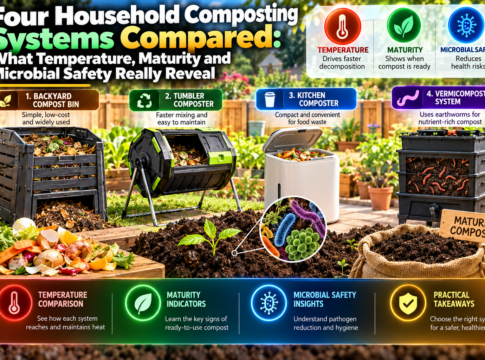

In the quest for sustainable living, household composting has emerged as a pivotal practice. A recent study published in Environmental Science and Pollution Research on October 10, 2026, delves into the intricacies of four distinct food-waste composting systems. This comprehensive analysis sheds light on temperature, maturity, and microbial safety, offering invaluable insights for eco-conscious households.
Key Highlights
– The study compared four composting systems: Traditional Composting, Vermicomposting, Bokashi, and Aerated Static Pile.
– Conducted under replicated conditions to ensure reliability and accuracy.
– Temperature monitoring was crucial, with thermophilic stages observed in all systems except Vermicomposting.
– Chemical analysis focused on carbon-to-nitrogen ratios and pH levels.
– Maturity indicators included color, texture, and odor assessments.
– Microbial testing evaluated pathogen presence and beneficial microbe activity.
– Household relevance emphasized ease of use, space requirements, and maintenance.
What You Will Learn
– The importance of maintaining an optimal carbon-to-nitrogen ratio for effective composting.
– How aeration impacts microbial activity and compost quality.
– The role of moisture in sustaining microbial life and preventing odor.
– Understanding thermophilic stages and their significance in pathogen reduction.
– Indicators of compost stability and maturity for safe application.
– Effective strategies for pathogen reduction to ensure microbial safety.
How and Why It Works
Microbes are the unsung heroes of composting, transforming organic matter into nutrient-rich humus. They thrive in environments with balanced moisture, aeration, and temperature. However, heat alone cannot confirm compost maturity. A combination of physical, chemical, and biological indicators is essential to determine when compost is ready for use.
Practical Applications
– Regularly monitor moisture levels to maintain a damp, not soggy, environment.
– Ensure adequate aeration by turning the compost pile or using aeration tools.
– Implement pest control measures to prevent infestations.
– Use gloves when handling compost to avoid direct contact with pathogens.
– Adhere to local waste management rules to ensure compliance and safety.
Limitations and Misconceptions
While the study provides valuable insights, results can vary based on feedstock, climate, scale, and equipment. It’s crucial to understand that not every home batch will meet safety standards without proper management. Misconceptions about composting, such as the belief that heat alone ensures safety, can lead to improper practices.
Learning Takeaways
– Check for a dark, crumbly texture and earthy smell as signs of readiness.
– Ensure the compost has cooled and stabilized before use.
– Test for pH levels and nutrient content if possible.
– Confirm the absence of recognizable food scraps.
– Verify that the compost has undergone a complete thermophilic phase.
In conclusion, understanding the nuances of household composting systems can significantly enhance their effectiveness and safety. By focusing on key factors such as temperature, maturity, and microbial safety, households can produce high-quality compost that benefits both their gardens and the environment. As we continue to explore sustainable practices, the insights from this study offer a roadmap for successful composting.