
About Us

At Study Tech Next, we’re committed to bringing you insightful, up-to-the-minute content across a spectrum of topics that impact our daily lives.

― Advertisement ―

LVMH’s Luxury Slowdown Shows How Brand Concentration and Regional Demand Can Shape a Global Business

Explore how LVMH's luxury slowdown reveals the impact of brand concentration and regional demand shifts on global business strategies. Learn about the risks of over-reliance on key markets like China and how strategic diversification can mitigate these challenges. Discover insights into maintaining business stability and growth.
HomeNewsBusinessWhy Consumer Sentiment Can Fall Even While Household Spending Continues

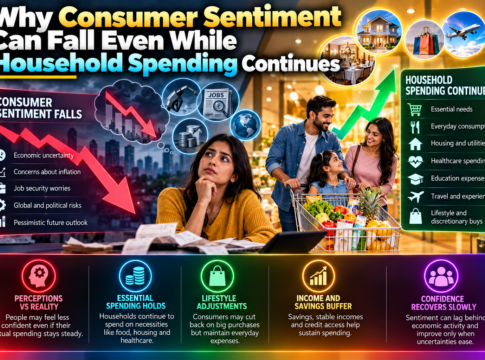
Why Consumer Sentiment Can Fall Even While Household Spending Continues

Consumer sentiment and household spending are two critical indicators of economic health, yet they can often tell different stories. The University of Michigan’s survey results from October 9, 2026, reported by Reuters, reveal a fascinating divergence: consumer sentiment has fallen even as household spending continues. This article explores the reasons behind this phenomenon, focusing on the different experiences of lower- and higher-income households. Key Highlights
  • The University of Michigan survey was conducted on October 9, 2026.
  • The headline index of consumer sentiment fell to 67.2 from 68.1 in September.
  • The current-conditions measure decreased to 70.5, indicating a decline in consumer confidence.
  • Inflation expectations for the year ahead rose to 3.2% from 3.1%.
  • Lower-income households reported more significant financial strain compared to higher-income households.
  • Despite falling sentiment, household spending remains robust, driven by pent-up demand and savings.
  • The data presented is preliminary and subject to revisions.
What You Will Learn
  • Understand the divergence between consumer sentiment indices and actual spending patterns.
  • Explore the sampling methods used in consumer sentiment surveys.
  • Analyze how inflation expectations influence consumer confidence.
  • Examine the wealth effects on spending behavior across different income groups.
  • Learn about the role of disposable income in maintaining spending levels.
  • Gain insights into the relationship between consumer confidence and observed spending trends.
  • Consider the future implications of current economic indicators on household financial planning.
How and Why It Works Consumer sentiment and actual spending can diverge due to several factors. Opinions about the economy are often shaped by media reports, personal financial conditions, and broader economic indicators. However, actual purchases are influenced by immediate needs, available savings, and credit access. For instance, even if consumers feel pessimistic about the economy, they may continue to spend due to necessity or because they have accumulated savings during more prosperous times. Practical Applications Families can benefit from a budget-stress worksheet to navigate economic uncertainties. This tool should cover essentials like housing, food, and utilities, allocate funds for emergency savings, and account for changing prices due to inflation. By regularly reviewing and adjusting their budgets, families can better manage financial stress and maintain spending levels even when sentiment is low. Limitations and Misconceptions It’s important to understand that consumer sentiment surveys measure reported attitudes, not guaranteed future behavior. These surveys can be influenced by temporary factors and should not be interpreted as definitive forecasts. Additionally, avoiding partisan interpretations ensures a more balanced understanding of the data. Learning Takeaways
  • What factors contribute to changes in consumer sentiment?
  • How do inflation expectations affect household spending?
  • In what ways do income levels influence financial perceptions and behaviors?
  • What are the limitations of using sentiment surveys as economic indicators?
In conclusion, while consumer sentiment can fall, household spending may continue due to various economic and personal factors. Understanding these dynamics helps families and policymakers make informed decisions in uncertain times. FAQs Why does consumer sentiment matter? Consumer sentiment is a key indicator of economic health, reflecting how optimistic or pessimistic consumers feel about their financial situation and the economy. How can families manage financial stress during economic uncertainty? By using budget-stress worksheets to prioritize essentials, save for emergencies, and adjust for inflation, families can better navigate financial challenges. What are the future implications of current consumer sentiment trends? If consumer sentiment continues to decline, it could eventually lead to reduced spending, impacting economic growth. Monitoring these trends helps anticipate potential economic shifts.