
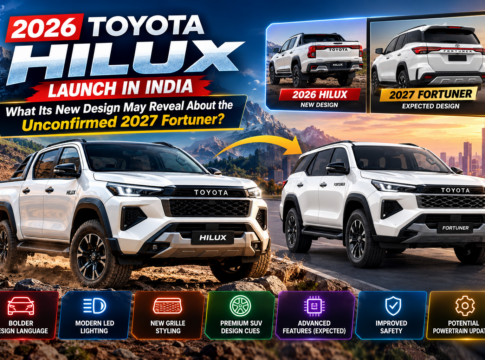

The Toyota Hilux has entered a new generation in India, bringing a redesigned exterior, updated cabin, additional technology and familiar diesel-powered capability.
Toyota officially launched the ninth-generation Hilux in India on July 28, 2026, with ex-showroom prices starting at ₹31.99 lakh.
But the launch has also sparked another interesting question: Could the new Hilux offer an early glimpse of how the next-generation Toyota Fortuner might look?
The connection is understandable. The Hilux pickup and Toyota Fortuner SUV have historically shared Toyota’s Innovative International Multi-purpose Vehicle (IMV) architecture. Their related engineering foundations make comparisons relevant, even though the two vehicles serve different purposes.
CarDekho explored this possibility in its July 30, 2026 article, using AI-generated representational images to imagine a future Fortuner inspired by the latest Hilux.
However, one distinction is essential: the new Hilux is officially launched, while the specific next-generation vehicle described as the “2027 Fortuner” remains unconfirmed in the cited reporting. Its appearance, launch schedule, pricing and powertrain choices should not be treated as established facts.
1. Key Highlights
– Official India launch: Toyota launched the ninth-generation Hilux on July 28, 2026, with bookings opening the same day and deliveries scheduled to begin in the second week of August 2026.
– Three variants and confirmed launch prices: The Double Cab pickup was announced at ₹31.99 lakh for GX 4×2 AT, ₹33.69 lakh for GX 4×4 AT and ₹36.69 lakh for VX 4×4 AT, all ex-showroom.
– Familiar body-on-frame construction: The new Hilux retains Toyota’s IMV architecture, combining a separate structural frame with a pickup body designed for passenger and cargo requirements.
– Diesel engine and automatic gearbox: The India-specification model uses a 2.8-litre, four-cylinder diesel engine producing 150 kW, approximately 204 PS, and 500 Nm, paired with a six-speed automatic transmission.
– Choice of 4×2 and 4×4: Buyers can choose rear-wheel drive or four-wheel drive. Toyota confirms high- and low-range four-wheel-drive modes, an electronic differential lock and Downhill Assist Control for the 4×4 system.
– New styling and cabin: The redesign features a more prominent grille, sharper LED lighting, sculpted bodywork and a refreshed interior with a 12.3-inch infotainment display and connected features.
– Safety equipment: Toyota lists seven airbags, Vehicle Stability Control, ABS with Brake Assist, ISOFIX child-seat anchors, parking assistance, tyre-pressure monitoring and a panoramic-view monitor among the vehicle’s safety technologies. Availability and details should be checked by variant.
– 2027 Fortuner remains speculative: A possible redesigned Fortuner could draw inspiration from the Hilux, but Toyota has not verified the specific 2027 launch, rendered styling, future prices, equipment or electrified powertrains discussed in the supplied CarDekho report.
Confirmed 2026 Toyota Hilux India prices
| Variant | Drivetrain | Transmission | Launch ex-showroom price |
|---|---|---|---|
| GX 4×2 AT | Rear-wheel drive | 6-speed automatic | ₹31.99 lakh |
| GX 4×4 AT | Four-wheel drive | 6-speed automatic | ₹33.69 lakh |
| VX 4×4 AT | Four-wheel drive | 6-speed automatic | ₹36.69 lakh |
Prices are those announced by Toyota on July 28, 2026. They exclude registration, insurance and other on-road charges.
2. What You Will Learn
This article will help you understand:
1. Body-on-frame construction: Why pickups and rugged SUVs often use a separate frame and how that affects load-carrying ability, packaging and ride comfort.
2. Toyota’s IMV platform: How the Hilux and Fortuner can share engineering foundations without being identical vehicles.
3. Pickup versus SUV design: Why an open cargo bed, rear passenger space, suspension tuning and cabin refinement lead to different development priorities.
4. 4×2 and 4×4 drivetrains: How rear-wheel drive differs from four-wheel drive and when additional traction equipment is useful.
5. Low-range gearing and electronic differential locks: How these systems help in suitable off-road conditions, and why correct operation matters.
6. Torque-converter automatic transmissions: How a conventional six-speed automatic transfers engine power and why its behaviour differs from a manual gearbox.
7. Toyota’s design direction: Which visible elements of the latest Hilux could plausibly influence a future Fortuner and why similarities do not guarantee identical styling.
8. Vehicle development and source verification: How product-development cycles, emission requirements, official specifications, media analysis and AI-generated renders should be interpreted.
3. How and Why It Works
Why do the Toyota Hilux and Fortuner share engineering foundations?
The Hilux and Fortuner belong to related branches of Toyota’s body-on-frame vehicle development.
Historically, both have used versions of Toyota’s IMV architecture. This allows Toyota to develop vehicles around related structural and mechanical systems while tailoring each model to different customer needs.
The Hilux is a pickup designed to balance cabin accommodation with an open cargo bed, equipment transport and utility-oriented driving.
The Fortuner is an enclosed SUV developed primarily around passenger transportation, cabin comfort, luggage security and family-oriented use, while retaining the capabilities associated with a rugged SUV.
Because they have related engineering foundations, the arrival of a new Hilux generation naturally attracts attention from Fortuner enthusiasts.
However, a shared platform does not mean both vehicles must share every feature or body panel.
What is body-on-frame construction?
In body-on-frame construction, the vehicle’s main structure includes a separate load-bearing frame to which the body, suspension and other mechanical systems are attached.
This approach differs from a typical passenger-car unibody structure, in which the body and principal load-bearing structure are more closely integrated.
Body-on-frame construction can be useful for vehicles designed around demanding loads, towing and difficult terrain.
However, the actual capability depends on the vehicle’s frame strength, suspension, tyres, brakes, cooling system, gearing and manufacturer-approved ratings.
It does not automatically guarantee superior safety, towing capacity or off-road performance.
Which components can a shared platform support?
A shared architecture may allow related vehicles to use common engineering solutions, including:
- Frame design principles and selected chassis components.
- Engines, transmissions and drivetrain technologies.
- Some steering, braking and electronic systems.
- Manufacturing processes and production tooling.
- Components used in electrical and safety architectures.
Nevertheless, manufacturers can substantially modify a platform for different vehicles.
For example, Toyota confirms that the 2026 Hilux uses double-wishbone front suspension and a leaf-spring rear arrangement. This suits the pickup’s particular engineering requirements.
An SUV based on related architecture can use different rear suspension design, spring rates, damping, wheelbase, cabin mounting and noise-insulation strategies to prioritise passenger comfort.
Therefore, shared architecture is evidence of an engineering relationship, not proof of identical ride quality, equipment or exterior design
What has changed in the 2026 Toyota Hilux design?
Toyota describes the new Hilux styling as a more muscular and contemporary interpretation of its pickup design.
Its official announcement identifies a prominent front end, sculpted bonnet, newly shaped bumper and revised lighting.


Visual references to the launched 2026 Hilux. These are not depictions of a confirmed next-generation Fortuner.
Notable design features include sharper LED headlights, a strong grille treatment, pronounced body surfaces, updated rear lighting and a more modern dashboard layout.
Toyota has also introduced a 12.3-inch infotainment display, wireless smartphone connectivity and additional comfort technologies.
This combination suggests Toyota is continuing to blend the Hilux’s utility-focused character with a more contemporary passenger-vehicle experience.
Could these design ideas influence a future Toyota Fortuner?
This is where confirmed facts end and design analysis begins.
Because the Hilux and Fortuner have historically shared an engineering family, it is reasonable to examine whether a future Fortuner could adopt some of the newest Hilux’s styling themes.
CarDekho’s July 30 analysis illustrated several possibilities using AI-generated images. Those images are visual interpretations, not official Toyota photographs, leaked prototypes or verified production designs.
Possible Hilux-inspired Fortuner design cues include:
Slimmer LED headlights
A future Fortuner could adopt more horizontal and angular headlight units, creating a sharper front appearance.
This is a design possibility rather than a confirmed Toyota feature.
Larger honeycomb-style grille
The new Hilux’s prominent grille makes a larger patterned grille a plausible visual direction for an SUV from the same vehicle family.
However, Toyota could choose a completely different grille design for the Fortuner.
Stronger bumper creases
More sculpted bumper surfaces could produce a muscular appearance consistent with Toyota’s recent rugged-vehicle styling.
Skid-plate-inspired styling
Silver or contrasting lower-bumper elements could reinforce the appearance of an off-road-oriented SUV.
A decorative skid-plate-style panel should not be confused with certified underbody protection.
Sharper rear lighting
A future model might adopt slimmer or more geometric rear lamps. A connected taillamp arrangement is another possibility illustrated in speculative designs, but it is not confirmed.
The important distinction is that these are informed styling possibilities, not equipment specifications or production commitments.
Why the next Fortuner may not look exactly like the Hilux
Even closely related vehicles need different styling solutions.
The Hilux has an open load bed, separate pickup proportions and utility-focused rear packaging.
The Fortuner requires an enclosed body, rear passenger accommodation, luggage space and an SUV-specific tailgate.
Different structural and packaging requirements affect body dimensions, lighting, rear pillars, roof design and exterior proportions.
Toyota may also choose to maintain a distinct identity for the Fortuner rather than replicate the Hilux front end.
A common design language can connect two models visually without making them look alike.
How does the Hilux’s 2.8-litre diesel engine work with its automatic transmission?
The India-specification ninth-generation Hilux uses a 2.8-litre four-cylinder diesel engine producing:
| Specification | Confirmed India-spec Hilux |
|---|---|
| Engine | 2.8-litre four-cylinder diesel |
| Maximum power | 150 kW, approximately 204 PS |
| Maximum torque | 500 Nm |
| Transmission | Six-speed automatic |
| Drive configurations | 4×2 and 4×4 |
| Fuel tank | 80 litres |
| Body configuration | Double Cab |
| Vehicle architecture | IMV body-on-frame |
Engine output and fuel-tank capacity are from Toyota’s July 28, 2026 announcement.
The engine delivers rotational force through an automatic transmission that selects suitable gear ratios.
A conventional torque-converter automatic uses a fluid coupling for smooth power transfer during starting and low-speed manoeuvres. A lock-up clutch can improve efficiency under suitable operating conditions.
This arrangement can be particularly useful when the driver needs controlled low-speed movement or is navigating varied terrain.
However, transmission behaviour and durability depend on calibration, operating conditions and proper maintenance.
What do 4×2, 4×4, low range and differential locks actually mean?
4×2: Engine power is delivered to two wheels. In the Hilux GX 4×2, this is a rear-wheel-drive configuration.
4×4: Power can be distributed to both axles through the four-wheel-drive system, providing additional traction in appropriate conditions.
Low-range transfer case: Low-range gearing multiplies torque at the wheels and enables slower, more controlled movement over demanding terrain.
Electronic differential lock: A locking differential can help when one driven wheel loses traction, subject to the design of the system and operating conditions.
Downhill Assist Control: This assists with controlling vehicle speed during certain descents.
These systems are not substitutes for appropriate tyres, terrain assessment, driver training or manufacturer instructions.
In particular, low-range and differential-lock systems should be engaged only in the conditions permitted by the owner’s manual. Incorrect use can stress drivetrain components and compromise control.
Could future emission rules encourage hybrid Fortuner powertrains?
Yes, as an industry-level possibility.
Stricter emissions and efficiency requirements can encourage manufacturers to combine combustion engines with electric assistance or adopt more highly electrified drivetrains.
For a vehicle such as the Fortuner, several technical pathways could be considered.
A diesel mild-hybrid system might use a small electric motor-generator to assist selected engine functions.
A strong-hybrid system could allow more substantial electric assistance and, depending on its design, limited electric-only driving.
A plug-in hybrid would require a larger externally rechargeable battery and a suitably engineered drivetrain.
A fully electric off-road SUV would need an entirely appropriate battery, motor, thermal-management and underbody-protection architecture.
None of these options is confirmed as the powertrain for a specific next-generation 2027 Fortuner in the supplied report.
Toyota’s broader experience with electrification, or the availability of certain Hilux powertrains in other markets, does not establish what Toyota will launch in India under the Fortuner name.
4. Practical Applications
Should you buy the 2026 Toyota Hilux or consider the current Fortuner?
The answer depends more on how you intend to use the vehicle than on whether the two models share a platform.
The Hilux is primarily a Double Cab pickup with a separate cargo bed. The Fortuner is an enclosed SUV designed around passenger transport, luggage protection and family travel.
Neither body style is automatically better for every buyer.
Toyota Hilux vs Fortuner: practical buying comparison
| Buying consideration | 2026 Toyota Hilux | Currently available Fortuner |
|---|---|---|
| Primary purpose | Pickup utility and lifestyle use | Passenger-focused SUV use |
| Passenger accommodation | Double Cab, two seating rows | Enclosed SUV cabin with additional passenger accommodation |
| Cargo requirements | Separate open cargo bed | Enclosed luggage compartment |
| City manoeuvrability | Consider pickup length and parking space | Consider SUV dimensions and turning requirements |
| Towing and loads | Check variant-specific certified ratings | Check variant-specific certified ratings |
| 4×4 capability | Available on GX 4×4 and VX 4×4 | Depends on the selected Fortuner variant |
| Ground clearance | Verify current brochure measurement | Verify current brochure measurement |
| Cabin comfort | Test rear-seat ride and noise levels | Test seating, suspension and highway refinement |
| Fuel and maintenance | Evaluate actual ownership costs | Evaluate actual ownership costs |
| Insurance | Obtain a variant-specific quotation | Obtain a variant-specific quotation |
| Service support | Verify local Toyota service availability | Verify local Toyota service availability |
| Resale considerations | Assess local demand and ownership condition | Assess local demand and ownership condition |
This table compares vehicle purposes rather than declaring a winner. Prices, specifications and equipment should be checked against current Toyota documentation.
Who might find the Hilux more suitable?
The Hilux may be worth considering for buyers who regularly need to transport equipment, carry cargo in a separate load bed or travel over terrain where appropriate four-wheel-drive capability is beneficial.
Its Double Cab configuration allows passenger use alongside pickup functionality.
However, the cargo bed requires consideration of weather protection, load restraint, theft prevention and safe weight distribution.
A pickup’s ability to carry equipment does not mean any load or trailer is safe. Buyers should follow the manufacturer’s limits.
Who might prefer the current Fortuner?
A Fortuner may better suit buyers who prioritise an enclosed passenger cabin, additional seating, protected luggage space and SUV-style family transportation.
However, the specific comfort, safety and drivetrain advantages of any Fortuner depend on the selected variant.
A practical decision should be based on the actual vehicle, not solely on its reputation or exterior appearance.
What should buyers check during a test drive?
A meaningful test drive should include the types of driving that the owner normally encounters.
Buyer Evaluation Checklist
Review resale conditions without assuming future value.
Check front and rear passenger comfort.
Assess vehicle dimensions and parking visibility.
Test low-speed driving and turning.
Evaluate suspension comfort on ordinary roads.
Inspect cargo or luggage usability.
Verify safety features for the exact variant.
Review official ground clearance and load ratings.
Check expected fuel and scheduled maintenance costs.
Obtain an itemised on-road price quotation.
Confirm warranty and authorised service availability.
Check insurance coverage and exclusions.
The driver should assess braking response, steering effort, visibility, seating comfort and transmission behaviour in safe, normal road conditions.
For an off-road demonstration, use a permitted location, follow the manufacturer’s instructions and obtain appropriate training or professional supervision.
Do not test differential locks or low-range systems aggressively on public roads.
Why you should verify dealer pricing
Toyota’s ₹31.99 lakh, ₹33.69 lakh and ₹36.69 lakh figures are July 28, 2026 launch ex-showroom prices.
The actual amount payable can include road tax, registration, insurance, accessories and other applicable charges.
Dealer quotations can also change with location, stock availability, policy changes and manufacturer pricing revisions.
Before booking, request a written quotation showing the exact variant, model year, warranty, insurance details and delivery conditions.
You can begin with Toyota India’s official website.
Should you wait for the unconfirmed 2027 Fortuner?
Waiting solely because of an unconfirmed launch timeline creates uncertainty.
A buyer who needs a vehicle now should evaluate the existing Hilux and Fortuner using verified specifications, available test vehicles and actual prices.
Waiting may be reasonable for someone whose purchase is flexible and who specifically wants to assess Toyota’s next official Fortuner announcement.
However, there is currently no verified basis in the cited report for guaranteeing that a new Fortuner will launch in 2027, offer a particular engine or arrive at a particular price.


5. Limitations and Misconceptions
What has Toyota officially confirmed?
Toyota has officially confirmed the ninth-generation Hilux’s July 28, 2026 India launch, its three announced automatic variants, prices, engine specifications, IMV architecture and several safety, convenience and drivetrain features.
Toyota’s launch release does not establish the exterior styling, launch date, pricing, features or electrified powertrain specifications of the particular future Fortuner imagined in the CarDekho article.
What remains unconfirmed about the 2027 Toyota Fortuner?
| Claim | Verification status |
|---|---|
| Ninth-generation Hilux launched in India | Confirmed |
| New Hilux uses IMV architecture | Confirmed |
| Hilux has a 2.8-litre diesel engine | Confirmed |
| Hilux and Fortuner have historically shared IMV foundations | Established vehicle relationship |
| Next-generation Fortuner launches in 2027 | Unconfirmed |
| Future Fortuner copies the Hilux grille | Speculative |
| Future Fortuner gets connected rear lamps | Speculative |
| Future Fortuner receives a strong-hybrid engine | Unconfirmed |
| Future Fortuner receives a plug-in hybrid | Unconfirmed |
| Future Fortuner receives an electric version | Unconfirmed |
| Future Fortuner pricing and full features | Unconfirmed |
| CarDekho’s renders show a production Fortuner | Incorrect — representational images |
Misconception 1: Platform sharing means both vehicles will look the same
Shared vehicle architecture does not require shared exterior panels or identical proportions.
Manufacturers often use common mechanical foundations for vehicles that have substantially different cabins, suspension systems and exterior designs.
The Hilux and Fortuner may share engineering ideas while following different design priorities.
Misconception 2: AI-generated images are leaked Toyota photographs
CarDekho explicitly identifies the images accompanying its article as AI-generated representations.
They are illustrations of a possible direction, not authenticated prototype photographs or Toyota-approved production designs.
Readers should not use these renders to make assumptions about confirmed equipment or pricing.
Misconception 3: International Hilux specifications automatically apply in India
Toyota sells the Hilux in multiple markets, and available configurations can differ.
A feature announced for an overseas Hilux, including an electric drivetrain or particular assistance technology, should not be assumed to be part of the India-specification vehicle.
The Indian launch announcement and variant-specific brochure should take priority when assessing vehicles sold in India.
Misconception 4: A new-generation model guarantees better performance in every area
Generational changes can improve certain aspects of a vehicle without improving everything.
A new model may become more comfortable, technologically advanced or efficient, while also introducing different pricing, repair complexity or maintenance requirements.
Each claim should be assessed with specifications and real-world testing.
Misconception 5: A future hybrid Fortuner is already confirmed
Electrification is a reasonable subject for industry analysis because manufacturers face evolving emissions, efficiency and customer requirements.
However, the CarDekho discussion does not establish a confirmed diesel mild-hybrid, strong-hybrid, plug-in-hybrid or electric version of a next-generation Fortuner.
Specific configurations require official verification.
How to assess different automotive information sources
Toyota’s official releases are primary evidence for announced Indian products, while recognised automotive publications can provide useful independent reporting and vehicle testing.
CarDekho’s article is relevant as design analysis, but its hypothetical Fortuner renders must be interpreted as illustrations.
Social-media posts, anonymous leaks and unsupported pricing claims should be treated with substantially greater caution.
Frequently Asked Questions
1. Has Toyota officially confirmed a 2027 Fortuner?
The supplied July 30, 2026 CarDekho report does not establish an official Toyota announcement confirming a next-generation Fortuner launch in 2027. The date remains speculative in this context.
2. Are the new Fortuner images genuine Toyota production photographs?
No. CarDekho identifies its images as AI-generated representations. They should not be presented as official Toyota designs or leaked production photographs.
3. Do the Hilux and Fortuner use the same platform?
They have historically used related versions of Toyota’s IMV body-on-frame architecture. However, this does not mean every chassis component, suspension arrangement or safety feature is identical.
4. Is the 2026 Hilux officially available in India?
Yes. Toyota officially launched the ninth-generation Hilux in India on July 28, 2026, announcing three automatic variants with ex-showroom prices starting at ₹31.99 lakh.
5. Will the next Fortuner definitely have a hybrid engine?
No. A particular next-generation hybrid configuration has not been confirmed in the supplied report.
6. Will Toyota introduce an electric Fortuner?
An electric Fortuner is an unconfirmed possibility, not an announced Indian production model in the evidence examined here.
7. Is the 2026 Hilux available with a manual gearbox in India?
Toyota announced the three launch variants with a six-speed automatic transmission. Buyers should check the latest official variant list for subsequent changes.
8. Does a 4×4 Hilux automatically have better fuel economy than a 4×2 version?
No such conclusion follows from the drivetrain designation. Fuel use depends on vehicle configuration, driving conditions, load, tyres and other factors. No unverified mileage figures should be relied upon.
9. Should buyers wait for the 2027 Fortuner?
Buyers with an immediate requirement should make decisions using confirmed and available products. Those who can postpone their purchase may choose to follow official announcements, but the expected launch timing and specifications remain uncertain.
6. Learning Takeaways
What the 2026 Toyota Hilux can realistically tell us about the future Fortuner
The new Hilux provides evidence that Toyota continues to develop its rugged, body-on-frame vehicles with updated exterior styling, improved cabin technology and established mechanical foundations.
Its new lighting, grille proportions, interior displays and driver-assistance equipment offer useful clues about technologies and design approaches Toyota may consider across related vehicle families.
However, the Hilux is not an official preview of the next Fortuner.
A future SUV could incorporate some ideas, use different solutions or follow an entirely distinct design direction.
Confirmed versus speculative: how to evaluate future Fortuner news
| Information | How to verify it | What it establishes |
|---|---|---|
| Official Toyota announcement | Toyota newsroom or official product pages | Announced product information |
| Homologation or regulatory record | Relevant authorised government database | Specific approval or technical filing |
| Verified specifications | Official brochure and technical documentation | Declared vehicle configuration |
| Dealer information | Written information from authorised dealers | Current availability and commercial details |
| Test vehicles | Authenticated, dated photographs or reporting | Evidence that a vehicle is being tested, not final specifications |
| Reliable media reports | Identified sources and corroborated reporting | Reported developments with stated limitations |
| AI-generated renders | Clear illustration or AI-image disclosure | A hypothetical visual concept |
| Social-media claims | Traceable primary evidence | Unverified until corroborated |
A test vehicle photographed on public roads may show that development work is underway, but camouflage can conceal its design and mechanical configuration.
Similarly, regulatory records can support specific technical findings without necessarily establishing a retail launch date.
What should readers revisit after an official Fortuner announcement?
When Toyota eventually releases authoritative next-generation Fortuner information, readers should verify the following:
- Confirmed model name and launch date.
- Indian variant structure and ex-showroom prices.
- Platform and construction details.
- Engine choices and emissions compliance.
- Transmission and drivetrain combinations.
- Four-wheel-drive and off-road equipment.
- Passenger seating, cargo capacity and dimensions.
- Suspension and ride-comfort improvements.
- Safety systems and relevant crash-test results.
- Warranty, servicing and ownership costs.
- Confirmed electrification features, if any.
Only after these details become available will it be possible to make a meaningful specification-by-specification comparison with the 2026 Hilux and the existing Fortuner.
Could diesel, hybrid and electric off-road vehicles coexist?
Several propulsion technologies may continue to serve different customer needs.
Diesel engines can remain relevant where high torque, refuelling access, extended journeys and demanding use cases are important. Their future viability will depend partly on emissions regulations and market requirements.
Diesel mild-hybrid systems may offer limited electric assistance and efficiency improvements without necessarily enabling meaningful electric-only driving.
Strong hybrids may allow greater electric assistance and, depending on their design, some driving under electric power.
Plug-in hybrids can combine a combustion engine with externally rechargeable energy storage, but introduce additional battery mass, packaging requirements and charging considerations.
Battery-electric off-road vehicles eliminate tailpipe emissions during operation, but require appropriate consideration of charging access, vehicle weight, battery protection, energy use and remote-area operation.
None of these technologies is universally superior for all applications.
And none should be presented as a confirmed next-generation Fortuner drivetrain without an official Toyota announcement.
Final Verdict: What the Hilux launch really reveals
Toyota’s July 28, 2026 Hilux launch is an established product development, not a rumour.
The ninth-generation pickup combines a redesigned exterior and cabin with a familiar 2.8-litre diesel engine, six-speed automatic gearbox and IMV body-on-frame architecture.
Its styling provides a credible starting point for discussing what Toyota could do with a future Fortuner.
But the possibility of shared design ideas should never be confused with proof of a confirmed 2027 Fortuner.
For current buyers, the most useful approach is to compare available vehicles against real transportation needs, check official specifications and take thorough test drives.
For enthusiasts, the Hilux offers an interesting indication of Toyota’s evolving approach to rugged-vehicle design.
The definitive answer about the next-generation Fortuner’s appearance, powertrain, equipment and launch date must come from Toyota itself.