
About Us

At Study Tech Next, we’re committed to bringing you insightful, up-to-the-minute content across a spectrum of topics that impact our daily lives.

― Advertisement ―

A Cell-by-Cell Map of Cadmium Defense in Alfalfa: What Single-Nucleus Data Reveal

Discover how cutting-edge single-nucleus sequencing reveals alfalfa's cellular defense against cadmium, offering insights into gene expression and chromatin accessibility. Uncover key mechanisms of heavy-metal stress responses and potential pathways for resilient crops. Read on to explore these groundbreaking findings.
HomeNewsTechCodeQL 2.27.2 Shows How Static Analysis Finds Language-Specific Security Problems Before Software...

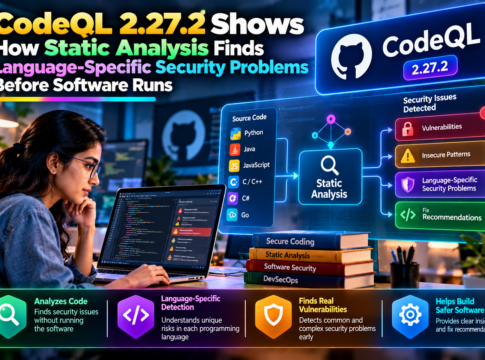
CodeQL 2.27.2 Shows How Static Analysis Finds Language-Specific Security Problems Before Software Runs

In the ever-evolving landscape of software development, ensuring security before deployment is crucial. GitHub’s latest update, CodeQL 2.27.2, released on October 9, 2026, offers a robust solution for identifying language-specific security problems through static analysis. This article delves into how CodeQL 2.27.2 enhances security measures for C++, Go, Rust, and JavaScript, providing developers with a powerful tool to detect vulnerabilities before software runs. Key Highlights
  • Release Date: October 9, 2026
  • Enhanced C++ regular-expression parsing for improved accuracy
  • Significant language-analysis improvements for Go, Rust, and JavaScript
  • Updated query packs to streamline security checks
  • Plays a critical role in code scanning and vulnerability detection
  • Compatibility with existing CI/CD pipelines
  • Gradual rollout to ensure seamless integration
What You Will Learn
  • Understanding static analysis and its role in security
  • How code databases are constructed for analysis
  • Insights into data flow and taint tracking mechanisms
  • Crafting effective queries to identify vulnerabilities
  • Minimizing false positives in security alerts
  • Utilizing language parsers for precise analysis
  • Integrating continuous analysis into CI workflows
How and Why It Works CodeQL translates source code into a queryable representation, allowing security rules to trace potentially unsafe paths without executing the program. This static analysis approach enables developers to identify vulnerabilities early in the development cycle, ensuring that security issues are addressed before deployment. Practical Applications Developers can leverage CodeQL 2.27.2 to establish a defensive workflow. By using sample repositories and pinned tool versions, they can generate reviewable alerts and conduct thorough tests. Implementing least-privilege CI permissions further enhances security, ensuring that only necessary access is granted during the analysis process. Limitations and Misconceptions While static analysis is a powerful tool, it cannot prove a program is entirely secure. Coverage varies by language and configuration, and alert suppression requires careful review to avoid overlooking genuine issues. Understanding these limitations is crucial for effective use of CodeQL. Learning Takeaways
  • Adopt a code-scanning checklist to ensure comprehensive security coverage
  • Regularly update query packs to maintain effectiveness
  • Integrate CodeQL into CI/CD pipelines for continuous security monitoring
  • Review and refine security alerts to minimize false positives
  • Stay informed about updates and improvements in static analysis tools
In conclusion, CodeQL 2.27.2 represents a significant advancement in static analysis, offering developers a powerful means to detect language-specific security problems before software runs. By integrating this tool into their workflows, developers can enhance their security posture and build safer software.