
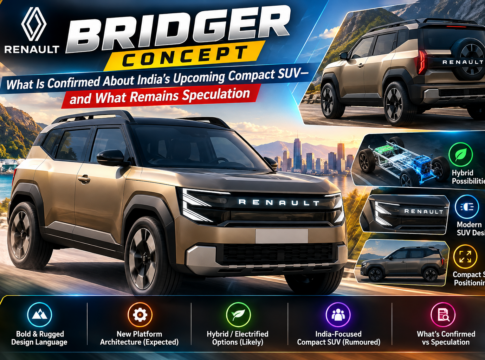

India’s compact SUV market could soon welcome an interesting new entrant from Renault. Its Renault Bridger Concept combines a boxy silhouette, elevated stance, tailgate-mounted spare wheel and an exterior measuring less than four metres.
At first glance, the Bridger resembles a miniature adventure SUV. But beneath its rugged appearance lies a more practical engineering question: Can Renault create a city-friendly compact vehicle that offers useful passenger space, a generous boot and the visual character of a larger SUV?
Renault revealed the Bridger Concept during its March 2026 futuREady strategy presentation. The concept previews a future production vehicle being developed with India as a key market.
Renault says the concept provides 200 mm of rear knee room and 400 litres of boot capacity, despite its compact dimensions. The company also intends to use India as the initial market for a production model before expanding to other international regions.


Renault Bridger Concept, revealed in March 2026. These images show the concept vehicle, not a final production SUV.
However, there is an important difference between what Renault has officially presented and what automotive websites expect.
CarWale lists an estimated ex-showroom price of ₹6–10 lakh and a tentative March 2027 launch. Neither figure represents a confirmed Renault retail announcement. Renault’s broader strategy instead points towards production and an India-first rollout in 2027, with official communication referring to a launch by the end of that year.
Let’s examine what the Bridger genuinely reveals about Renault’s plans and which details buyers should continue treating as possibilities.
– Official March 2026 reveal: Renault announced the Bridger name on March 4 and publicly revealed the show car on March 10, 2026, during its international strategy presentation.
1. Key Highlights
– A concept, not a dealership-ready vehicle: The Bridger is a design and packaging preview of a future compact SUV. Renault has not yet released a complete final Indian production specification or retail variant list.
– Sub-four-metre exterior: Renault officially describes the concept as measuring less than four metres in length, making it relevant to India’s compact urban SUV segment.
– Space-focused packaging: Renault claims 200 mm of rear knee room and 400 litres of boot capacity for the concept. These are concept-specific figures and must not automatically be applied to the future production model.
– Rugged styling: The displayed show car has upright proportions, squared-off bodywork, high ground clearance, prominent 18-inch wheels and a spare wheel mounted on the tailgate. Renault’s Indian concept page confirms these design characteristics.
– India-centred development and production: Renault’s strategy identifies India as the first market for the planned production vehicle. Reuters reported that production is targeted to start in 2027, followed by expansion to international markets.
– Expected price and launch remain provisional: CarWale estimates ₹6–10 lakh ex-showroom and displays March 2027 as a tentative launch date. Renault’s own strategy communication points to an India introduction by the end of 2027, so March should not be treated as confirmed.
– Multiple powertrain possibilities: Renault’s broader product roadmap refers to combustion, hybrid and electric variants depending on the market. However, no final India-specific engine output, battery capacity, EV range, transmission, AWD configuration or trim-level equipment list has been established in the cited official concept material.
Renault Bridger Concept: confirmed versus expected specifications
| Detail | Available information | Verification status |
|---|---|---|
| Name | Renault Bridger Concept | Official show-car name |
| First public reveal | 10 March 2026 | Confirmed |
| Body style | Compact urban SUV concept | Confirmed |
| Length | Under 4 metres | Confirmed for concept |
| Rear knee room | 200 mm | Renault concept claim |
| Boot capacity | 400 litres | Renault concept claim |
| Wheels | 18-inch concept wheels | Confirmed for concept |
| Spare wheel | Tailgate-mounted | Confirmed concept design |
| Ground clearance | High-riding concept; approximately 200 mm reported elsewhere | Final production figure unconfirmed |
| Production | Targeted for 2027 in India | Announced plan, not completed production |
| March 2027 launch | CarWale tentative listing | Unconfirmed |
| Price | ₹6–10 lakh estimated ex-showroom | Unconfirmed |
| Petrol, hybrid or electric versions | Renault’s planned multi-energy direction | Market-specific versions unconfirmed |
| AWD availability | Discussed in automotive reporting | Unconfirmed |
| Safety and ADAS features | Final production equipment not published | Unconfirmed |
Important distinction: A manufacturer’s announced production plan is stronger evidence than an independent price estimate. However, an announced plan is still not proof that manufacturing or customer deliveries have begun.
2. What You Will Learn
This article explains eight essential ideas about the Bridger and the compact SUV market.
1. Concept versus production vehicle: Why manufacturers reveal show cars and which features can change before a model reaches dealerships.
2. Sub-four-metre engineering: How compact vehicle dimensions affect cabin layout, boot space, turning requirements and urban usability.
3. Interior packaging: How seat position, roofline, wheelbase and other design choices influence usable passenger space.
4. Urban SUV design: Why a high seating position, upright body and rugged exterior do not necessarily indicate serious off-road capability.
5. Monocoque versus body-on-frame construction: How these different vehicle structures affect packaging, weight and engineering priorities.
6. AWD, 4WD and ground clearance: Why driven wheels, traction systems, tyre choice and underbody geometry matter more than styling alone.
7. Vehicle development and homologation: How a show car evolves through engineering validation, manufacturing preparation, regulatory approval and safety testing.
8. Evidence-based buying: How to distinguish Renault’s official statements from media estimates, rendered images, provisional specifications and unsupported rumours.
3. How and Why It Works
What exactly is the Renault Bridger Concept?
A concept car is a vehicle used to demonstrate a manufacturer’s design intentions, technical ideas or vision for a future product.
Some concepts are experimental vehicles with little connection to production. Others closely preview models that eventually reach customers.
The Bridger belongs to the second general category: Renault has specifically presented it as a forerunner to a future compact SUV.
That makes its design relevant, but not final.
Renault can use the concept to demonstrate intended proportions, assess public response and communicate its plans for a new vehicle category.
At the same time, the eventual production version must meet engineering, regulatory, financial and manufacturing requirements that may lead to substantial changes.
Why the Bridger’s sub-four-metre size matters
At less than four metres in length, the concept targets a part of the market where compact exterior dimensions are especially useful.
A smaller vehicle can be easier to position in tight parking spaces and narrow city streets, although turning radius, width, steering geometry and visibility also matter.
The Bridger’s visual approach is distinctive because it combines compact length with a comparatively upright body.
Instead of relying entirely on sweeping rooflines and rounded surfaces, its concept design uses a boxier form intended to convey useful cabin space and SUV character.
How can a small SUV provide 400 litres of boot space?
Interior packaging is about how effectively a manufacturer uses the space inside a vehicle.
Several design decisions can influence the usable cabin and luggage volume:
- Wheelbase and axle placement.
- Engine-bay length and mechanical packaging.
- Dashboard depth.
- Seat structure and thickness.
- Rear-seat positioning.
- Roof height and tailgate geometry.
- Spare-wheel storage location.
- Fuel tank, battery and suspension packaging.
The Bridger Concept’s exterior spare-wheel arrangement may help avoid placing the spare beneath the luggage floor, but Renault has not established how the final production vehicle will package every component.
The official 400-litre capacity is an encouraging concept target, not a confirmed figure for a production variant.
Similarly, 200 mm of rear knee room is a particular interior-space measurement. It does not mean the vehicle has 200 mm more legroom than every competing SUV.
Actual passenger comfort also depends on headroom, thigh support, foot space, seat shape and the position of the front seats.
Why does the Bridger look so rugged?
The concept uses a number of recognizable SUV design elements.
Upright body proportions: The relatively vertical surfaces and squared-off silhouette give the vehicle a more traditional SUV appearance.
Bold front styling: A strong grille treatment and angular lighting help distinguish the Bridger from softer-looking urban crossovers.
Prominent wheel arches: The substantial wheel-arch surrounds reinforce the vehicle’s muscular appearance.
18-inch wheels: The large concept wheels contribute to its visual stance. Their final size, tyre profile and construction may change for production.
High ground clearance: The concept is presented as having a raised stance suitable for conveying everyday versatility.
Tailgate-mounted spare wheel: This provides a recognizable rugged-SUV visual cue and influences the design of the rear door.
None of these exterior features, taken individually, proves that the eventual vehicle will have a low-range transfer case, locking differentials or tested off-road capability.
Why might the production SUV look different?
Turning a concept into a production vehicle requires engineers to balance styling with real-world constraints.
For example, dramatic concept headlights may need revised assemblies to meet lighting regulations and durability requirements.
Similarly, large wheels may be replaced or supplemented by smaller wheel sizes to balance tyre cost, ride comfort, efficiency and pothole resistance.
Other components that could change include:
- Front and rear bumpers to meet crash and pedestrian-protection requirements.
- Door handles and mirrors to meet durability and visibility needs.
- Wheel-arch cladding for manufacturing and repairability.
- Underbody protection and structural reinforcements.
- Seats, dashboard materials and infotainment equipment.
- Roof structures and occupant-protection systems.
- Tailgate hinges and mechanisms supporting a rear-mounted spare wheel.
Manufacturing feasibility is another factor. Components must be capable of being produced consistently, serviced appropriately and supplied at an acceptable cost.
Consequently, a production Bridger may retain the concept’s overall personality without reproducing every visible detail.
Monocoque versus body-on-frame: which structure will it use?
A monocoque, or unibody, vehicle integrates much of the body structure into the primary load-bearing assembly.
This approach is widely used in modern passenger cars and urban SUVs because it can support efficient packaging and weight management.
Body-on-frame construction uses a separate structural frame, with the body mounted to it. It is associated with various pickups and utility-oriented off-road vehicles.
However, the exterior appearance cannot establish which construction type a car uses.
Renault’s broader strategy identifies the RGMP small modular platform for the Bridger-related production programme. This points towards a modern modular vehicle architecture rather than proving that the Bridger will be a traditional ladder-frame off-roader.
The final production model’s precise body structure, suspension and drivetrain should be verified when Renault publishes its technical specifications.
AWD versus 4WD: why the difference matters
AWD, or all-wheel drive, generally refers to systems capable of distributing propulsion to both axles, sometimes automatically.
4WD, or four-wheel drive, is a broader term that often describes selectable systems in utility vehicles, including arrangements designed for demanding terrain.
Actual systems vary considerably, and the names alone do not reveal their capabilities.
For challenging off-road use, important technical factors can include low-range gearing, differential control, traction calibration, wheel articulation, approach and departure angles, tyres and underbody protection.
CarWale has discussed possible AWD capability for the Bridger. However, Renault has not confirmed an India-production AWD version through the cited concept pages.
What does ground clearance tell buyers?
Ground clearance describes the vertical distance between the ground and a specified low point beneath the vehicle, using a stated measurement condition.
Figures can vary depending on whether they are measured with or without load.
More ground clearance may help reduce contact with certain obstacles, but it does not automatically guarantee off-road capability.
A vehicle with good ground clearance can still struggle if it has unsuitable tyres, insufficient traction or vulnerable underbody components.
Although automotive reporting has described the concept with approximately 200 mm of ground clearance, Renault’s supplied Indian concept page highlights high ground clearance without publishing the final production measurement.
Buyers should await the official unladen and, where provided, laden ground-clearance specifications.
Why India’s vehicle-size and taxation rules matter
India’s tax framework can influence how manufacturers engineer compact cars and SUVs.
Under the September 2025 GST changes described by the Government of India, qualifying small petrol, LPG or CNG cars with engines up to 1,200 cc and lengths up to 4,000 mm fall within the 18% small-car GST category. The corresponding diesel-engine threshold is 1,500 cc, subject to the stated classification conditions.
Other vehicles can fall into different tax categories. A sub-four-metre body alone does not establish eligibility for a particular tax rate, especially for hybrid or electric variants.
The Bridger’s compact length is therefore commercially relevant, but its final GST treatment will depend on its certified dimensions, powertrain specifications and the rules applicable when it reaches sale.
Could petrol, hybrid and EV versions share engineering?
Renault’s wider international strategy refers to combustion, hybrid and electric options for the model family depending on the market.
A modular platform can potentially support different powertrains through related body structures and selected shared components.
However, each version may require different engineering.
A petrol model needs fuel storage, engine cooling and an exhaust system.
A hybrid additionally needs electric propulsion components, high-voltage electronics and battery packaging.
A battery-electric version needs substantially different energy storage, electrical protection, thermal management and charging hardware.
These differences can affect weight, boot space, ride height, suspension calibration and crash structures.
Although multi-energy development is part of Renault’s stated direction, that does not mean a petrol engine of a particular displacement, a hybrid system with specific output or an EV with a particular range has been confirmed for India.
4. Practical Applications
Renault Bridger vs compact SUV rivals: what should buyers compare?
The production Bridger is expected to enter a crowded Indian market that already offers several different interpretations of the compact SUV.
Some competitors focus on urban practicality. Others prioritise passenger comfort, cabin features or rough-road ability.
The Renault Kiger, Tata Nexon, Maruti Suzuki Brezza, Hyundai Venue, Kia Sonet and Mahindra XUV 3XO are useful comparisons.
The Maruti Suzuki Jimny and Mahindra Bolero Neo are relevant when discussing the difference between rugged styling and utility-oriented engineering.
However, these vehicles do not all have identical purposes or body construction.
Practical competitor comparison
| Model | General positioning | Buyer considerations |
|---|---|---|
| Renault Bridger production SUV | Future compact urban SUV | Final dimensions, price, powertrain and safety information pending |
| Renault Kiger | Compact urban crossover | Current pricing, passenger packaging and Renault service access |
| Tata Nexon | Compact family SUV | Variant-specific safety equipment, powertrain and cabin usability |
| Maruti Suzuki Brezza | Compact urban family SUV | Passenger comfort, service convenience and running costs |
| Hyundai Venue | Feature-focused compact SUV | Cabin technology, available safety equipment and powertrain choices |
| Kia Sonet | Compact SUV with varied equipment | Variant differences, rear-seat comfort and ownership budget |
| Mahindra XUV 3XO | Compact SUV emphasising cabin and performance options | Rear-seat space, engine choices and safety equipment |
| Maruti Suzuki Jimny | Body-on-frame 4WD SUV | Low-range capability, compact dimensions and road comfort |
| Mahindra Bolero Neo | Utility-oriented body-on-frame SUV | Passenger and utility requirements, ride behaviour and drivetrain |
This table compares established vehicle categories and buying considerations, not unverified numerical specifications.
The Bridger’s final position within this group will depend on its actual production price, equipment and mechanical configuration.
Does the Bridger compete with the Renault Kiger?
The Bridger is expected to complement Renault’s compact SUV range rather than simply duplicate the Kiger.
The Kiger already serves buyers seeking an urban crossover with compact dimensions.
By comparison, the Bridger Concept suggests a more upright design and a stronger visual emphasis on SUV character.
That could appeal to buyers who prefer a boxier shape and elevated seating position.
But the eventual differences in passenger space, boot capacity, engine choice and pricing cannot be established until the production model is announced.
The concept’s appearance alone does not demonstrate that the Bridger will be more spacious, more capable or better value than the Kiger.
How does it compare with the Maruti Suzuki Jimny?
The Jimny provides a useful contrast because its rugged appearance is supported by a body-on-frame structure and a dedicated four-wheel-drive system with low-range gearing.
The Bridger Concept also looks rugged, but Renault has not verified comparable off-road hardware for its final production vehicle.
Therefore, a Bridger with large wheels and a rear-mounted spare would not automatically be an alternative to the Jimny for demanding off-road use.
For buyers who regularly drive on challenging terrain, mechanical capability and manufacturer-approved operating limits matter more than appearance.
What should city buyers prioritise?
Urban buyers should evaluate more than exterior length.
A compact SUV must also be convenient to park, comfortable over broken roads and easy to drive through traffic.
Important practical factors include visibility, turning radius, steering effort, brake response and rear-seat access.
A raised driving position may improve the driver’s view of some surroundings, but large pillars, spare-wheel placement and other body features can also create blind spots.
Rear parking assistance, mirrors and camera systems should be assessed on the actual production vehicle.
What about boot space and passenger comfort?
Renault’s concept claim of 400 litres is promising for a vehicle shorter than four metres.
However, the final boot may differ because of changes to seats, suspension components, fuel storage, batteries or the spare-wheel arrangement.
Buyers should check whether the luggage area can accommodate their everyday needs.
For example, a family might want to test the space using actual suitcases, a folded stroller or other regularly carried items.
Similarly, the claimed 200 mm of rear knee room should be considered alongside headroom, shoulder room, seat cushioning and entry-and-exit convenience.
A showroom inspection and test drive will ultimately provide more useful information than a concept-only space claim.
Neutral buyer evaluation checklist
Before comparing the Bridger with an available SUV, review these points:
- Check the official ex-showroom price and city-specific on-road quotation.
- Measure parking space and assess urban manoeuvrability.
- Test front and rear passenger comfort.
- Inspect usable boot space and loading height.
- Verify the final ground-clearance measurement.
- Confirm the drivetrain and whether AWD is actually offered.
- Compare officially certified fuel efficiency or EV range, as applicable.
- Examine standard and optional safety equipment.
- Check independent crash-test results for the relevant vehicle specification.
- Confirm authorised service centres and spare-parts availability.
- Compare scheduled maintenance costs and insurance premiums.
- Review the warranty for the vehicle and any hybrid or EV battery.
- Test visibility, braking, steering and ordinary-road ride comfort.
- Check whether the vehicle’s capability suits its intended terrain.
- Obtain a written delivery estimate and booking-cancellation terms.
Should buyers wait for the Renault Bridger?
This depends on when a vehicle is needed.
Anyone who needs a car immediately should evaluate SUVs that are already available, using confirmed prices, specifications and test-drive experience.
Waiting only because of CarWale’s tentative March 2027 date would involve uncertainty, particularly because Renault’s published roadmap points towards an introduction by the end of 2027.
Buyers with flexible purchase plans may choose to follow the Bridger’s development and compare it when Renault releases official specifications.
However, there is no verified basis for promising that it will offer a particular price, engine, hybrid option or off-road system.
5. Limitations and Misconceptions
Which Renault Bridger details are officially confirmed?
Renault has confirmed that the Bridger Concept is a compact SUV show car, under four metres long, with rugged styling and India-focused production ambitions.
Its official concept material identifies 200 mm of rear knee room, 400 litres of boot capacity, 18-inch wheels, high ground clearance and a tailgate-mounted spare wheel.
Renault’s broader strategy establishes a plan for a production vehicle based on its RGMP small modular architecture, with India as the first market and other international markets intended to follow.
But that should not be confused with a completed production launch or a final variant brochure.
What remains unconfirmed?
| Specification or feature | Current verification status |
|---|---|
| Final production model name | Not established by a final retail announcement |
| March 2027 launch | CarWale tentative estimate |
| ₹6–10 lakh ex-showroom price | CarWale estimate |
| Specific 1.2-litre petrol engine | Unconfirmed |
| Engine power and torque | Unconfirmed |
| Manual or automatic transmission choices | Unconfirmed |
| Certified fuel efficiency | Unconfirmed |
| Hybrid system specification | Unconfirmed |
| India-market electric version and launch | Unconfirmed; multi-energy roadmap exists |
| Battery capacity and EV driving range | Unconfirmed |
| Charging speed | Unconfirmed |
| AWD configuration | Unconfirmed |
| 360-degree camera | Unconfirmed |
| Off-road assistance systems | Unconfirmed |
| Airbag count and ADAS package | Unconfirmed |
| NCAP crash-test rating | Unconfirmed |
| Production ground clearance | Unconfirmed |
| Production wheel sizes | Unconfirmed |
| Final body dimensions and boot volume | Unconfirmed |
| Final trim and colour list | Unconfirmed |
Misconception 1: The Bridger has already launched in India
Renault has revealed the Bridger Concept, not a completed retail range.
There is no verified final production price list or customer-delivery announcement in the supplied official information.
Misconception 2: The Bridger will definitely cost ₹6 lakh
CarWale publishes ₹6–10 lakh as an estimated ex-showroom range.
It is not a Renault-confirmed price.
The final amount could differ depending on variants, equipment, powertrains and market conditions.
Misconception 3: Renault has guaranteed a March 2027 launch
No. March 2027 is identified as tentative by CarWale.
Reuters reported a 2027 production target, while Renault’s fuller strategic communication describes a planned India-first introduction by the end of 2027.
These statements should not be collapsed into one confirmed March launch date.
Misconception 4: The concept’s exterior is the finished production design
The production model may retain its upright proportions and rugged appearance, but individual exterior components can change.
Lighting, bumpers, wheels, tyres, mirrors, roof details and the rear-mounted spare-wheel design must be validated for production.
Official concept images are authentic images of the concept—not leaked photographs of the final road-going vehicle.
Misconception 5: A rugged appearance guarantees off-road capability
Large wheels and high ground clearance do not prove that a vehicle has AWD, low-range gearing, locking differentials or dedicated off-road suspension.
The production Bridger’s capabilities will depend on its actual mechanical specification.
Misconception 6: The Bridger’s hybrid and EV specifications are final
Renault’s broader strategy includes combustion, hybrid and electric possibilities depending on the market.
That is meaningful official product-direction evidence.
However, it does not confirm that every powertrain will be available in India or establish a particular battery size, range, charging speed, engine output or launch date.
Misconception 7: Concept-space figures guarantee production practicality
The 200 mm rear knee-room and 400-litre boot figures refer to the concept.
The final production vehicle may need different structures and mechanical packaging that affect passenger and luggage space.
Frequently Asked Questions
1. Has the Renault Bridger officially launched in India?
No. Renault officially revealed the Bridger Concept in March 2026, but the production SUV has not been established as a launched retail model in the cited sources.
2. Is ₹6 lakh the confirmed starting price?
No. CarWale estimates a ₹6–10 lakh ex-showroom range. Renault has not confirmed final Indian prices.
3. Will the Renault Bridger have AWD?
AWD has been discussed in automotive reporting, but Renault’s supplied official concept pages do not confirm AWD for the production model.
4. Is an electric Renault Bridger confirmed?
Renault’s broader product roadmap refers to an electric version as part of a market-dependent multi-energy strategy. However, India-specific EV availability, launch timing, battery capacity, range and charging specifications remain unconfirmed.
5. Is the Bridger a genuine off-road SUV?
Its concept styling suggests ruggedness, but the final vehicle’s off-road capability cannot be assessed without verified drivetrain, tyre, suspension and underbody specifications.
6. How is the Bridger different from the Renault Kiger?
The Kiger is an existing urban crossover, while the Bridger is a future compact SUV previewed through a more upright, rugged-looking concept. Their exact production-space, powertrain and price differences remain to be established.
7. Does the Bridger use a ladder-frame chassis?
Renault’s strategic material points to its RGMP small modular architecture. The concept’s styling does not establish traditional body-on-frame construction. Detailed production structural specifications should be confirmed separately.
8. Will the Bridger get a 1.2-litre petrol engine?
That engine size has appeared in speculative discussions, but Renault has not verified it as the final India-market Bridger engine through the supplied concept information.
9. Does the Renault Bridger have a five-star crash-test rating?
No verified production-model NCAP rating is established in the cited sources. A concept display does not provide a production crash-test result.
10. Should buyers wait for the Bridger instead of buying an existing SUV?
Buyers who need a vehicle now should compare currently available models. Waiting may be an option for those with flexible timelines, but it should not depend on an unconfirmed launch date or estimated price.
6. Learning Takeaways
Confirmed versus expected: Renault Bridger evaluation checklist
The most important lesson is to distinguish a manufacturer’s confirmed concept and strategic plans from the final specifications of a vehicle offered for sale.
| Information | What the evidence establishes | Status |
|---|---|---|
| Bridger Concept reveal | Publicly unveiled on 10 March 2026 | Confirmed |
| Exterior length | Less than four metres | Confirmed for concept |
| India-focused development | Renault identifies India as a key development market | Confirmed direction |
| Rear knee room | 200 mm | Official concept claim |
| Boot capacity | 400 litres | Official concept claim |
| Rugged exterior | Upright styling, large wheels and rear spare wheel | Confirmed concept design |
| Production architecture | RGMP small modular platform | Announced development plan |
| Production beginning in 2027 | Reported by Reuters from Renault’s strategy presentation | Planned, not yet completed |
| India-first launch | Renault’s published international strategy | Planned |
| March 2027 launch | CarWale estimate | Unconfirmed |
| ₹6–10 lakh price | CarWale estimated ex-showroom range | Unconfirmed |
| Petrol, hybrid and EV choices | Multi-energy international roadmap | Market-specific availability unconfirmed |
| AWD and advanced off-road equipment | Automotive speculation | Unconfirmed |
| Safety equipment and NCAP rating | No final production information | Unconfirmed |
| International exports | Expansion beyond India is part of Renault’s strategy | Planned; future destinations and volumes not final |
What should readers verify when Renault reveals the production model?
Once Renault formally announces the road-going SUV, the following information will be especially valuable:
- Final model name: Whether Renault retains Bridger or adopts another retail name.
- Launch date: The confirmed date for the India-market introduction and opening of bookings.
- Prices: Official variant-wise ex-showroom figures and city-specific on-road costs.
- Platform: The completed vehicle’s RGMP architecture and structural configuration.
- Powertrains: Engine displacement, output, torque, transmission and fuel choices.
- Electrification: Whether hybrid or electric versions are actually offered in India.
- Drivetrain: Front-wheel drive, AWD or any other officially specified system.
- Dimensions: Production length, width, height, wheelbase and turning radius.
- Ground clearance: Official measurements and the stated loading conditions.
- Boot capacity: Final usable luggage volume and measurement method.
- Wheels and tyres: Standard sizes for each variant.
- Safety equipment: Airbags, electronic stability systems and driver assistance.
- Crash-test results: Applicable Bharat NCAP or other independently published ratings.
- Warranty: Coverage for the vehicle and any high-voltage battery.
- Delivery schedule: Confirmed production availability and dealer delivery timelines.
Why Renault’s India production strategy matters
Renault’s plans extend beyond introducing another compact SUV.
Reuters reported in March 2026 that Renault intends to introduce four new models in India by 2030. Its leadership also indicated that Bridger production should begin in 2027, with subsequent expansion into international markets.
This creates several possible opportunities.
India-focused vehicle development
Designing a model around local requirements can encourage manufacturers to focus on practical dimensions, cabin packaging, road conditions, service costs and market-specific customer preferences.
Manufacturing and supplier development
Producing a vehicle in India for both domestic and international markets could support demand for locally sourced components and manufacturing capabilities.
However, the scale of any resulting employment, investment or economic contribution cannot be determined from the concept announcement alone.
More diverse compact SUVs
An additional Renault compact SUV could give buyers another option alongside existing urban crossovers and rugged utility vehicles.
Its actual competitiveness will depend on final pricing, safety, equipment, reliability and ownership costs.
Future electrification opportunities
The planned modular architecture could support different propulsion technologies for different markets.
This flexibility may be useful as customer demand, charging infrastructure and regulatory requirements change.
Nevertheless, a multi-energy platform does not guarantee that every powertrain will be manufactured locally or introduced simultaneously.
Could the Bridger influence future compact SUV design?
One of the more interesting aspects of the concept is its emphasis on conventional SUV proportions within a compact footprint.
Much of the market has moved towards crossover designs with smooth surfaces and flowing rooflines.
The Bridger explores another approach: a relatively upright body, high seating position and substantial-looking exterior.
If Renault carries these themes into production, it could offer an alternative for buyers who prefer the appearance of traditional SUVs but need city-friendly dimensions.
That remains a design possibility rather than proof of future customer demand or sales success.
What can we learn from the Renault Bridger Concept?
The Bridger offers five useful lessons about modern vehicle development.
1. Exterior dimensions do not tell the whole story.
A vehicle shorter than four metres can still aim for useful passenger accommodation and luggage capacity through careful packaging.
2. Concept design communicates priorities, not final specifications.
The Bridger’s upright shape and rugged appearance communicate Renault’s intended product character, but the production model may need significant engineering changes.
3. Styling and mechanical capability are different.
A rear-mounted spare wheel, large tyres and high ground clearance cannot confirm serious off-road hardware.
4. Modular platforms can support different products.
A flexible architecture can potentially accommodate combustion, hybrid and electric systems. However, the final engineering and availability must be verified for each market.
5. Reliable automotive reporting requires clear source distinctions.
Renault’s official concept dimensions, its planned production schedule and CarWale’s estimated price are different categories of information. Treating them equally would create a misleading picture.
Final Verdict: An interesting concept with important details still missing
The Renault Bridger Concept offers a clear indication of the company’s ambition to develop a new compact urban SUV centred on India.
Its officially displayed design combines a sub-four-metre body, upright proportions, 18-inch wheels and a tailgate-mounted spare wheel. Renault’s stated interior targets of 200 mm rear knee room and 400 litres of boot space suggest a strong focus on practical packaging.
The company’s broader international strategy also establishes India as a starting point for the planned production vehicle, with other markets intended to follow.
But the Bridger Concept is not yet a finished production SUV.
Its final price, retail launch date, engine specifications, electric range, safety equipment, drivetrain and real-world capabilities remain to be established.
For prospective buyers, the most useful approach is to follow Renault’s official announcements and compare the eventual production model with existing alternatives only when verified specifications and test-drive vehicles become available.
The Bridger’s most important message is not that a particular ₹6-lakh off-road SUV is guaranteed. It is that Renault is exploring how to combine compact dimensions, practical space and rugged design in a future India-focused vehicle.