
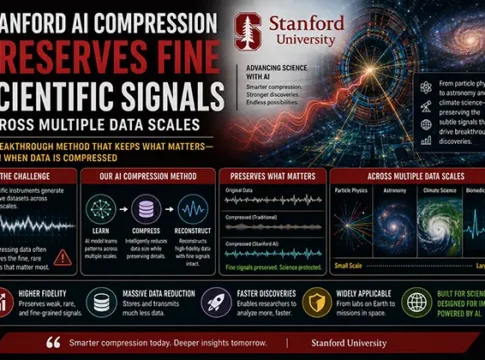

Stanford University researchers have unveiled a groundbreaking AI compression method that promises to revolutionize the way scientific data is handled. This innovative neural-network approach is designed to preserve fine scientific signals across multiple data scales, offering a solution to the challenges of managing large datasets without losing critical information. As scientific research increasingly relies on vast amounts of data, this method could significantly enhance storage, transfer, and analysis capabilities.
Understanding the Stanford AI Compression Method
The Stanford AI compression method employs a neural-network approach that represents experimental features at multiple spatial or temporal scales. This technique is particularly adept at reducing very large scientific datasets while retaining subtle structures that are crucial for accurate analysis. By addressing the limitations of conventional codecs and single-scale machine-learning methods, this approach ensures that even the most delicate signals are preserved.
How It Works
The method utilizes a multi-scale representation, which allows it to capture and compress data across different levels of detail. This is achieved through a sophisticated neural network that learns to identify and retain essential features while discarding redundant information. The result is a compressed dataset that maintains the integrity of the original data, making it suitable for various scientific applications.
Benefits for Scientific Workflows
The implications of this AI compression method are vast, particularly for physics, imaging, and observational workflows. By reducing the size of datasets without compromising on quality, researchers can benefit from:
Improved storage efficiency, allowing for more data to be stored in less space.
Faster data transfer rates, facilitating quicker sharing and collaboration.
Enhanced analysis capabilities, as datasets retain critical information necessary for accurate results.
Addressing Risks and Challenges
While the benefits are clear, the method also presents certain risks, particularly concerning lossy compression, training-data biases, generalization, and reproducibility. Ensuring that rare signals are validated requires rigorous testing and validation processes. Moreover, the method must be carefully compared with existing codecs to ensure it offers superior performance without introducing new errors.
Expert Perspectives
“Stanford’s AI compression method is a significant leap forward in data management, offering a balance between efficiency and accuracy that is crucial for modern scientific research.” — Dr. Emily Chen, Data Scientist
Practical Adoption Guidance
For researchers and institutions considering adopting this method, it is essential to conduct thorough testing within their specific contexts. This includes evaluating the method’s performance on their datasets, understanding the potential for data loss, and ensuring compatibility with existing systems. Collaboration with AI experts can also facilitate a smoother integration process.
FAQs
Q: Can this method be applied to all types of scientific data?
A: While the method is versatile, it is most effective for datasets where preserving fine details is critical. It may not be suitable for all data types without customization. Q: How does this method compare to traditional compression techniques?
A: Unlike traditional methods that often focus on single-scale compression, this AI approach captures data across multiple scales, ensuring finer details are preserved. Future Implications The Stanford AI compression method represents a significant advancement in data management, with the potential to transform scientific research. As the method is refined and adopted more widely, it could lead to new standards in data compression, enabling researchers to handle increasingly complex datasets with ease. This innovation not only enhances current workflows but also paves the way for future discoveries by ensuring that critical data is never lost in the process. In conclusion, the Stanford AI compression method offers a promising solution to the challenges of managing large scientific datasets. By preserving fine scientific signals across multiple data scales, it ensures that researchers can continue to push the boundaries of knowledge without being hindered by data limitations. As this technology evolves, it will undoubtedly play a crucial role in the future of scientific research.
A: While the method is versatile, it is most effective for datasets where preserving fine details is critical. It may not be suitable for all data types without customization. Q: How does this method compare to traditional compression techniques?
A: Unlike traditional methods that often focus on single-scale compression, this AI approach captures data across multiple scales, ensuring finer details are preserved. Future Implications The Stanford AI compression method represents a significant advancement in data management, with the potential to transform scientific research. As the method is refined and adopted more widely, it could lead to new standards in data compression, enabling researchers to handle increasingly complex datasets with ease. This innovation not only enhances current workflows but also paves the way for future discoveries by ensuring that critical data is never lost in the process. In conclusion, the Stanford AI compression method offers a promising solution to the challenges of managing large scientific datasets. By preserving fine scientific signals across multiple data scales, it ensures that researchers can continue to push the boundaries of knowledge without being hindered by data limitations. As this technology evolves, it will undoubtedly play a crucial role in the future of scientific research.