
OLD IS GOLD
For many Indian youngsters growing up in the 1990s, owning a Royal Enfield Bullet was more than a dream. It represented freedom, pride, independence and a sense of achievement.
Imagine a typical Indian street in the 1990s. There were bicycles outside houses, scooters carrying families and motorcycles used for everyday transportation.
Then, somewhere in the distance, came a familiar sound.
Dug… Dug… Dug… Dug…
1990s Royal Enfield Bullet Sound
Before anyone could see the motorcycle, they knew a Bullet was approaching.
Its large metal body, round headlamp, chrome exhaust and unmistakable engine beat made people turn their heads.
In many communities, buying a Bullet was seen as a sign that someone had become financially settled. It might belong to a respected professional, a successful businessman or a family that had finally fulfilled a long-standing ambition.
That perception was cultural, not a universal measure of financial success. Yet it explains why the motorcycle occupies such a special place in memories of the 1990s.
For some children, the dream was simple: One day, I will own a Bullet like that.
Today, the motorcycle has changed dramatically. The old cast-iron engine has given way to the refined J-series engine. Traditional kick-starting has been replaced by electric starting, and the distinctive four-speed right-side gear arrangement has become a modern five-speed left-side system.
But the Bullet name, distinctive silhouette and emotional appeal remain.
So which is better: the mechanically engaging Bullet of 1990 or the more refined Bullet 350 of 2026? And why do so many enthusiasts still prefer the old engine’s legendary thump?
This comparison explores the engineering, riding experience, maintenance, prices and cultural significance of both generations.

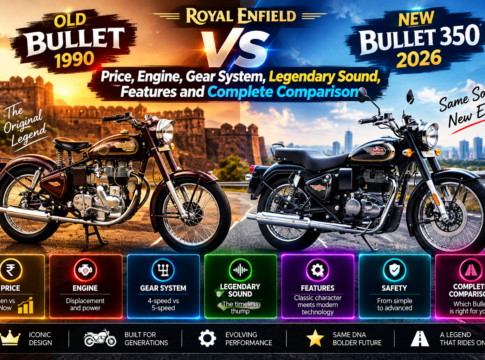
1990-era Bullet 350Classic cast-iron engine, kick-starting and traditional controls.

2026 Bullet 350 Modern J-series engine with classic Bullet styling.
Historical motorcycles may have undergone restoration or modification. Photographs are visual references, not evidence of factory originality.
1. Key Highlights
– A motorcycle with extraordinary heritage: Royal Enfield’s origins date to British manufacturing in the late nineteenth century, with its first motorcycle appearing in 1901. Production in India developed through the Madras Motors partnership during the 1950s. By 1990, the Bullet had become a powerful cultural symbol.
– Old cast-iron versus modern J-series engine: The 1990-era Indian Bullet 350 generally used a 346cc-class cast-iron-cylinder, pushrod-operated, carburetted single-cylinder engine. The 2026 model uses a 349cc, fuel-injected, air-oil-cooled J-series engine producing approximately 20.2 bhp and 27 Nm.
– Traditional starting versus modern convenience: The older motorcycle relied on a kick-starter, requiring familiarity with compression and carburettor behaviour. The modern Bullet offers electric starting and electronically controlled fuelling.
– Four gears versus five gears: A typical 1990 Indian Standard Bullet used a four-speed gearbox with a right-side gear lever and left-side rear brake. The 2026 Bullet uses five speeds, with the gear lever on the left and rear brake on the right.
– The legendary thump: The old Bullet’s deep exhaust beat and pronounced mechanical vibration remain central to its appeal. The modern engine retains a recognisable single-cylinder rhythm but operates more smoothly and quietly.
– Safety and ride comfort: Vintage drum brakes, older electrics and a traditional chassis contrast with the new Bullet’s modern frame, front disc brake, variant-dependent rear disc and ABS, better-controlled vibration and revised seating.
– 2026 pricing: Recent Indian listings put the new Bullet 350 at approximately ₹1.66 lakh ex-showroom for the entry model, with higher versions around ₹2.10 lakh or more depending on applicable pricing. Vintage Bullet values depend heavily on originality, documentation and condition.
– Different ownership experiences: The old Bullet rewards mechanical involvement and patient maintenance. The new Bullet offers easier commuting, more predictable starting and contemporary safety equipment. Neither should be judged by nostalgia or specifications alone.
2. What You Will Learn
By the end of this article, you will understand:
1. Why the Bullet became a dream motorcycle for 1990s youngsters, and why owning one could represent personal achievement and social status.
2. How the cast-iron engine differs from the J-series engine, including valve operation, fuelling, lubrication, compression, vibration and power delivery.
3. Why starting methods changed, from traditional kick-starting and decompressor techniques to electric starting and electronic fuel injection.
4. How the gear systems evolved, including the old four-speed right-side shift, neutral-finder mechanism and modern five-speed left-side gearbox.
5. What creates the famous Bullet thump, why the old engine sounds different and why a louder exhaust does not necessarily produce more power.
6. How ride comfort and safety improved, through changes in chassis design, seating, suspension, tyres, braking and ABS.
7. How the design has survived across generations, from the teardrop fuel tank and chrome fittings to the modern digi-analogue instrument cluster.
8. How to evaluate ownership costs, including current new-bike prices, vintage market conditions, mileage, petrol expenses, spare parts and restoration requirements.
3. How and Why It Works
The history: how an old British motorcycle became an Indian icon
The Royal Enfield story began in Britain during the late nineteenth century. The brand’s manufacturing heritage eventually became associated with the famous phrase Made Like a Gun.
Royal Enfield produced its first motorcycle in 1901.
The Bullet name became established over the following decades, and its association with India strengthened substantially during the 1950s.
In 1955, the British manufacturer partnered with Madras Motors to establish Enfield India. Production activities developed at Tiruvottiyur, near Madras, now Chennai.
The motorcycle’s use by the Indian armed forces and other institutional customers contributed to its public recognition. Over time, it became closely associated with Indian motorcycling culture.
By 1990, the Bullet was already an established motorcycle rather than a new fashion trend.
Its appeal was different from that of lighter commuter motorcycles. It was substantial, mechanically distinctive and instantly recognisable.
Why the Bullet was a dream bike for 90s kids
The Bullet’s emotional appeal was closely connected with its presence on Indian roads.
A child hearing the familiar exhaust beat might rush outside to watch one pass.
A teenager might admire the polished engine, black-and-gold fuel tank or the way an experienced rider started the motorcycle with a deliberate kick.
For some households, buying a Bullet represented a significant financial decision.
That is why the motorcycle became associated with expressions such as “He has settled in life” or “He has finally bought his dream bike.”
The meaning was not simply that the owner had purchased a motorcycle. It could signal independence, personal progress and the ability to afford something aspirational.
Families also developed attachments to individual motorcycles. A Bullet owned by a father or grandfather could become part of family history.
This emotional connection explains why collectors sometimes invest considerable time and money restoring vintage examples even when a new motorcycle would be more convenient.
Engine and performance: cast-iron power versus J-series refinement

Classic cast-iron engineTraditional cylinder construction, pushrod valve operation and exposed mechanical character.

Modern J-series engineUpdated cylinder head, overhead camshaft and modern fuel injection.
The 1990 cast-iron Bullet engine
A typical Indian-market Bullet 350 from around 1990 used an older single-cylinder, four-stroke engine architecture with a cast-iron cylinder barrel and traditional valve operation.
Its engine capacity was approximately 346cc, with a commonly documented bore and stroke of 70 mm × 90 mm.
The relatively long piston travel contributed to the engine’s low-speed mechanical character.
The engine used overhead valves operated through pushrods, rather than a camshaft positioned directly in the cylinder head.
A camshaft lower in the engine operated lifters and pushrods, which transferred movement to rocker arms controlling the valves.
Carburettor fuelling, traditional ignition arrangements and the engine’s mechanical construction demanded periodic attention.
Precise compression ratio, ignition configuration, power and torque should be checked against the correct year-specific factory manual. Surviving motorcycles may have been rebuilt with later components, so an assumed factory output should not be presented as a verified measurement.
The 2026 J-series Bullet engine
The modern Bullet uses a 349cc single-cylinder, air-oil-cooled engine with:
- Electronic fuel injection.
- Single overhead camshaft (SOHC).
- A four-stroke combustion cycle.
- A bore and stroke of approximately 72 mm × 85.8 mm.
- A balance shaft designed to reduce unwanted vibration.
- Approximately 20.2 bhp at 6,100 rpm.
- Maximum torque of 27 Nm at 4,000 rpm.
- A five-speed manual gearbox.
The newer engine has a modern lubrication system, updated engine management and revised internal engineering.
Its balancing system reduces some reciprocating vibration without removing the motorcycle’s characteristic single-cylinder feel.
Why does the modern engine feel smoother?
A single-cylinder engine contains a piston that repeatedly accelerates, stops and changes direction.
These movements produce forces that can cause vibration.
The older Bullet’s heavy rotating components, traditional engine architecture and frame mounting created a distinctive physical sensation.
The modern J-series engine uses revised internal balancing, combustion management, engine construction and chassis engineering to reduce undesirable vibration.
This makes the new motorcycle more comfortable for many riders during everyday travel.
However, smoother operation is not necessarily more emotionally satisfying for every enthusiast.
Some classic-bike owners actively enjoy the mechanical feedback that modern engines are designed to reduce.
Starting and mechanics: the unforgettable kick-start ritual
For many old Bullet enthusiasts, starting the engine was part of the experience.
Unlike a modern electric-start motorcycle, a traditional Bullet required an understanding of how the engine behaved.
On a typical older configuration, the rider would check the fuel supply, select the appropriate carburettor enrichment, position the piston using the kick lever and decompressor where fitted, and then deliver a controlled starting kick.
The precise process depended on carburettor adjustment, ignition condition, temperature and engine compression.
The decompressor helps reduce cylinder pressure while positioning the engine for starting.
An incorrectly executed kick can cause kickback, potentially injuring the rider.
Owners unfamiliar with the system should learn the correct process from a knowledgeable mechanic rather than experimenting with forceful kicks.
The modern starting experience is different.
The 2026 Bullet uses an electric starter and electronically controlled fuel injection.
The engine control system manages fuelling according to operating conditions, reducing the need for manual carburettor adjustment during normal starts.
Electronic ignition also reduces routine attention to contact-breaker components found on many historical configurations.
This does not mean the modern engine is maintenance-free. Oil, filters, spark plugs, sensors, throttle components and other systems still require inspection according to the service schedule.
Traditional gearbox versus modern five-speed transmission
One of the most memorable characteristics of the classic Indian Bullet is its unusual control arrangement.
On many traditional 1990-era Standard Bullets, the gear-shift lever was located on the right side, while the rear brake pedal was on the left.
This is the opposite of the familiar arrangement used by most modern Indian motorcycles.
The old four-speed transmission also required a different shifting technique from the modern five-speed gearbox.
Many classic Bullets included a separate neutral-finder lever intended to help return the transmission to neutral.
The rider needed to become familiar with the shift sequence, clutch operation and neutral-finder mechanism.
The newer Bullet offers five forward ratios, with conventional left-side gear selection and right-side rear braking.
Its modern integrated powertrain and shift arrangement are generally more familiar to contemporary riders.
Important: Older Bullets may have been modified with later gearboxes or left-shift conversions. Always check the actual lever positions before riding an unfamiliar motorcycle.
What happens inside the clutch and gearbox?
The clutch temporarily disconnects engine torque from the gearbox so that a gear can be selected.
The gearbox changes the ratio between engine speed and rear-wheel speed.
Lower gears provide greater torque multiplication at lower road speeds, while higher gears allow the engine to operate at a more suitable speed while cruising.
The older four-speed transmission has fewer ratios across which to distribute engine speed.
The newer five-speed arrangement offers an additional ratio and benefits from more modern gearbox engineering.
But the presence of five gears alone does not guarantee better acceleration or efficiency. The actual ratios, engine characteristics and riding conditions determine performance.
The legendary sound: why did the old Bullet go “Dug-Dug-Dug”?
The classic Bullet’s exhaust, engine construction and low-speed combustion rhythm contributed to its familiar sound.
This is the question that matters most to many enthusiasts.
Why does an old Bullet sound different from the new Bullet 350?
The traditional thump is produced by the interaction of several engineering factors.
Single-cylinder combustion
Both engines use one cylinder operating on a four-stroke cycle.
In a four-stroke single-cylinder engine, a combustion event occurs once every two crankshaft revolutions.
At an illustrative idle speed of 900 rpm, that corresponds to approximately 7.5 combustion events per second.
This helps create a recognisable sequence of exhaust pulses.
Engine speed and flywheel behaviour
The older Bullet’s operating characteristics and substantial flywheel inertia contributed to the way it responded at low speeds.
However, flywheel mass alone does not determine exhaust sound.
Exhaust system construction
The exhaust pipe, internal silencer chambers, restrictions and acoustic properties shape the sound heard outside the motorcycle.
An original silencer can sound different from a modified or restored one.
Mechanical vibration
Valve-train noise, piston movement and other mechanical sounds combine with the exhaust note to create the rider’s overall impression.
Combustion and ignition behaviour
Engine tuning, combustion consistency and idle speed also affect the character of the sound.
The classic thump is therefore not explained by long stroke alone.
The modern Bullet remains a single-cylinder motorcycle with a long-stroke engine, but its updated combustion system, balancing, ignition control and compliant exhaust produce a smoother, more controlled note.
Why a louder Bullet is not necessarily more powerful
An aftermarket exhaust can increase perceived loudness without producing a meaningful improvement in engine output.
Removing or altering silencer components can also affect emissions, noise compliance and engine tuning.
A loud exhaust should never be used as evidence of greater horsepower.
Owners should retain compliant exhaust systems and avoid modifications that violate applicable noise or emissions requirements.
For a genuine sound comparison, recordings should identify the motorcycle’s year, engine configuration, exhaust originality and microphone conditions.
Comfort, handling and road behaviour
The traditional Bullet offered an upright riding position, substantial construction and a memorable mechanical connection.
Its weight could contribute to a planted sensation on open roads, but it also required attention during parking and slow manoeuvres.
The 1998 Standard Bullet in the user’s referenced video was described as weighing approximately 195 kg. That should be regarded as an approximate description of the reviewed example—not a verified factory weight for every 1990 Bullet.
Vintage handling also depends on tyres, steering bearings, suspension condition and frame alignment.
The modern Bullet retains an upright posture but uses a revised chassis, updated suspension tuning and improved seating.
Autocar India’s road test described the new Bullet’s engine as smooth and easygoing, with comfortable ride quality. It also noted that handlebar reach might be less comfortable for some rider heights. These are published reviewer observations rather than universal owner experiences.
Safety: drum brakes versus discs and ABS
A classic Bullet from around 1990 commonly used drum brakes at both wheels.
Drum brakes use friction shoes that press outward against a rotating drum.
They can provide useful stopping performance when correctly maintained but may be more susceptible to heat-related fade and require proper adjustment.
The new Bullet uses a front disc brake. Entry-level variants have a rear drum and single-channel ABS, while higher variants offer a rear disc and dual-channel ABS.
ABS, or Anti-lock Braking System, helps limit wheel lock-up during certain braking situations.
Single-channel ABS protects the front-wheel circuit, while dual-channel ABS monitors and regulates both wheels.
Neither system eliminates accident risk or compensates for worn tyres, excessive speed or poor riding technique.
Design, lighting and cockpit: what stayed the same?
Despite extensive mechanical changes, the Bullet still carries recognisable traditional styling.
Both generations feature a round headlamp, teardrop-style fuel tank, distinctive metal bodywork, prominent engine and relaxed riding posture.
The older motorcycle’s appeal lies in its relatively exposed mechanical components, classic metal mudguards, chrome finishes and traditional pinstriping.
The modern model offers improved finishing and a redesigned J-series engine, while retaining many familiar visual elements.
The 1990-era instrument arrangement was predominantly analogue, accompanied by basic warning lamps and conventional switches.
The 2026 Bullet uses a digi-analogue instrument cluster and includes a USB charging port.
Its factory headlamp remains halogen in the Indian range reviewed by Autocar India; a modern motorcycle should not automatically be described as having LED lighting.
4. Practical Applications
Old Bullet 1990 vs New Bullet 350 2026: complete technical comparison
| Feature | 1990-era Royal Enfield Bullet 350 | 2026 Royal Enfield Bullet 350 |
|---|---|---|
| Engine capacity | Approximately 346cc | 349cc |
| Engine type | Single-cylinder, four-stroke | Single-cylinder, four-stroke |
| Construction | Traditional cast-iron cylinder architecture | Modern J-series construction |
| Valve operation | Pushrod-operated OHV | Single overhead camshaft |
| Bore × stroke | Commonly documented as 70 × 90 mm | Approximately 72 × 85.8 mm |
| Fuel system | Carburettor | Electronic fuel injection |
| Cooling | Primarily air-cooled | Air-oil-cooled |
| Ignition | Traditional system; contact-breaker on applicable examples | Electronic engine management |
| Starting | Kick-start | Electric start |
| Engine power | Requires year-specific factory verification | 20.2 bhp at 6,100 rpm |
| Maximum torque | Requires year-specific factory verification | 27 Nm at 4,000 rpm |
| Transmission | Four-speed manual | Five-speed manual |
| Gear lever | Typically right side | Left side |
| Rear brake pedal | Typically left side | Right side |
| Neutral finder | Traditional separate mechanism on applicable gearboxes | Conventional neutral selection |
| Engine and gearbox | Older separate gearbox architecture | Modern integrated powertrain |
| Exhaust sound | Deeper, mechanically pronounced thump | Smoother, controlled single-cylinder note |
| Vibration | Generally more pronounced | Reduced by modern balancing |
| Front brake | Drum on typical period specification | 300 mm disc |
| Rear brake | Drum | Drum or 270 mm disc, variant-dependent |
| ABS | Not fitted to typical 1990 specification | Single- or dual-channel, variant-dependent |
| Chassis | Traditional steel motorcycle frame | Updated twin-downtube cradle frame |
| Suspension | Telescopic front forks, twin rear shocks | Revised telescopic front suspension and twin rear shocks |
| Wheels | Traditional wire-spoke wheels | 19-inch front, 18-inch rear wire-spoke wheels |
| Seat | Traditional bench-style layout; restored examples vary | Redesigned single-piece bench seat |
| Lighting | Older conventional electrical lighting | Halogen headlamp in current Indian specification |
| Instruments | Predominantly analogue | Digi-analogue cluster |
| Fuel tank | Verify particular period specification | 13 litres |
| Mileage | Highly condition-dependent; no universal verified 1990 figure | Approximately 35–36 kmpl in reported owner data |
| Maintenance | Carburettor, ignition, seals, adjustments and age-related repairs | Scheduled modern EFI and mechanical servicing |
| Spare parts | Requires specialist sourcing for some original components | Current manufacturer service and parts support |
| Price | Depends on collector market and condition | Approximately ₹1.66 lakh onward ex-showroom in recent 2026 listings |
Historical entries describe a typical Indian-market 1990-era cast-iron Bullet, not every surviving example. Restoration, conversions and production differences can change specifications. Modern figures are supported by Royal Enfield and published road-test documentation.
New Royal Enfield Bullet 350 price in India — October 2026
The modern Bullet is available in several versions with different finishes and braking equipment.
Recent October 2026 listings for Moosapet, Hyderabad, provide the following indicative prices.
| 2026 Bullet 350 variant | Listed ex-showroom price | Indicative on-road price |
|---|---|---|
| Military | ₹1,66,981 | ₹2,03,726 |
| Battalion | ₹1,69,243 | ₹2,06,365 |
| Standard | ₹1,93,273 | ₹2,34,403 |
| Black Gold | ₹2,11,250 | ₹2,61,717 |
Source: ZigWheels, October 2026 Moosapet quotation. These are third-party estimates, not a binding dealership quotation. Other published Hyderabad quotations vary because of insurance, registration calculations and optional charges.
The Military and Battalion versions offer single-channel ABS, while Standard and Black Gold provide dual-channel ABS with front and rear disc brakes.
For the current manufacturer’s specifications, colours and dealership information, visit Royal Enfield India’s official Bullet 350 page.
How much does a 1990 Bullet cost in India today?
There is no reliable nationwide fixed selling price for a 1990 Bullet.
Unlike a newly manufactured motorcycle, each vintage example can be substantially different.
A collector may value a well-preserved motorcycle with verified original components and complete documents more highly than a heavily modified example.
A restored motorcycle may look attractive but could contain replacement engines, later ignition systems or non-original bodywork.
A motorcycle requiring an engine rebuild, registration work or substantial structural repairs can involve major additional expense.
Buyers should distinguish three things:
Asking price: What the seller hopes to receive.
Completed sale price: What a buyer actually pays in a documented transaction.
Restoration expenditure: What must be spent to make the motorcycle mechanically sound, legally usable and presentable.
These values are not interchangeable.
A defensible valuation requires comparable current listings, condition reports and, ideally, documented transactions. No universal collector-market figure should be assumed.
Petrol mileage: does the old Bullet consume more fuel?
The 2026 Bullet’s reported real-world efficiency of approximately 35–36 kmpl provides a useful reference, although individual riders may obtain different results.
The 1990 Bullet is harder to assess using a single number.
Fuel economy can be affected by:
- Engine compression and cylinder wear.
- Carburettor condition and adjustment.
- Ignition timing.
- Chain condition and wheel alignment.
- Tyre pressure.
- Riding speed, traffic and load.
- Mechanical modifications.
- Engine and gearbox friction.
A poorly maintained vintage engine may consume substantially more fuel than a properly tuned example.
Illustrative monthly petrol expense
To demonstrate how running costs can be calculated, consider a rider travelling 600 km per month, with petrol priced at an assumed ₹105 per litre.
For illustration only, assume an old Bullet returns 25 kmpl and a new Bullet returns 35 kmpl.
Example monthly fuel expenditure
Old Bullet — assumed 25 kmpl
₹2,520
600 ÷ 25 × ₹105
New Bullet — assumed 35 kmpl
₹1,800
600 ÷ 35 × ₹105
Illustrative difference: ₹720 per monthThe 25 kmpl and 35 kmpl values are calculation assumptions, not directly comparable certified test results. ₹105/litre is an assumed petrol price, not a verified current local pump price.
The formula is straightforward:
Monthly petrol cost = Monthly distance ÷ Actual mileage × Petrol price per litre
For a meaningful ownership comparison, fuel expenditure should be combined with maintenance, repairs, insurance and purchase costs.
Classic Bullet restoration: what must you inspect?


A 1990-era Bullet may have passed through several owners and decades of repair work.
Before buying one, ask an experienced classic-motorcycle mechanic to inspect the machine.
Engine condition: Check compression, oil leaks, crankshaft and bearing noise, excessive smoke and unusual vibration.
Gearbox and clutch: Verify all four gears engage correctly, inspect clutch operation and check the neutral-finder mechanism where fitted.
Carburettor and ignition: Check correct fuelling, stable running and the existing ignition configuration.
Electrical wiring: Inspect deteriorated insulation, previous modifications, charging performance and lighting.
Fuel tank and frame: Look for internal tank rust, damaged mounts, corrosion, cracked welds and evidence of poorly repaired accidents.
Brakes and tyres: Inspect drum condition, cables, wheel bearings, tyre age and tread.
Originality: Verify engine numbers, chassis identity, paintwork, tank, exhaust and other parts against the appropriate period specification.
Documents: Check the registration certificate, ownership transfer eligibility, insurance and applicable legal requirements.
Restoration budgets should be divided into engine and gearbox work, chassis and suspension, paint and chrome, electrical repairs, tyres and brakes, documentation and specialist labour.
A good-looking paint job cannot compensate for a worn crankshaft or unsafe brakes.
Which Bullet should you buy?
| Your priority | Suitable direction |
|---|---|
| Weekend heritage riding | Mechanically sound classic Bullet |
| Everyday office commuting | Modern Bullet 350 |
| Learning vintage motorcycle mechanics | Restorable old Bullet with expert support |
| Comfortable occasional highway trips | Test-ride the modern Bullet; compare ergonomics |
| First motorcycle | Modern Bullet with appropriate training |
| Collecting and preserving history | Documented, period-correct vintage Bullet |
| Enjoying traditional mechanical character | Classic cast-iron Bullet |
| Easier starting and contemporary braking | Modern J-series Bullet |
A beginner should also consider the motorcycle’s weight, seat height, braking ability and low-speed manoeuvrability before purchasing.

1998 Royal Enfield Standard Bullet
A vintage-bike perspective covering the engine thump, design, riding experience and maintenance.
5. Limitations and Misconceptions
Does an old Bullet always have a better engine?
Not necessarily.
The vintage cast-iron engine has a distinctive operating character that enthusiasts may value. But that does not establish superior power, efficiency or reliability.
The modern J-series engine offers electronic fuel injection, improved refinement and more convenient starting.
Which engine is preferable depends on whether the rider prioritises traditional mechanical character or everyday usability.
Is every 1990 Bullet factory-original?
No.
A motorcycle more than three decades old may have undergone multiple repairs, restorations and modifications.
Changes to the gearbox, ignition, carburettor, exhaust or engine internals can significantly alter its behaviour.
Even two motorcycles registered in the same year may feel different.
Does a louder exhaust mean greater horsepower?
No.
Exhaust loudness is not a direct measure of engine power.
A modified silencer can make a motorcycle considerably louder while producing little or no meaningful performance gain.
Non-compliant exhaust alterations can also create legal and environmental problems.
Are old cast-iron engines indestructible?
No.
Cast iron has useful engineering properties, but the age, lubrication, operating temperature, maintenance and condition of a particular engine are essential factors.
An old Bullet may require major mechanical work if it has been poorly maintained.
Is kick-starting superior to electric starting?
Neither method is universally superior.
Kick-starting provides a traditional mechanical interaction but can require technique and physical effort.
Electric starting offers greater convenience, particularly during frequent city use.
Both systems require proper maintenance.
Are four-speed gearboxes stronger than five-speed gearboxes?
Gear count does not establish strength.
Gearbox durability depends on materials, design, lubrication, loads, maintenance and operating technique.
The old four-speed gearbox is part of the traditional Bullet experience, while the five-speed system suits the modern engine’s characteristics.
Frequently Asked Questions
1. What is the main difference between the 1990 and 2026 Royal Enfield Bullet?
The 1990-era motorcycle generally uses a cast-iron-cylinder engine, carburettor, kick-start and four-speed gearbox. The 2026 model uses a 349cc J-series engine, electronic fuel injection, electric starting, five-speed gearbox and modern braking systems.
2. What is the current price of the 2026 Bullet 350?
October 2026 Moosapet listings show approximately ₹1.67 lakh ex-showroom for the Military variant and about ₹2.04 lakh on-road. Higher variants cost more. Verify the latest quotation with a Royal Enfield dealership.
3. How much does a 1990 Royal Enfield Bullet cost?
There is no verified universal price. The amount depends on condition, originality, registration status, completed restoration work and buyer demand.
4. Which Bullet has the better engine?
For modern commuting and refinement, the J-series offers important advantages. For traditional mechanical character and heritage interest, many enthusiasts prefer the cast-iron engine.
5. Why does the old Bullet produce a distinctive thumping sound?
Its single-cylinder combustion rhythm, exhaust design, operating speed, engine architecture and mechanical vibrations combine to create the familiar sound.
6. Why does the new Bullet sound smoother?
The J-series uses modern combustion management, revised balancing and an exhaust designed around current operating and regulatory requirements.
7. Did the old Bullet have right-side gear shifting?
Many traditional Indian Standard Bullets did, with the rear brake on the left. Restored or modified motorcycles may differ.
8. How does the old four-speed gearbox differ from the new five-speed gearbox?
The older gearbox has four forward ratios and traditional controls, often including a neutral finder. The modern gearbox uses five ratios and a conventional left-side shift arrangement.
9. Why did old Bullets require kick-starting?
They were designed around the starting equipment and electrical technology of their period. Starting involved manually rotating the engine and managing its fuelling and compression.
10. Is the 1990 Bullet more powerful than the new model?
The modern Bullet has a documented output of approximately 20.2 bhp. A precise comparison requires authenticated factory output data for the specific 1990 motorcycle; modified or restored examples may differ.
11. Which Bullet offers better mileage?
The modern Bullet has reported owner mileage of approximately 35–36 kmpl. A vintage Bullet’s efficiency depends heavily on condition, tuning and operating circumstances.
12. Which motorcycle is more comfortable for long rides?
The modern Bullet generally offers reduced vibration and an updated seat and chassis. However, comfort depends on rider height, posture, road conditions and personal preference.
13. Is the old Bullet suitable for everyday commuting?
A properly maintained example can be used regularly where legally permitted, but its starting, brakes, age-related repairs and mechanical requirements may make it less convenient than a modern motorcycle.
14. Are spare parts available for vintage Bullets?
Many components can be sourced through specialist workshops and suppliers. However, authentic period-correct parts may be harder to find than modern replacement items.
15. Should I buy a restored 1990 Bullet or a new 2026 Bullet?
Choose based on intended use. A documented, mechanically sound classic may suit heritage enthusiasts. The new model is generally more practical for riders prioritising regular commuting, contemporary braking and easier maintenance.
6. Learning Takeaways
What the old and new Bullet teach us about motorcycle engineering
The Royal Enfield Bullet’s transformation is a fascinating example of how motorcycle engineering has progressed without entirely abandoning traditional styling.
The older motorcycle demonstrates the mechanical principles of carburettor fuelling, pushrod valve operation, kick-starting and traditional gearboxes.
The new Bullet illustrates how electronic fuel injection, overhead-camshaft engines, balancing systems, modern transmissions and updated braking technology can improve everyday usability.
Both motorcycles retain a single-cylinder identity, but they produce noticeably different riding experiences.
Essential buying and ownership checklist
Before buying either generation, consider the following:
- Understand the differences between cast-iron and J-series engine construction.
- Compare kick-starting and electric starting.
- Learn the old four-speed and modern five-speed gearbox arrangements.
- Confirm gear-shift and rear-brake positions before riding a classic.
- Assess the original or modified exhaust configuration.
- Evaluate engine vibration and power delivery.
- Test seating position and suspension comfort.
- Compare drum brakes, disc brakes and ABS.
- Verify engine compression and mechanical condition on vintage motorcycles.
- Check the registration certificate, VIN or chassis number, and ownership records.
- Obtain accurate current price quotations or condition-based vintage valuations.
- Include repairs and restoration expenses in the total budget.
- Compare fuel costs using realistic mileage assumptions.
- Investigate spare-parts and specialist-service availability.
- Take a safe test ride and obtain a professional mechanical inspection.
What makes the traditional Bullet thump so memorable?
A motorcycle’s identity is not created by specifications alone.
The old Bullet’s sound reminds some riders of childhood streets, family journeys, respected owners and the excitement of watching an admired motorcycle pass by.
For a person who grew up dreaming of owning a Bullet, that sound may carry emotional meaning that no dyno chart can measure.
This helps explain why a classic motorcycle can remain desirable even when a modern version offers improved comfort, convenience and braking.
The old Bullet may not be the most advanced motorcycle, but for many enthusiasts, it represents a period of Indian motorcycling that cannot be recreated simply by fitting an old-style exhaust to a new engine.
Future of the Royal Enfield Bullet
Royal Enfield has maintained much of the Bullet’s traditional appearance while changing its engineering.
This approach may continue as customer expectations, emissions standards, safety requirements and technology evolve.
Future developments could involve additional electronic features, changes in combustion technology or different forms of electrification.
However, specific future Bullet powertrains and features should not be described as confirmed unless Royal Enfield officially announces them.
The central challenge is preserving the design and character that riders value while meeting contemporary expectations for safety, efficiency and usability.
Final Verdict: Old Bullet 1990 or New Bullet 350 2026?
The 1990 Royal Enfield Bullet 350 is best appreciated as a heritage motorcycle.
Its traditional engine, kick-starting procedure, four-speed gearbox and distinctive mechanical sound make riding an involving experience.
For a collector, restorer or experienced enthusiast, maintaining such a motorcycle can be deeply rewarding.
The 2026 Royal Enfield Bullet 350 retains the recognisable styling while introducing a smoother engine, more convenient starting, updated chassis and modern brakes.
For regular commuting, new riders who are comfortable with its size and weight, and riders who value predictable everyday operation, the modern motorcycle offers meaningful advantages.
Neither generation is automatically the right choice for everyone.
OLD IS GOLD — but the new Bullet shows how a legendary motorcycle can preserve its heritage while becoming easier to own and ride.
In the 1990s, buying a Bullet could feel like announcing to the world that you had achieved something important.
In 2026, buying a Bullet can still be an emotional decision.
The difference is that today’s owner can choose between preserving a piece of Indian motorcycling history and enjoying that same iconic identity with modern engineering.