
About Us

At Study Tech Next, we’re committed to bringing you insightful, up-to-the-minute content across a spectrum of topics that impact our daily lives.

― Advertisement ―

A Cell-by-Cell Map of Cadmium Defense in Alfalfa: What Single-Nucleus Data Reveal

Discover how cutting-edge single-nucleus sequencing reveals alfalfa's cellular defense against cadmium, offering insights into gene expression and chromatin accessibility. Uncover key mechanisms of heavy-metal stress responses and potential pathways for resilient crops. Read on to explore these groundbreaking findings.
HomeScienceHow Clubroot Pathogens Hijack Plant Trafficking: What the PbALE Effector Reveals About...

How Clubroot Pathogens Hijack Plant Trafficking: What the PbALE Effector Reveals About Immunity

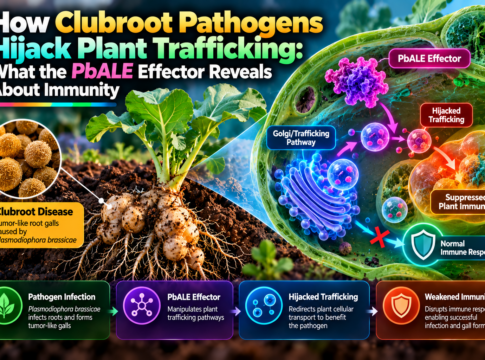
“`html In the intricate world of plant-pathogen interactions, the clubroot disease caused by *Plasmodiophora brassicae* presents a significant challenge to brassica growers. Recent studies have shed light on how the PbALE effector manipulates plant cellular processes, revealing crucial insights into plant immunity. This article delves into the mechanisms by which clubroot pathogens hijack plant trafficking and what this means for plant health and agricultural practices. Key Highlights
  • The clubroot disease is characterized by tumor-like root galls caused by *Plasmodiophora brassicae*.
  • The PbALE effector is a key player in manipulating plant trafficking pathways.
  • Microscopy and expression evidence highlight the effector’s role in organelle aggregation.
  • PbALE affects immune-protein trafficking, impacting proteins like FLS2 and PEN1.
  • Research utilizes model systems to study these interactions, though field relevance remains unresolved.
What You Will Learn
  • Understanding the clubroot disease and its impact on crops.
  • The role of pathogen effectors in plant-pathogen interactions.
  • Insights into lipid binding and its significance in plant immunity.
  • The importance of endosomes and membrane recycling in plant defense.
  • How pattern-recognition receptors like FLS2 contribute to plant immunity.
How and Why It Works Pathogen-secreted molecules like the PbALE effector can redirect host trafficking pathways, weakening the delivery or recycling of defense components. By manipulating the Golgi and trafficking pathways, these effectors suppress plant immunity, allowing pathogens to thrive. This disruption in immune responses is crucial for the pathogen’s success in forming galls and spreading infection. Practical Applications For brassica growers, managing clubroot disease involves integrated strategies. Use clean transplants and ensure proper drainage to prevent pathogen spread. Sanitation practices and resistant cultivars are essential, alongside local extension recommendations. Avoid experimental molecular treatments without proven field efficacy. Limitations and Misconceptions While microscopy and overexpression studies provide valuable insights, they do not equate to field control. Discovering an effector like PbALE does not immediately translate into a home remedy. Understanding these limitations is crucial for realistic expectations in disease management. Learning Takeaways
  • Recognize the disease cycle of clubroot and its impact on crops.
  • Identify research questions for breeding resistant plant varieties.
In conclusion, understanding how clubroot pathogens hijack plant trafficking through effectors like PbALE is vital for developing effective management strategies. By focusing on integrated approaches and acknowledging current research limitations, we can better protect crops and enhance plant immunity. FAQs
  • What is clubroot disease? Clubroot is a disease caused by *Plasmodiophora brassicae*, leading to root galls in brassicas.
  • How does the PbALE effector affect plants? It manipulates plant trafficking pathways, suppressing immunity and aiding pathogen success.
  • What are practical steps for managing clubroot? Use clean transplants, ensure drainage, practice sanitation, and choose resistant cultivars.
By understanding these complex interactions, we can better equip ourselves to tackle plant diseases and improve agricultural outcomes. “`