
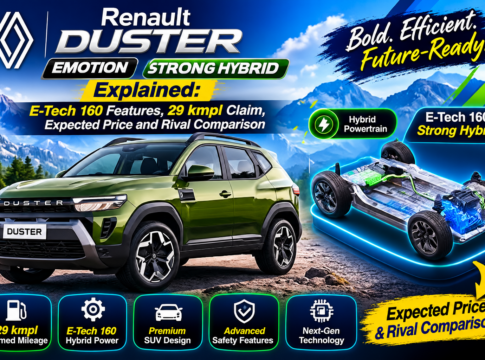

The Renault Duster is preparing to enter India’s competitive strong-hybrid SUV market with an interesting combination: a 1.8-litre petrol engine, electric propulsion, a compact self-charging battery and a manufacturer-claimed 29 kmpl fuel-efficiency figure.
Unlike an electric vehicle, the upcoming Duster Strong Hybrid E-Tech 160 does not require a charging cable. Instead, its petrol engine, electric motors and regenerative braking work together to manage energy while driving.
Renault has officially confirmed the hybrid system’s major specifications, including 160 PS maximum system output, a 1.4-kWh battery and a multimode automatic gearbox. It also claims the vehicle can operate electrically for up to 80% of city-driving time under specified conditions.
But what about the much-discussed Duster Emotion 1.8L Strong Hybrid, its ₹20.09-lakh price and features such as Level 2 ADAS, ventilated seats and a panoramic sunroof?
Those details need greater caution. CarWale and DriveSpark publish pre-launch listings, but their pricing descriptions differ, and not every listed Emotion specification has been established through Renault’s final Indian variant documentation.
Here is what the technology actually does, how the Duster compares with established strong-hybrid rivals, and what buyers should verify before placing an order.
1. Key Highlights
– Officially confirmed powertrain: Renault’s upcoming Strong Hybrid E-Tech 160 combines a 1.8-litre petrol engine with electric propulsion and delivers a maximum combined system output of 160 PS.
– Compact self-charging battery: A 1.4-kWh traction battery stores energy recovered through deceleration and supplied by the petrol-engine-driven system. External plug-in charging is not required.
– Claimed 29 kmpl fuel efficiency: Renault publishes a 29 km/l figure certified by a test agency under the relevant Indian motor-vehicle rules. It is a test-cycle result, not an independently measured owner average.
– Electric-assisted city driving: Renault says the hybrid can operate electrically for up to 80% of city-driving time under its stated conditions. This does not mean 80% of every journey’s distance or unlimited electric driving.
– Multimode automatic gearbox: The hybrid system coordinates petrol and electric power through an automatic multimode transmission. Renault’s official hybrid page does not describe it as a conventional eight-speed torque-converter gearbox.
– Availability update: Renault’s official website continues to describe the hybrid as coming soon, while its October 9, 2026 announcement confirms the 29 km/l certification and the opening of bookings. Media reports identify October 17 as the expected price-announcement or launch date.
– Emotion variant information remains provisional: CarWale lists an Emotion 1.8L Strong Hybrid with an estimated ₹20.09-lakh ex-showroom price and expected October 17 launch. DriveSpark displays ₹20.09 lakh as an on-road price. Neither designation should be treated as Renault’s confirmed final price.
– Reported equipment needs confirmation: Front-wheel drive (FWD), Level 2 ADAS, six airbags, a panoramic sunroof, ventilated front seats, dual-zone climate control and a 10.1-inch touchscreen appear in third-party listings. Their final India-specification Emotion availability must be verified with Renault.
What is officially confirmed and what is still expected?
| Detail | Current information | Status |
|---|---|---|
| Strong Hybrid E-Tech 160 | Confirmed by Renault | Official |
| Petrol engine | 1.8 litres | Official |
| Maximum combined output | 160 PS | Official |
| Hybrid traction battery | 1.4 kWh | Official |
| External charging | Not required | Official |
| Claimed efficiency | 29 km/l | Official certified claim |
| City electric operation | Up to 80% of driving time | Conditional manufacturer claim |
| Transmission | Multimode automatic | Official |
| Emotion trim name and equipment | Listed by automotive portals | Awaiting final variant confirmation |
| October 17, 2026 launch/pricing | Reported upcoming date | Not completed as of October 12 |
| ₹20.09-lakh pricing | Conflicting website labels | Estimated, not official |
| FWD configuration | Listed by CarWale and DriveSpark | Reported; verify final brochure |
The distinction matters because an accurate description of the powertrain does not automatically establish the final price, trim name or complete feature list.
2. What You Will Learn
This guide explains eight practical aspects of the Renault Duster’s strong-hybrid technology:
1. Strong-hybrid architecture: How an internal-combustion engine and electric propulsion work together without needing an external charging point.
2. Engine and motor roles: Why the petrol engine, traction motor and generator motor perform different tasks in the system.
3. Regenerative braking: How energy normally lost as heat during slowing down can be partially recovered and stored in the battery.
4. Electric start-up: Why Renault’s E-Tech system can move away using electric power before bringing the petrol engine into operation when required.
5. Multimode transmission: How the system selects different combinations of petrol and electric operation without functioning like a conventional manual gearbox.
6. FWD and hybrid battery packaging: What front-wheel drive means and why battery location, cargo space and vehicle balance are worth checking.
7. Claimed versus real-world efficiency: Why a certified 29 kmpl figure may not match the mileage experienced during daily ownership.
8. Reliable specification checking: How to distinguish Renault’s official technical data from expected prices and equipment published by automotive comparison websites.
3. How and Why It Works
What makes the Renault Duster E-Tech 160 a strong hybrid?
A strong hybrid uses a petrol engine and electric propulsion system that can contribute meaningfully to driving the vehicle.
This differs from a basic mild-hybrid arrangement, in which a relatively small motor-generator generally supports the combustion engine but does not provide the same independent electric propulsion capability.
Renault’s E-Tech technology combines a petrol engine, electric motors, a traction battery and a specially designed multimode automatic transmission.
The hybrid control system decides how to use these components based on vehicle speed, acceleration demand, battery charge and driving conditions.
Rather than requiring the driver to choose between petrol and electric power continuously, the system manages those decisions automatically.
What do the petrol engine, traction motor and generator motor do?
1. The 1.8-litre petrol engine
The combustion engine supplies energy from petrol. It can contribute directly to propulsion and support battery charging through the hybrid system.
This is particularly important when travelling at sustained speeds or when additional power is required.
2. The electric traction motor
The traction motor provides driving force using electrical energy stored in the hybrid battery.
It can help the vehicle start moving, accelerate and travel for short periods without the petrol engine directly supplying propulsion.
3. The generator motor
The generator motor assists the hybrid system by generating electrical energy and supporting the management of engine operation.
CarWale reports a 49 bhp traction motor and a 20 bhp generator motor for the Duster hybrid. Those individual motor ratings are secondary-source specifications and should be checked against Renault’s final Indian technical documentation.
Importantly, the motors’ individual ratings should not simply be added to the petrol engine’s peak power.
Renault’s 160 PS figure is the maximum combined system output, representing the manufacturer’s specified output of the complete hybrid powertrain.
How does the Duster start in electric mode?
Renault explains that its E-Tech strong-hybrid vehicles are designed to begin moving using electric power.
When the driver starts the vehicle and moves away, the traction motor can initially propel it using battery energy.
The petrol engine may then start automatically when more power is needed, the battery charge requires support or operating conditions demand it.
This helps explain why strong hybrids can feel smooth and responsive at low urban speeds.
However, an electric start is not guaranteed in every imaginable condition. Battery charge, temperature, system protection and other operating requirements can affect how a hybrid behaves.
How regenerative braking helps recharge the battery
A conventional vehicle slows down primarily by converting kinetic energy into heat through friction brakes.
A hybrid can recover part of that energy through regenerative braking.
During suitable deceleration, an electric motor operates as a generator and converts some vehicle movement into electrical energy.
That electricity can then be stored in the traction battery for future use.
The vehicle still requires conventional friction brakes, and regeneration cannot recover every unit of energy previously used to accelerate it.
This process helps explain why strong hybrids can be particularly efficient in stop-and-go traffic.
What does “self-charging” actually mean?
A self-charging hybrid does not need to be plugged into an external electricity supply.
Its battery is charged using energy from the petrol-powered system and through energy recovered during deceleration.
But self-charging does not mean the vehicle creates energy for free.
The original energy comes from petrol or from kinetic energy that was previously created through propulsion or changes in elevation.
Every energy conversion also has losses.
The benefit is that the hybrid system can recover otherwise wasted energy and operate the petrol engine more strategically.
Why is the battery only 1.4 kWh?
The Renault Duster Strong Hybrid E-Tech 160 uses a compact 1.4-kWh battery.
That is much smaller than the batteries used in full battery-electric cars because a strong hybrid is not designed to complete long trips using stored electricity alone.
Instead, its battery supports repeated short phases of electric operation and energy recovery.
During city driving, it may charge and discharge frequently as the vehicle accelerates, slows down and stops.
This allows the electric system to assist the petrol engine without requiring a large battery pack or external charging infrastructure.
It does not establish a particular continuous electric-only driving range.
How does the multimode automatic transmission work?
Renault describes the E-Tech system as using a multimode automatic gearbox.
This transmission coordinates the electric motors and petrol engine to select appropriate operating modes and power paths.
It can allow electric propulsion at low speeds and combine or transition between power sources as required.
The driver does not need to manually coordinate these changes.
There is an important pre-launch specification discrepancy, however.
CarWale labels the Emotion variant’s transmission as an eight-gear automatic torque-converter unit, while Renault’s official hybrid page identifies a multimode automatic.
Those descriptions should not be treated as interchangeable.
Until Renault releases the final Indian variant specification, the correct verified description is multimode automatic gearbox.
What does Renault’s claimed 29 kmpl mileage mean?
Renault reports a certified fuel-efficiency figure of 29 kilometres per litre for the upcoming Duster Strong Hybrid E-Tech 160.
Its October 9 announcement refers to ARAI-certified efficiency, while Renault’s official product page describes certification by a test agency under Rule 115(G) of the Central Motor Vehicles Rules, 1989.
This is a standardised test result, not a guarantee that every owner will achieve exactly 29 kmpl.
Actual fuel efficiency can vary with:
- Traffic density and stop-start frequency.
- Highway speed and acceleration behaviour.
- Ambient temperature and engine warm-up.
- Air-conditioning and other accessory use.
- Vehicle load and tyre condition.
- Road gradients and driving terrain.
- Battery charge and hybrid-system operating conditions.
For buyers, official certified efficiency is useful for initial comparison, but independent road tests and personal driving conditions remain important.
Can the Duster really drive electrically for 80% of city time?
Renault claims that its E-Tech technology can operate in electric mode for up to 80% of city-driving time, subject to the stated conditions.
This refers to time spent operating electrically, not necessarily 80% of the total journey distance.
For example, urban journeys can involve slow movement and frequent stops. A hybrid may spend a substantial amount of time using electric propulsion even when the total distance travelled electrically is comparatively limited.
The figure also describes an upper-end result, not a minimum guaranteed proportion for every driver.
It should therefore be read as a conditional manufacturer claim.
How does the Duster compare with other strong-hybrid SUVs?
The Toyota Urban Cruiser Hyryder, Maruti Suzuki Grand Vitara and Maruti Suzuki Victoris provide relevant comparisons.
CarWale reports that these models use related Toyota-developed strong-hybrid technology, with a 1.5-litre petrol engine and a combined output of approximately 114 bhp.
Their published claimed efficiencies are 27.97 kmpl for the Hyryder and Grand Vitara strong hybrids, and 28.65 kmpl for the Victoris strong hybrid.
Claimed fuel efficiency of strong-hybrid SUVs
Manufacturer-published or reported homologated figures; not independent real-world results.
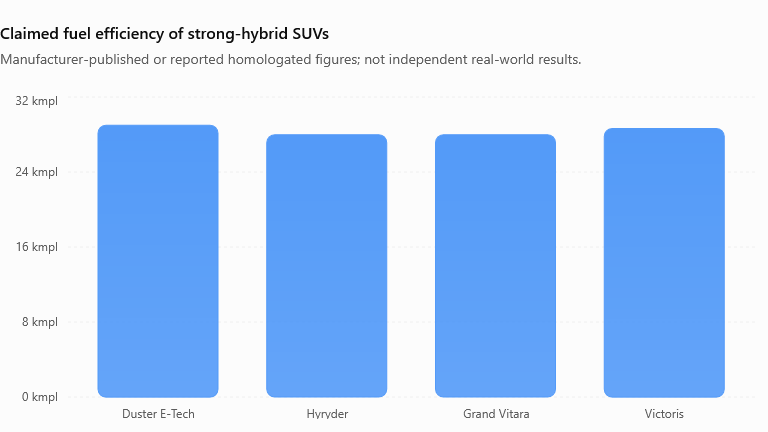
The Duster’s published figure is numerically higher, but the margins are relatively small.
For example, the difference between the Duster’s 29 kmpl claim and the Victoris’s 28.65 kmpl figure is only 0.35 kmpl.
Such differences should not automatically be interpreted as proof that one vehicle will be more economical in every real-world driving situation.
Acceleration, refinement, highway efficiency, luggage capacity and ownership costs all require separate assessment.
4. Practical Applications
Renault Duster Emotion Strong Hybrid vs its main rivals
For prospective buyers, the most important question is not simply which SUV claims the highest mileage. It is whether the vehicle suits everyday journeys, passenger requirements, ownership budget and local service availability.
The Duster hybrid will compete with established strong-hybrid SUVs as well as Renault’s existing petrol-powered Duster variants.
| Model | Powertrain | Claimed efficiency | Key buying consideration |
|---|---|---|---|
| Renault Duster E-Tech 160 | 1.8L strong hybrid, 160 PS | 29 kmpl | Upcoming; final Emotion price and equipment pending |
| Toyota Urban Cruiser Hyryder Strong Hybrid | 1.5L petrol-electric hybrid | 27.97 kmpl | Established hybrid option; check current variant pricing |
| Maruti Suzuki Grand Vitara Strong Hybrid | 1.5L petrol-electric hybrid | 27.97 kmpl | Compare service access, cabin space and ownership costs |
| Maruti Suzuki Victoris Strong Hybrid | 1.5L petrol-electric hybrid | 28.65 kmpl | Compare variant equipment, packaging and current prices |
| Renault Duster Turbo Petrol | 1.0L or 1.3L turbo-petrol options | Variant-specific; verify brochure | Lower purchase-cost potential without full-hybrid complexity |
Efficiency figures for the strong-hybrid rivals are those reported by CarWale. They are published test-cycle claims, not independent road-test averages.
Where might the Duster hybrid have an advantage?
The new Duster combines a relatively large 1.8-litre petrol engine with an electric hybrid system producing a confirmed maximum combined 160 PS.
Its 29 kmpl certified figure also places it competitively against the published figures of established strong-hybrid SUVs.
However, the specification sheet alone cannot establish which vehicle will accelerate faster, cruise more quietly, climb gradients more comfortably or use less fuel during sustained highway driving.
Those questions require comparable vehicle tests.
CarWale itself notes that real-world performance and efficiency need to be assessed after driving the Duster hybrid.
Who may benefit most from a strong hybrid?
A strong-hybrid SUV can make particular sense for someone who frequently drives through congested urban roads.
Common examples include daily office commuting, school runs, shopping trips and regular city journeys involving traffic lights and slow-moving vehicles.
In such conditions, regenerative braking and short electric-driving phases may offer useful efficiency benefits.
Drivers who cover substantial annual distances may also have more opportunities to offset a higher initial purchase price through fuel savings, provided the real-world efficiency advantage is meaningful.
But that conclusion depends on the actual purchase-price difference, fuel costs, driving pattern and years of ownership.
When could a petrol Duster be more economical?
A lower-priced petrol variant may remain financially attractive for drivers who cover relatively few kilometres annually.
For example, someone who drives mainly on weekends might not save enough fuel to recover a large hybrid purchase premium within their planned ownership period.
A petrol model may also appeal to buyers who place greater weight on initial affordability than maximum city efficiency.
The existing Duster petrol range has officially announced prices beginning at ₹10.49 lakh ex-showroom for the standard entry-level offering, although current variant prices should be rechecked.
The final price difference between a particular petrol variant and the Emotion hybrid cannot be calculated reliably until Renault announces the latter’s official price.
What should buyers compare beyond mileage?
| Ownership factor | Why it matters |
|---|---|
| City fuel efficiency | Frequent stops can favour hybrid energy recovery |
| Highway performance | Sustained-speed economy and overtaking response may differ |
| Acceleration | Combined power does not reveal real-world acceleration times |
| Cabin comfort | Seat support, noise, climate control and visibility affect daily use |
| Boot space | Hybrid battery packaging can affect usable luggage volume |
| Ride comfort | Suspension tuning and wheel/tyre choice matter |
| Service access | Local authorised workshop availability influences convenience |
| Battery warranty | Coverage duration, mileage limit and exclusions must be verified |
| Insurance | Hybrid-component coverage and premiums can differ |
| Maintenance | Scheduled service costs and component replacement policies matter |
| Resale | Future demand and depreciation are uncertain |
| ADAS | Verify which driver-assistance functions are actually included |
| Total ownership cost | Purchase price, fuel, insurance, servicing and depreciation all count |
Does the hybrid battery reduce boot space?
Hybrid batteries need protected space within the vehicle, but their effect on luggage capacity varies by model and engineering design.
CarWale and DriveSpark list boot-space figures for the Duster Emotion. However, the final usable boot volume for the India-specification hybrid must be verified with Renault.
DriveSpark lists up to 518 litres measured to the parcel tray and 700 litres measured to the roof, but these remain third-party figures for the Emotion listing rather than verified final hybrid-variant measurements.
Buyers should inspect the actual luggage compartment, rather than relying on headline capacities alone.
Check whether the boot floor is raised, whether the rear seats fold as expected and whether the space accommodates regular luggage.
What about ground clearance and rough-road ability?
DriveSpark and CarWale list 212 mm of unladen ground clearance for the Emotion variant.
That figure should be treated as provisional until Renault publishes the final Indian strong-hybrid specification.
Also, ground clearance alone does not determine off-road capability.
Tyres, approach and departure angles, suspension travel, underbody protection and the drivetrain all influence how a vehicle handles challenging terrain.
The Emotion hybrid is listed as front-wheel drive by third-party websites. Buyers should not assume it offers all-wheel-drive capability unless Renault confirms such a configuration.
What should buyers know about ADAS?
CarWale and DriveSpark list Level 2 ADAS for the Emotion variant.
ADAS stands for Advanced Driver Assistance Systems, a collection of technologies intended to help a driver with selected tasks such as warnings, braking support or steering assistance, depending on the equipment offered.
However, the exact Emotion feature list remains provisional.
Even if Renault confirms Level 2 functions, they would remain driver-assistance systems, not autonomous driving.
The driver must stay attentive, monitor road conditions and remain responsible for controlling the vehicle.
A practical pre-booking checklist
Before committing to the Renault Duster Emotion Strong Hybrid, check the following:
- Confirm the final Emotion variant name and availability.
- Obtain Renault’s official ex-showroom price.
- Request an itemised on-road quotation for your city.
- Check booking-cancellation and refund terms in writing.
- Download the final India-specification hybrid brochure.
- Confirm the gearbox description and drivetrain.
- Check the official 29 kmpl certification and any test conditions.
- Verify the hybrid battery’s warranty and exclusions.
- Inspect actual rear-seat comfort and boot capacity.
- Confirm airbags, ADAS and other variant-specific safety features.
- Compare scheduled maintenance costs with the petrol Duster.
- Check authorised service support near your home.
- Request a realistic delivery schedule from the dealer.
How should you test-drive the Duster hybrid?
A useful test drive should include city traffic, safe acceleration, braking, parking and an opportunity to assess ride comfort.
Pay particular attention to how smoothly the vehicle moves away from rest, how the petrol engine starts during acceleration and whether the transition between operating modes feels comfortable.
If possible, compare it directly with a rival strong-hybrid SUV under similar conditions.
Do not attempt emergency braking tests, aggressive manoeuvres or ADAS demonstrations on public roads.
For driver-assistance functions, ask the dealership for a supervised explanation in a suitable environment.
The official Renault hybrid information is available at Renault India — Strong Hybrid E-Tech 160.
5. Limitations and Misconceptions
Which Duster Emotion details are not yet fully confirmed?
As of October 12, 2026, Renault’s official information establishes the E-Tech 160 hybrid powertrain and its headline specifications.
However, the final Emotion-specific equipment list and retail price have not been verified in the cited official material.
Third-party listings include several specifications that require confirmation.
| Reported detail | Current status |
|---|---|
| Emotion 1.8L Strong Hybrid name | Third-party variant listing |
| ₹20.09-lakh price | Estimated; conflicting price labels |
| October 17 launch/pricing | Reported future date |
| Front-wheel drive | Reported by CarWale and DriveSpark |
| Level 2 ADAS | Listed; final variant confirmation required |
| Six airbags | Listed; final variant confirmation required |
| Panoramic sunroof | Listed; final variant confirmation required |
| Ventilated front seats | Listed; final variant confirmation required |
| Dual-zone climate control | Listed; final variant confirmation required |
| 10.1-inch touchscreen | Listed; final variant confirmation required |
| Ground clearance of 212 mm | Third-party specification |
| Boot capacity | Third-party measurements; verify hybrid packaging |
| Body dimensions | Third-party measurements; confirm India-spec variant |
| Eight-speed torque-converter description | Not established by official hybrid page |
| Colours and complete safety equipment | Check final Emotion brochure |
These listings are helpful for forming questions before a launch. They should not be used as proof that every feature will be delivered in the final vehicle.
Why is the ₹20.09-lakh price confusing?
CarWale lists the Emotion 1.8L Strong Hybrid at ₹20.09 lakh as an estimated ex-showroom price.
DriveSpark displays the same figure as an on-road price.
These are different definitions.
An ex-showroom price normally excludes registration, road tax, insurance and certain other charges.
An on-road price generally includes applicable charges needed to register and insure the vehicle, and varies according to location and circumstances.
The difference cannot be resolved merely because both websites show the same amount.
Until Renault announces the official price, ₹20.09 lakh should be described only as an unconfirmed third-party figure with inconsistent classifications.
Misconception 1: Self-charging means free energy
A hybrid battery does not recharge through an unlimited energy source.
The system obtains energy from petrol and from recovering part of the vehicle’s kinetic energy during deceleration.
Self-charging simply means that the user does not connect the car to an external charger.
Misconception 2: A strong hybrid is the same as a plug-in hybrid
A conventional strong hybrid and a plug-in hybrid are different.
The Duster E-Tech 160 uses a compact battery that is replenished during operation.
A plug-in hybrid normally uses a larger battery that can be charged from an external electrical source and may support longer electric-only journeys.
Misconception 3: A strong hybrid is a fully electric car
No. The Duster Strong Hybrid E-Tech 160 retains a petrol engine.
It can use electric propulsion during suitable phases, but it is not a battery-electric vehicle designed to travel long distances using electricity alone.
Misconception 4: The 29 kmpl figure is guaranteed
Renault’s published 29 kmpl figure is a certified test result.
Actual fuel efficiency depends on driving conditions, vehicle condition, climate, road type and load.
An owner should not assume that every full tank will deliver the exact certified figure.
Misconception 5: Electric operation for 80% of city time means 80% of the distance
Time and distance are different measurements.
The system may spend significant time operating electrically during slow city driving without covering an equivalent proportion of journey distance using electric power alone.
Renault’s claim also includes the qualification up to, which should not be ignored.
Misconception 6: A higher combined power figure proves faster acceleration
The Duster’s 160 PS maximum system output is higher than the combined output CarWale reports for its three principal strong-hybrid rivals.
But acceleration also depends on vehicle mass, gearing, traction, torque delivery, battery charge and software calibration.
Comparable timed tests are needed before drawing acceleration conclusions.
Misconception 7: An online feature list is the final brochure
Automotive portals sometimes publish expected or preliminary information before manufacturers release final variant specifications.
Such data can be useful, but may change.
Buyers should cross-check expensive or safety-critical features using Renault’s final official documentation.
Frequently Asked Questions
1. Has the Renault Duster Emotion Strong Hybrid officially launched in India?
As of October 12, 2026, Renault’s official hybrid page continues to describe the E-Tech 160 as coming soon. Bookings have been reported as open from October 9, while October 17 is identified as the upcoming launch or pricing date. The final Emotion launch has not yet occurred within this timeframe.
2. Is ₹20.09 lakh the confirmed Renault Duster Emotion price?
No. CarWale calls it an estimated ex-showroom price, while DriveSpark labels the same amount as an on-road price. Renault’s final official hybrid price must take precedence.
3. Does the Duster Strong Hybrid need external charging?
No. Renault confirms that the system is self-charging through vehicle operation and energy recuperation.
4. Can the Duster travel long distances as a pure electric vehicle?
It is not designed as a long-range battery-electric vehicle. The 1.4-kWh battery supports short electric-driving phases and hybrid operation, not a separately guaranteed long-distance electric range.
5. Will every Duster hybrid owner get 29 kmpl?
No. The 29 kmpl figure is a certified efficiency claim, not a guaranteed result for each driver.
6. Is Level 2 ADAS officially confirmed for the Emotion hybrid?
CarWale and DriveSpark list it, but buyers should verify the exact functions and availability against Renault’s final Emotion equipment list.
7. How is the Duster different from the Hyryder, Grand Vitara and Victoris hybrids?
The Duster uses Renault’s 1.8-litre E-Tech 160 system and 1.4-kWh battery. Its main rivals use related Toyota-developed 1.5-litre hybrid systems. The difference in architecture and output does not by itself establish a superior ownership experience.
8. Does a bigger hybrid battery always mean better mileage?
No. Battery capacity is only one factor. Vehicle weight, drivetrain efficiency, motor design, software calibration, engine characteristics and driving conditions also influence fuel consumption.
9. Can the Emotion hybrid be bought with all-wheel drive?
The current third-party Emotion listings describe a front-wheel-drive configuration. Buyers should check Renault’s final variant specifications rather than assume the availability of all-wheel drive.
10. Is the multimode automatic an eight-speed torque-converter gearbox?
Renault’s official hybrid information calls it a multimode automatic. The eight-speed torque-converter description appearing in an aggregator listing has not been established by the final official Indian specification.
6. Learning Takeaways
Confirmed versus expected: the essential buyer checklist
The biggest lesson from the Renault Duster Emotion Strong Hybrid is that confirmed hybrid technology and unconfirmed retail specifications must be evaluated separately.
| Information to check | Current evidence | Buyer action |
|---|---|---|
| E-Tech 160 system | Officially confirmed | Understand how the system works |
| 1.8-litre petrol engine | Officially confirmed | Review final technical documentation |
| 160 PS combined power | Officially confirmed | Do not confuse it with individual motor ratings |
| 1.4-kWh battery | Officially confirmed | Check warranty and packaging |
| Self-charging operation | Officially confirmed | No plug-in charging required |
| 29 kmpl efficiency | Official certified claim | Compare with independent real-world tests |
| Up to 80% electric city time | Conditional manufacturer claim | Do not treat as guaranteed electric range |
| Multimode automatic gearbox | Officially confirmed | Verify final transmission details |
| Emotion variant | Third-party listing | Confirm official variant identity |
| October 17, 2026 launch/pricing | Reported upcoming event | Recheck Renault announcements |
| ₹20.09-lakh price | Estimated, inconsistently labelled | Obtain final ex-showroom and on-road prices |
| ADAS and comfort features | Third-party listings | Check exact variant equipment |
| Ground clearance and boot space | Third-party figures | Verify final hybrid brochure |
| Delivery timeline | Not fully established for individual orders | Obtain dealer confirmation |
What should buyers revisit after the official launch?
Once Renault publishes the final Emotion Strong Hybrid price and variant documentation, buyers should reassess the vehicle using the following information:
- Final variant name and complete equipment list.
- Official ex-showroom price and city-specific on-road cost.
- Confirmed gearbox design and drivetrain configuration.
- Maximum combined power and official motor specifications.
- Homologated mileage and its stated test basis.
- Standard airbags, stability systems and other safety equipment.
- Exact ADAS functions and variant availability.
- Hybrid battery warranty, coverage and exclusions.
- Boot capacity with the hybrid battery installed.
- Confirmed loaded and unladen ground-clearance figures.
- Official colour choices.
- Delivery availability and booking conditions.
- Scheduled service requirements and estimated ownership costs.
Could the Duster E-Tech 160 change India’s hybrid SUV market?
Renault’s entry adds another hybrid powertrain architecture to a segment already served by Toyota and Maruti Suzuki.
That could encourage buyers to compare not only claimed mileage but also electric-driving behaviour, engine refinement, performance, packaging, warranty support and total ownership cost.
Greater competition may encourage manufacturers to improve hybrid technology, equipment and pricing.
It could also support further local production and the development of components, engineering capabilities and services related to electrified vehicles in India.
However, these are possibilities rather than guaranteed outcomes.
The availability of more strong-hybrid SUVs does not automatically prove that prices will decrease or that every vehicle will produce a measurable environmental improvement.
Environmental effects depend on fuel consumption, driving conditions, manufacturing processes, vehicle lifespan and other factors.
Strong hybrid or petrol: which technology makes more sense?
The choice depends on how the car will be used.
A strong hybrid may be particularly attractive for frequent urban driving because it can recover energy and use electric propulsion during suitable low-speed conditions.
A conventional petrol SUV may offer a more affordable starting point, especially for drivers with limited annual mileage.
Buyers should compare the additional hybrid purchase cost with realistic fuel savings rather than relying on the highest published mileage figure.
The Duster’s final official pricing and independent road-test results will be important to that calculation.
What can we learn from the Renault Duster Emotion’s hybrid technology?
The Renault Duster E-Tech 160 demonstrates how a petrol engine and electric motors can work together without requiring a large battery or an external charging point.
Its main engineering lessons are clear.
First, electrification does not always mean replacing the petrol engine entirely. Hybrid technology can improve how combustion and electrical energy are used together.
Second, regenerative braking and electric-assisted operation are particularly relevant to city driving, where a vehicle frequently slows down and accelerates.
Third, intelligent coordination between the engine, motors, battery and transmission is as important as the capacity of any single component.
Fourth, certified efficiency figures provide a useful comparison point, but they cannot replace real-world testing.
Finally, buying decisions require more than power and mileage figures. Price, safety, comfort, warranty, servicing and long-term suitability matter equally.
Conclusion: A promising hybrid, but final pricing matters
The Renault Duster Strong Hybrid E-Tech 160 brings an officially confirmed 1.8-litre petrol-electric powertrain, 160 PS combined output, 1.4-kWh self-charging battery and 29 kmpl certified efficiency claim to India’s midsize SUV conversation.
Its ability to operate electrically during suitable city-driving conditions makes it particularly interesting for buyers who spend considerable time in stop-and-go traffic.
But the precise value proposition of the Emotion variant cannot be established until Renault confirms its final pricing, equipment and warranty coverage.
The ₹20.09-lakh figure currently circulating online remains an estimate, with conflicting ex-showroom and on-road descriptions.
The most useful conclusion is that Renault’s E-Tech 160 has a verified technical foundation, while the Emotion variant’s final ownership proposition still depends on official launch details and independent real-world testing.