
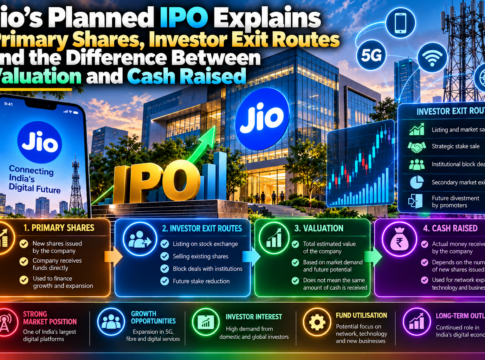

Jio, a major player in the telecommunications industry, is gearing up for a significant Initial Public Offering (IPO) that has captured the attention of investors and analysts alike. This move is set to reshape the landscape of investor opportunities and company valuation. In this article, we delve into the intricacies of Jio’s planned IPO, exploring primary shares, investor exit routes, and the crucial distinction between valuation and cash raised.
Key Highlights
- Jio’s IPO is anticipated to be one of the largest in the telecommunications sector, with a proposed valuation of approximately $100 billion.
- The primary offering structure will focus on issuing new shares to raise capital for the company, rather than providing immediate exits for existing investors.
- Private-equity commitments have previously valued Jio at around $65 billion, indicating significant growth expectations.
- Shareholder ownership will be diluted as new shares are issued, impacting existing equity stakes.
- Earnings multiples are expected to play a crucial role in determining the final IPO pricing, though exact figures remain unresolved.
- Commentary from Reuters Breakingviews suggests that the timing of the IPO is strategically aligned with market conditions.
- Unresolved pricing details highlight the complexity of balancing investor expectations with market realities.
- Understand the mechanics of IPOs and how they serve as a capital-raising tool for companies.
- Differentiate between primary and secondary shares and their implications for investors.
- Explore the concept of dilution and how it affects shareholder value during an IPO.
- Gain insights into lockup periods and how they influence investor exit strategies.
- Learn about valuation multiples and their role in determining a company’s market value.
- Examine the use of proceeds from an IPO and how they can drive future growth.
- Identify the primary and secondary shares involved in the IPO.
- Analyze the potential impact of dilution on existing shareholders.
- Evaluate the lockup period and its implications for investor exits.
- Assess the valuation multiples used to price the IPO.
- Consider the strategic use of proceeds from the IPO.
- What are the key factors influencing Jio’s IPO valuation?
- How does the issuance of primary shares impact existing shareholders?
- What strategies can investors use to evaluate the potential success of an IPO?
- How do market conditions affect the timing and pricing of an IPO?
- What are the potential risks and rewards associated with investing in an IPO?