
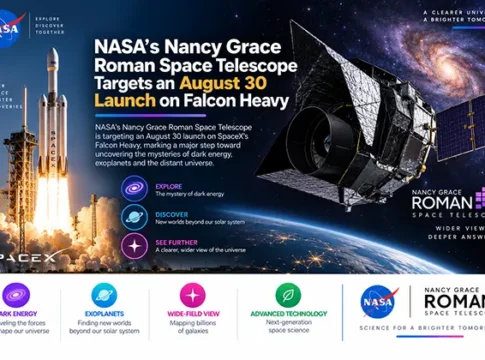

NASA is gearing up for a monumental event in space exploration with the scheduled launch of the Nancy Grace Roman Space Telescope on August 30, aboard a Falcon Heavy rocket. This mission promises to revolutionize our understanding of the universe, targeting key scientific goals such as dark energy research, exoplanet discovery, and infrared astronomy. As the launch date approaches, excitement builds around the telescope’s advanced instruments and its potential to surpass the capabilities of the Hubble Space Telescope.
NASA’s Launch Schedule and Mission Overview
The Nancy Grace Roman Space Telescope is set to launch on August 30, marking a significant milestone in NASA’s quest to explore the cosmos. The telescope will be carried into space by SpaceX’s Falcon Heavy, a powerful launch vehicle known for its reliability and efficiency. Once in orbit, the telescope will travel to the Sun–Earth L2 Lagrange point, a stable gravitational location ideal for space observations.
Advanced Instruments: Wide Field and Coronagraph
Equipped with cutting-edge technology, the Roman Space Telescope boasts two primary instruments: the Wide Field Instrument and the Coronagraph Instrument. The Wide Field Instrument will capture vast areas of the sky with a field of view 100 times greater than that of the Hubble Space Telescope, enabling unprecedented surveys of the universe. Meanwhile, the Coronagraph Instrument will directly image exoplanets and study their atmospheres, paving the way for future discoveries in planetary science.
Scientific Goals: Dark Energy, Exoplanets, and Infrared Astronomy
The Roman Space Telescope’s mission is centered around three primary scientific goals. First, it aims to unravel the mysteries of dark energy, a force driving the accelerated expansion of the universe. By observing distant supernovae and galaxy clusters, the telescope will provide critical data to refine our understanding of this enigmatic phenomenon.
Second, the telescope will search for and study exoplanets, particularly those in the habitable zones of their stars. Its advanced instruments will allow scientists to detect planets with unprecedented precision, offering insights into their composition and potential for hosting life.
Lastly, the telescope’s infrared capabilities will enable it to peer through cosmic dust clouds, revealing hidden structures and processes in the universe. This will enhance our understanding of star formation, galaxy evolution, and the lifecycle of cosmic objects.
Field-of-View Advantages Over Hubble
One of the Roman Space Telescope’s standout features is its expansive field of view. Unlike the Hubble Space Telescope, which focuses on narrow sections of the sky, the Roman Telescope can survey large areas quickly and efficiently. This capability will allow astronomers to conduct wide-ranging studies, capturing more data in less time and providing a more comprehensive view of the universe.
Launch and Commissioning Risks
As with any space mission, the launch and commissioning of the Roman Space Telescope come with inherent risks. The complexity of the instruments and the precision required for their deployment in space pose significant challenges. However, NASA’s rigorous testing and contingency planning aim to mitigate these risks, ensuring a successful mission that will yield valuable scientific data.
Public Data Plans and Accessibility
In line with NASA’s commitment to open science, the data collected by the Roman Space Telescope will be made publicly available. Researchers and the general public will have access to a wealth of information, fostering collaboration and innovation in the scientific community. This transparency will enable a broader understanding of the universe and inspire future generations of scientists.
FAQs About the Roman Space Telescope
What is the primary mission of the Roman Space Telescope? The primary mission is to study dark energy, discover exoplanets, and conduct infrared astronomy.
When is the launch date? The telescope is scheduled to launch on August 30.
What rocket will be used for the launch? The Falcon Heavy rocket will carry the telescope into space.
Where will the telescope be positioned in space? It will be positioned at the Sun–Earth L2 Lagrange point.
Future Implications for Space Science
The successful deployment and operation of the Nancy Grace Roman Space Telescope will have profound implications for space science. By addressing fundamental questions about the universe, the mission will enhance our understanding of cosmic phenomena and potentially lead to groundbreaking discoveries. As we look to the future, the Roman Space Telescope represents a pivotal step in humanity’s quest to explore the cosmos and unlock the secrets of the universe.
In conclusion, NASA’s Nancy Grace Roman Space Telescope, with its targeted August 30 launch on Falcon Heavy, is poised to transform our understanding of the universe. Its advanced instruments and ambitious scientific goals promise to deliver insights into dark energy, exoplanets, and the cosmos at large, marking a new era in space exploration.