
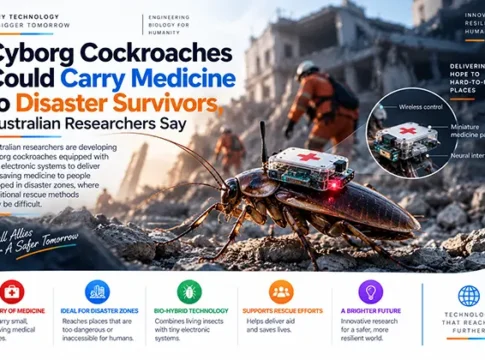

Cyborg cockroaches, a groundbreaking innovation by Australian researchers, could revolutionize disaster response by delivering medicine to survivors in hard-to-reach areas. This biohybrid search-and-rescue system combines the resilience of cockroaches with advanced electronic control equipment, offering a novel solution to the challenges faced in disaster environments. As we delve into this fascinating development, we explore the technology behind these cyborg insects, their potential applications, and the ethical considerations surrounding their use.
The Biohybrid Search-and-Rescue System
The concept of cyborg cockroaches involves integrating electronic control systems with live insects to create a biohybrid organism capable of navigating complex environments. Australian scientists have developed a system where tiny electronic backpacks are attached to cockroaches, allowing researchers to direct their movements remotely. This innovative approach leverages the natural agility and durability of cockroaches, making them ideal candidates for search-and-rescue missions in disaster-stricken areas.
How Electronic Control Equipment Directs the Insects
The electronic control equipment used in these cyborg cockroaches is a marvel of miniaturization and precision. The backpack contains a microcontroller, wireless receiver, and electrodes that interface with the cockroach’s nervous system. By sending electrical impulses to specific neural pathways, researchers can steer the cockroach in desired directions. This level of control is crucial for navigating debris-filled environments where traditional robots might struggle.
Medical Payloads and Disaster Environments
One of the most promising applications of cyborg cockroaches is their ability to carry medical payloads to survivors trapped in disaster zones. These payloads could include essential medicines, water, or communication devices. The cockroaches’ small size and ability to traverse tight spaces make them ideal for reaching individuals in collapsed buildings or other inaccessible areas. Current studies are focused on optimizing the payload capacity and ensuring the stability of the delivery system.
Experimental Results and Potential Benefits
Initial experiments have shown promising results, with cyborg cockroaches successfully navigating complex mazes and delivering payloads to designated targets. The potential benefits of this technology are significant, including enhanced mobility in cluttered environments, reduced operational costs compared to traditional search-and-rescue methods, and the ability to operate in environments where drones or robots might fail.
Challenges: Reliability, Range, and Communication
Despite their potential, cyborg cockroaches face several challenges. Ensuring reliable control over the insects in unpredictable environments is a primary concern. Additionally, the range of communication between the control unit and the cockroach is limited, which could hinder operations in large-scale disaster areas. Researchers are actively working on improving these aspects to enhance the system’s effectiveness.
Animal Welfare and Public Acceptance
The use of live insects in technological applications raises important ethical questions. Ensuring the welfare of the cockroaches and addressing public concerns about the use of living organisms in this manner are critical for the project’s acceptance. Researchers are committed to maintaining high ethical standards and are engaging with the public to address any concerns.
Comparisons with Miniature Robots and Drones
Cyborg cockroaches offer several advantages over miniature robots and drones, particularly in terms of cost and mobility. While robots and drones require complex engineering and significant power sources, cyborg cockroaches are low-cost and can operate in environments where electronic devices might fail. However, the precision and control offered by robots and drones are currently superior, highlighting the need for further development in biohybrid systems.
Expert Perspectives and Practical Deployment
Experts in the field of robotics and bioengineering are optimistic about the potential of cyborg cockroaches. They emphasize the need for continued research to address current limitations and explore practical deployment scenarios. Successful integration of this technology into disaster response protocols could significantly enhance the efficiency and effectiveness of rescue operations.
FAQs
What are cyborg cockroaches? Cyborg cockroaches are live insects equipped with electronic control systems that allow researchers to direct their movements for specific tasks.
How do they carry medicine? The cockroaches are fitted with tiny backpacks that can hold medical payloads, which they deliver to survivors in disaster zones.
What are the ethical concerns? The primary concerns involve the welfare of the cockroaches and the ethical implications of using living organisms in technological applications.
Future Implications
The development of cyborg cockroaches represents a significant step forward in biohybrid technology. As researchers continue to refine this system, the potential applications extend beyond disaster response to include environmental monitoring and other fields. By addressing current challenges and ethical considerations, cyborg cockroaches could become a vital tool in our technological arsenal, offering innovative solutions to complex problems.
In conclusion, cyborg cockroaches could carry medicine to disaster survivors, offering a unique blend of biological resilience and technological control. As Australian researchers continue to advance this technology, the potential for these biohybrid systems to transform disaster response and other fields remains immense. With ongoing research and ethical considerations, cyborg cockroaches may soon become an integral part of our approach to tackling some of the world’s most pressing challenges.