
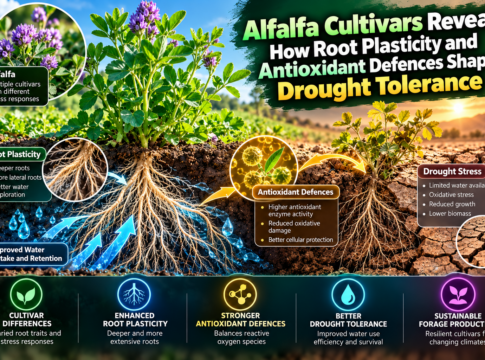

Alfalfa, a crucial forage crop, plays a significant role in sustainable agriculture, especially in regions prone to drought. A recent study published on October 8, 2026, in Frontiers in Plant Science, delves into how different alfalfa cultivars adapt to varying soil-water levels, focusing on root plasticity and antioxidant defences. This research provides valuable insights into enhancing drought tolerance, a critical factor for maintaining crop yield under water-limited conditions.
Key Highlights
- The study compared three distinct alfalfa cultivars under four different soil-water levels.
- Each treatment was replicated to ensure robust and reliable data.
- Root architecture was meticulously analyzed to assess plasticity in response to drought.
- Biomass production was measured to evaluate overall plant health and productivity.
- Oxidative-stress measurements were conducted to understand the role of antioxidant defences.
- Findings highlighted cultivar-specific responses to drought conditions.
- How root plasticity contributes to drought tolerance in alfalfa.
- The impact of reactive oxygen species on plant stress responses.
- The role of antioxidant enzymes in mitigating oxidative stress.
- Water-use efficiency variations among different alfalfa genotypes.
- Insights into genotype-by-environment interactions under controlled conditions.
- The importance of controlled experiments in understanding plant responses to drought.
- Conduct small-plot comparisons to evaluate cultivar performance under local conditions.
- Incorporate soil moisture monitoring to tailor irrigation practices effectively.
- Utilize local extension services for region-specific advice on cultivar selection.
- Regularly update management practices based on the latest research findings.