
About Us

At Study Tech Next, we’re committed to bringing you insightful, up-to-the-minute content across a spectrum of topics that impact our daily lives.

― Advertisement ―

LVMH’s Luxury Slowdown Shows How Brand Concentration and Regional Demand Can Shape a Global Business

Explore how LVMH's luxury slowdown reveals the impact of brand concentration and regional demand shifts on global business strategies. Learn about the risks of over-reliance on key markets like China and how strategic diversification can mitigate these challenges. Discover insights into maintaining business stability and growth.
HomeGardenHow Root Coumarins and Helpful Bacteria Can Unlock Iron in High-pH Soil

How Root Coumarins and Helpful Bacteria Can Unlock Iron in High-pH Soil

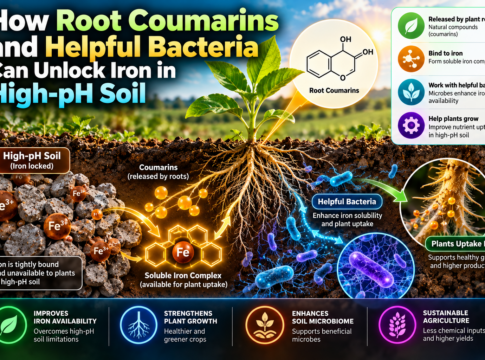
In the quest to enhance plant growth in challenging soil conditions, recent research has unveiled the potential of root coumarins and beneficial bacteria in unlocking iron in high-pH soils. This groundbreaking study, conducted on Arabidopsis, sheds light on how plants adapt to alkaline environments, offering promising insights for agriculture and gardening. Key Highlights
  • The study focused on Arabidopsis, a model organism in plant biology.
  • Research was conducted under alkaline soil conditions, which typically limit iron availability.
  • Root-secreted coumarins were identified as key compounds in iron mobilization.
  • Beneficial root-associated bacteria play a crucial role in enhancing iron uptake.
  • Increased iron availability was measured through plant growth responses.
  • The research is currently in the experimental stage, with promising preliminary results.
What You Will Learn
  • Understanding the role of micronutrients in plant health and soil chemistry.
  • The process of chelation and its importance in nutrient availability.
  • How rhizosphere chemistry is altered by plant root exudates.
  • Identifying and managing iron chlorosis in plants.
  • The interaction between root exudates and soil microbiomes.
  • Insights from genetic experiments on plant adaptation to high-pH soils.
How and Why It Works Iron is often present in high-pH soils but remains chemically unavailable due to its tendency to form insoluble compounds. Plants like Arabidopsis secrete coumarins, which chelate iron, making it soluble and accessible. Additionally, root-associated bacteria enhance this process by altering the rhizosphere chemistry, further facilitating iron uptake. Practical Applications Gardeners can apply these findings by starting with comprehensive soil and tissue tests to determine nutrient deficiencies. Selecting plants adapted to alkaline conditions, incorporating organic matter, and using locally approved soil treatments can improve iron availability. Understanding the role of beneficial bacteria can also guide the use of biofertilizers. Limitations and Misconceptions While the Arabidopsis study offers valuable insights, it is not a ready-made solution for microbial products. Gardeners should avoid culturing unknown bacteria, as this can disrupt local ecosystems. Instead, focus on integrating proven practices and products that enhance soil health. Learning Takeaways
  • Check for yellowing leaves, a common sign of iron chlorosis.
  • Test soil pH and iron levels regularly.
  • Incorporate organic matter to improve soil structure and nutrient availability.
  • Consider using iron chelates or biofertilizers to enhance iron uptake.
In conclusion, the study on Arabidopsis provides a promising avenue for improving iron availability in high-pH soils through the use of root coumarins and beneficial bacteria. By understanding and applying these principles, gardeners and farmers can enhance plant health and productivity in challenging soil conditions.