
About Us

At Study Tech Next, we’re committed to bringing you insightful, up-to-the-minute content across a spectrum of topics that impact our daily lives.

― Advertisement ―

LVMH’s Luxury Slowdown Shows How Brand Concentration and Regional Demand Can Shape a Global Business

Explore how LVMH's luxury slowdown reveals the impact of brand concentration and regional demand shifts on global business strategies. Learn about the risks of over-reliance on key markets like China and how strategic diversification can mitigate these challenges. Discover insights into maintaining business stability and growth.
HomeNewsBusinessStellantis and Wayve Show How One AI Driving Stack Could Be Adapted...

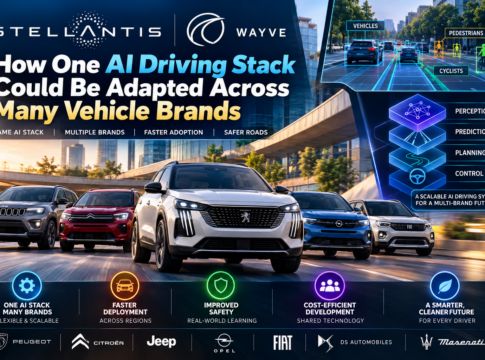
Stellantis and Wayve Show How One AI Driving Stack Could Be Adapted Across Many Vehicle Brands

Stellantis and Wayve have embarked on a groundbreaking partnership to revolutionize the automotive industry with a unified AI driving stack adaptable across multiple vehicle brands. This collaboration, announced on October 9, 2026, showcases the potential of integrating Wayve’s advanced software with Stellantis’ STLA AutoDrive platform. Demonstrations in Fiat and Maserati vehicles highlight the versatility and promise of this technology, with a targeted North American product launch around 2028. This article delves into the key highlights, operational insights, and future implications of this innovative venture. Key Highlights
  • Partnership announced on October 9, 2026, between Stellantis and Wayve.
  • Integration of Wayve software with Stellantis’ STLA AutoDrive platform.
  • Demonstrations conducted in Fiat and Maserati vehicles.
  • Targeted North American product launch around 2028.
  • Potential cost and development benefits through shared AI driving stack.
  • Focus on Level 3 automation capabilities.
  • Unconfirmed specifications regarding sensor suite and processing power.
What You Will Learn
  • Understanding embodied AI and its role in autonomous driving.
  • Insights into sensor inputs and their integration with AI systems.
  • The importance of driver supervision in current autonomous systems.
  • Validation processes for AI-driven vehicles.
  • Benefits of common platforms for diverse vehicle brands.
  • Operational design domains and their impact on vehicle performance.
How and Why It Works The collaboration between Stellantis and Wayve leverages a shared AI driving model that can be calibrated for different vehicles. This adaptability is achieved through a modular approach, allowing the AI stack to adjust to various vehicle dynamics and sensor configurations. By utilizing a common platform, Stellantis can streamline development processes and reduce costs, while ensuring that each vehicle brand maintains its unique driving characteristics. Practical Applications For potential buyers, understanding the capabilities of Advanced Driver Assistance Systems (ADAS) is crucial. Here is a checklist to compare ADAS features safely:
  • Check for Level 3 automation capabilities and driver supervision requirements.
  • Evaluate the integration of sensor inputs and AI processing.
  • Assess the vehicle’s operational design domain for specific driving conditions.
  • Review validation and testing processes for safety assurance.
  • Consider the adaptability of the AI stack across different vehicle models.
Limitations and Misconceptions While the demonstrations and targets set by Stellantis and Wayve are promising, it is important to note that these do not equate to approved self-driving products. The driver remains responsible for vehicle operation where required, and current systems are designed to assist rather than replace human drivers. Understanding these limitations is crucial for managing expectations and ensuring safety. Learning Takeaways When evaluating autonomy announcements, consider the following questions:
  • What level of automation is being promised, and is it achievable?
  • How does the AI system integrate with existing vehicle technologies?
  • What are the safety and validation protocols in place?
  • How adaptable is the technology across different vehicle brands?
  • What are the timelines for product launch and regulatory approval?
In conclusion, the partnership between Stellantis and Wayve represents a significant step forward in the development of adaptable AI driving technologies. By focusing on a shared AI driving stack, they aim to deliver versatile and efficient autonomous solutions across multiple vehicle brands. As the industry progresses, staying informed about these advancements will be key to understanding the future of automotive technology.