
About Us

At Study Tech Next, we’re committed to bringing you insightful, up-to-the-minute content across a spectrum of topics that impact our daily lives.

― Advertisement ―

LVMH’s Luxury Slowdown Shows How Brand Concentration and Regional Demand Can Shape a Global Business

Explore how LVMH's luxury slowdown reveals the impact of brand concentration and regional demand shifts on global business strategies. Learn about the risks of over-reliance on key markets like China and how strategic diversification can mitigate these challenges. Discover insights into maintaining business stability and growth.
HomeNewsBusinessWhy Electric-Car Adoption Is Accelerating in Europe but Slowing in the United...

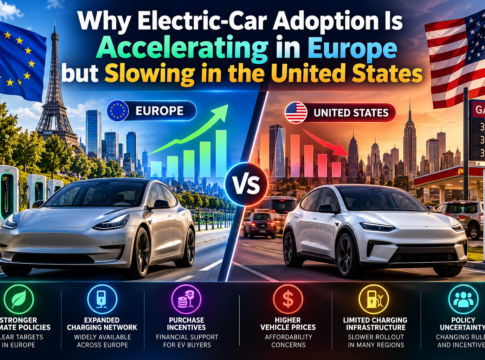
Why Electric-Car Adoption Is Accelerating in Europe but Slowing in the United States

Electric vehicles (EVs) are transforming the global automotive landscape, yet their adoption rates vary significantly between regions. In Europe, EV adoption is accelerating, while in the United States, it appears to be slowing. This divergence is influenced by a complex interplay of policy, market dynamics, and consumer preferences. In this article, we delve into the factors driving these trends, based on Reuters’ October 8, 2026, analysis. Key Highlights
  • As of Q3 2026, EVs accounted for 25% of new car sales in Europe, compared to 15% in the United States.
  • Europe introduced stricter CO2 emission regulations in early 2026, boosting EV sales.
  • The U.S. saw a reduction in federal EV tax credits in mid-2026, impacting sales negatively.
  • Fuel prices in Europe remain high, encouraging the shift to electric vehicles.
  • Model availability in Europe increased by 30% in 2026, offering more choices to consumers.
  • Hybrid vehicle sales in the U.S. rose by 10% in 2026, indicating a preference for transitional technologies.
  • Uncertainty around charging infrastructure expansion in the U.S. is a barrier to EV adoption.
What You Will Learn
  • How purchase incentives differ between Europe and the U.S. and their impact on EV sales.
  • The role of total cost of ownership in consumer decision-making.
  • Access to charging infrastructure and its influence on EV adoption.
  • The variety of EV models available and how this affects consumer choice.
  • The impact of fuel prices on the shift towards electric vehicles.
  • Fleet rules and regulations that are driving market share changes.
  • Understanding market share versus fleet share in the context of EV adoption.
How and Why It Works The acceleration of EV adoption in Europe is largely driven by stringent environmental policies and high fuel prices, which make electric vehicles a more attractive option. European governments have implemented robust incentives and regulations that favor EVs, such as subsidies and tax breaks, which reduce the overall cost of ownership. Additionally, the expansion of charging infrastructure across Europe has alleviated range anxiety, making EVs a viable option for more consumers. In contrast, the U.S. has seen a slowdown in EV adoption due to reduced federal incentives and a slower rollout of charging infrastructure. While some states have introduced their own incentives, the lack of a cohesive national strategy has hindered growth. Moreover, the availability of cheaper fuel and a strong market for hybrid vehicles provide consumers with alternatives to fully electric cars. Practical Applications For drivers considering the switch to electric or hybrid vehicles, it’s essential to evaluate personal driving habits, local fuel prices, and available incentives. Here’s a simple worksheet to guide your decision:
  • Calculate your average monthly fuel cost and compare it with potential savings from an EV.
  • Research local and federal incentives for EV purchases in your area.
  • Assess the availability and convenience of charging stations near your home and workplace.
  • Consider the range and model options that fit your lifestyle and budget.
Limitations and Misconceptions It’s important to note that regional averages do not necessarily predict individual costs or savings. While market share data provides insights into trends, it does not reflect the actual composition of vehicles on the road, known as fleet share. Consumers should consider their unique circumstances when evaluating the benefits of EV ownership. Learning Takeaways
  • What are the local incentives available for EV purchases in your area?
  • How accessible is charging infrastructure in your region?
  • What are the current fuel prices and how do they impact your decision?
  • Are there specific regulations or fleet rules that could influence your choice?
In conclusion, while Europe continues to lead in EV adoption due to favorable policies and infrastructure, the U.S. faces challenges that slow its progress. Understanding these dynamics can help consumers make informed decisions about transitioning to electric vehicles.