
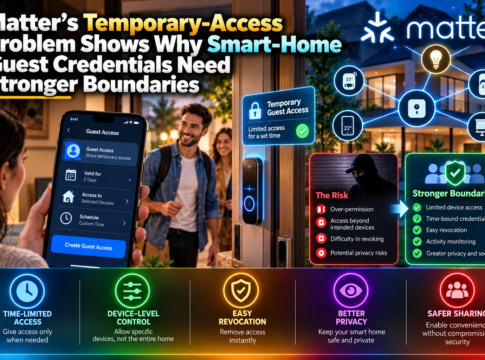

In the rapidly evolving world of smart-home technology, the Matter protocol has emerged as a promising standard for seamless device interoperability. However, a recent October 2026 research preprint has highlighted a critical issue: the potential for temporary access to be exploited for prolonged surveillance or impersonation. This article delves into the implications of this finding and underscores the need for stronger boundaries in smart-home guest credentials.
Key Highlights
– The research is currently in preprint status, indicating preliminary findings that have not yet undergone peer review.
– Matter credentials, designed for interoperability, may inadvertently allow extended access beyond intended temporary permissions.
– Temporary access, such as guest credentials, can potentially be converted into long-term surveillance or impersonation.
– The study identifies persistence paths that could exploit short-term access for ongoing unauthorized control.
– Trust assumptions in smart-home environments are affected, questioning the reliability of temporary access controls.
– Disclosure status remains open, with vendors yet to fully address the potential vulnerabilities highlighted.
– The impact on vendors is unresolved, with ongoing discussions about necessary security enhancements.
What You Will Learn
– The commissioning process of smart-home devices and its role in security.
– Understanding the concept of fabrics in Matter and their security implications.
– How device credentials are managed and the potential risks involved.
– The dynamics of guest access and the importance of robust revocation mechanisms.
– Risks of impersonation and how they can be mitigated through better threat modeling.
– The significance of physical trust in smart-home environments and its vulnerabilities.
How and Why It Works
The concept of trust boundaries is central to understanding the vulnerabilities in Matter’s temporary-access framework. Trust boundaries define the limits within which devices and users can operate securely. When these boundaries are breached, even temporarily, it opens the door to potential exploitation. The research suggests that short-term access, such as that granted to guests, can be manipulated to extend control beyond the intended timeframe. This is achieved through exploiting the inherent trust placed in temporary credentials, which may not be adequately monitored or revoked.
Practical Applications
– Implement guest networks to isolate temporary users from critical smart-home systems.
– Regularly remove unused credentials to minimize the risk of unauthorized access.
– Maintain an updated inventory of controllers and devices to ensure all are accounted for.
– Schedule regular updates and resets to patch potential vulnerabilities.
Limitations and Misconceptions
It’s important to note that this research is a preprint, meaning it has not yet been peer-reviewed. This does not imply that every Matter-enabled home is compromised, but rather highlights potential vulnerabilities under specific conditions. The study’s findings are based on laboratory assumptions, which may not fully represent real-world scenarios. Therefore, while the risks are plausible, they are not guaranteed to occur in every instance.
Learning Takeaways
– Always verify the identity of guests before granting access.
– Limit the duration of guest credentials and ensure they are automatically revoked.
– Educate household members about the importance of maintaining secure access controls.
– Regularly review and update security settings to adapt to new threats.
In conclusion, while the Matter protocol offers significant advancements in smart-home interoperability, the potential for temporary access to be exploited underscores the need for stronger security measures. By understanding and addressing these vulnerabilities, homeowners can better protect their smart environments from unauthorized access and ensure a safer, more secure home.