
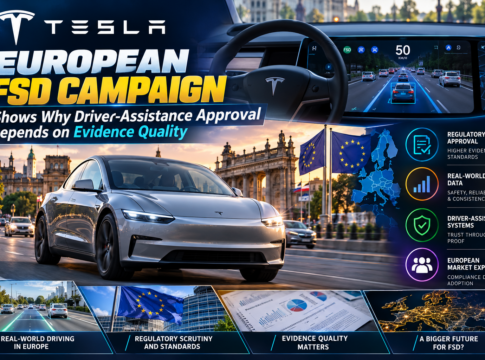

Tesla’s European Full Self-Driving (FSD) campaign has sparked significant debate over the quality of evidence required for driver-assistance system approvals. A recent investigation by Reuters on October 7, 2026, delves into the intricacies of regulatory lobbying, the safety evidence submitted by Tesla, national approvals, and the criticisms from independent researchers. This article explores why the approval of driver-assistance systems hinges on the quality of evidence presented.
Key Highlights
- The Reuters investigation was published on October 7, 2026, highlighting Tesla’s lobbying efforts in Europe.
- Tesla’s FSD is classified as a supervised system, requiring driver oversight.
- The approval process varies across European nations, with some granting permissions based on Tesla’s submitted data.
- Disputes have arisen over the quality and comprehensiveness of the safety evidence provided by Tesla.
- Independent researchers have raised concerns about the representativeness of Tesla’s testing methods.
- Pending decisions in several countries could set precedents for future driver-assistance system approvals.
- Understand the homologation process for driver-assistance systems in Europe.
- Explore the importance of driver monitoring in supervised systems like Tesla’s FSD.
- Learn about surrogate measures used in evaluating system safety.
- Compare crash rates and their implications for system approval.
- Examine the role of exposure data in assessing system performance.
- Discuss the need for regulatory independence in the approval process.
- Always read the driver-assistance system manual thoroughly.
- Understand the limitations and capabilities of the system.
- Ensure you remain attentive and ready to take control at all times.
- Check for updates and recalls related to the system.
- Be aware of the legal implications of using such systems in your region.
- Verify the quality and source of evidence supporting driver-assistance systems.
- Consider independent research and findings when evaluating system safety.
- Understand the regulatory landscape and its impact on system approval.
- Stay informed about ongoing investigations and their outcomes.