
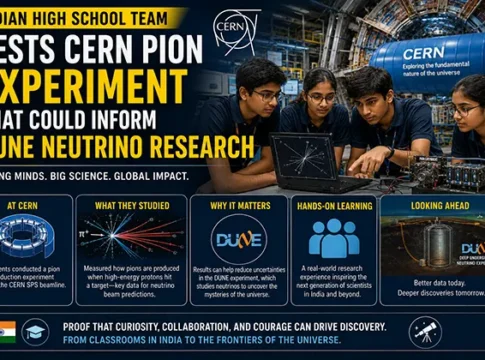

In a remarkable achievement, an Indian high school team, known as Team attoPION, has been selected from 712 proposals across 89 countries to conduct a pioneering experiment at CERN. This experiment, focusing on pion charge exchange, holds potential implications for the Deep Underground Neutrino Experiment (DUNE), a major international effort to study neutrinos. This article delves into the significance of this experiment, its educational and scientific benefits, and the broader implications for particle physics research.
The Journey of Team attoPION to CERN
Team attoPION’s journey to CERN began with their proposal being selected from a competitive pool of 712 submissions from 89 countries. This selection underscores the innovative nature of their experiment, which aims to measure pion charge exchange. The team’s success is a testament to the growing interest and capability in high-level scientific research among high school students in India.
Understanding the Pion Experiment
The core of Team attoPION’s experiment is the measurement of pion charge exchange. Pions, which are subatomic particles, play a crucial role in understanding the strong force that holds atomic nuclei together. By studying how pions interact and exchange charge, researchers can gain insights into fundamental particle interactions, which are essential for refining theoretical models in particle physics.
Relevance to DUNE Neutrino Research
The findings from the pion experiment could significantly inform the DUNE project, which aims to unravel the mysteries of neutrinos. Neutrinos are elusive particles that are notoriously difficult to study due to their weak interactions with matter. By reducing uncertainties in pion interactions, the experiment could enhance the accuracy of neutrino detection and analysis in DUNE, potentially leading to groundbreaking discoveries in particle physics.
Educational and Scientific Benefits
Participating in such a high-level experiment offers immense educational benefits for the students involved. It provides them with hands-on experience in experimental design, data analysis, and scientific communication. Moreover, it inspires other students and educators by demonstrating the possibilities of student-led research in contributing to global scientific endeavors.
Experimental Design and Challenges
The experimental design of Team attoPION’s project involves sophisticated techniques to measure rare signals and manage sample-size limitations. These challenges are typical in high-energy physics experiments, where detecting and analyzing rare events require precision and innovation. The team must also navigate publication limitations, as producing a publishable result is a possibility rather than a guarantee.
Comparisons with Conventional Classroom Science Programs
Unlike conventional classroom science programs, which often focus on established experiments and theories, Team attoPION’s project involves original research that could contribute to the scientific community. This approach not only enhances students’ understanding of scientific principles but also encourages critical thinking and problem-solving skills.
Interpreting Preliminary Results
Interpreting the preliminary results of the pion experiment requires careful consideration of the data and its implications. Practical guidance from experts in the field can help the team and other interested parties understand the significance of their findings and how they might influence future research directions.
Future Implications and Expert Perspectives The potential implications of Team attoPION’s experiment extend beyond immediate findings. By contributing to the understanding of pion interactions, the research could pave the way for future studies in particle physics. Experts emphasize the importance of such student-led initiatives in fostering a new generation of scientists who are equipped to tackle complex scientific challenges. Frequently Asked Questions“The contribution to DUNE or a publishable result is possible rather than guaranteed, highlighting the exploratory nature of scientific research.” – Expert Perspective
- What is the significance of pion charge exchange? Pion charge exchange is crucial for understanding the interactions that govern atomic nuclei and can inform theoretical models in particle physics.
- How does this experiment relate to DUNE? The experiment’s findings could reduce uncertainties in neutrino research, enhancing the accuracy of the DUNE project’s results.
- What are the educational benefits for students? Students gain hands-on experience in scientific research, data analysis, and communication, inspiring future scientific pursuits. In conclusion, Team attoPION’s pioneering experiment at CERN represents a significant step forward in both educational and scientific domains. By exploring pion charge exchange, the team not only contributes to potential advancements in DUNE neutrino research but also sets a precedent for student-led scientific inquiry. As the results unfold, the possibility of contributing to major scientific discoveries remains an exciting prospect for these young researchers and the broader scientific community.