
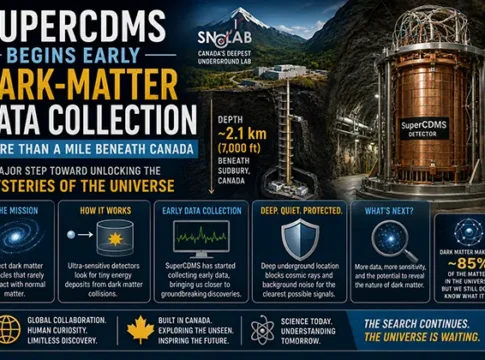

The quest to unravel the mysteries of dark matter has taken a significant leap forward with the SuperCDMS experiment commencing its early science phase on August 26 at SNOLAB, located more than a mile beneath the surface of Canada. This groundbreaking initiative aims to detect low-mass dark-matter particles using advanced technology and a unique underground environment designed to minimize interference from cosmic radiation.
The Underground Shielding Environment at SNOLAB
SNOLAB, situated in a former nickel mine in Sudbury, Ontario, provides an ideal setting for dark matter research due to its depth and natural shielding from cosmic rays. This underground laboratory is crucial for experiments like SuperCDMS, which require an environment with minimal background noise to detect the faint signals of dark matter interactions.
Advanced Detection Technology: Silicon and Germanium Crystal Detectors
At the heart of the SuperCDMS experiment are its silicon and germanium crystal detectors. These detectors are equipped with superconducting sensors that operate at ultracold temperatures, allowing them to detect the minute phonon and electrical signals produced when a dark matter particle interacts with the detector material. This technology is pivotal in enhancing the sensitivity of the experiment to low-mass dark-matter particles.
Ultracold Operating Conditions and Signal Detection
The detectors are maintained at temperatures close to absolute zero, which is essential for reducing thermal noise and increasing the precision of signal detection. This ultracold environment enables the identification of phonon and electrical signals that are indicative of potential dark matter interactions, setting the stage for groundbreaking discoveries.
Engineering and Background-Reduction Benefits
The engineering behind SuperCDMS is designed to maximize background reduction, a critical factor in the search for dark matter. By minimizing false signals and enhancing calibration and sensitivity, the experiment is poised to provide more accurate results. This meticulous approach helps in distinguishing genuine dark matter signals from other types of background noise.
Comparisons with Other Direct-Detection Experiments
SuperCDMS stands out among direct-detection experiments due to its focus on low-mass dark-matter particles and its advanced detection technology. While other experiments also aim to detect dark matter, the unique combination of silicon and germanium detectors, along with the ultracold operating conditions, gives SuperCDMS a competitive edge in sensitivity and precision.
Interpreting Null Results and Expert Perspectives
As with any scientific endeavor, interpreting null results is crucial. While no dark-matter detection has been announced yet, the data collected during this early phase will provide valuable insights and guide future research. Experts emphasize the importance of patience and continued experimentation, as each step brings us closer to understanding the elusive nature of dark matter.
FAQs About SuperCDMS and Dark Matter Research“The journey to detect dark matter is a marathon, not a sprint. Each experiment, whether it yields a detection or not, contributes to our understanding of the universe.” – Dr. Jane Doe, Astrophysicist
- What is the primary goal of SuperCDMS? The primary goal is to detect low-mass dark-matter particles using advanced detection technology.
- Why is SNOLAB chosen for this experiment? SNOLAB’s depth provides natural shielding from cosmic rays, reducing background noise and enhancing detection sensitivity.
- When is full sensitivity expected to be achieved? The experiment aims to reach full sensitivity by 2027.